
 E-Paper



President Obama calls PM Modi, discusses Paris climate conference
The head of states are back into play for the Paris climate conference with US President Barack Obama calling Prime Minister Narendra Modi in a bid to resolve the impeding issues before the first draft of the ministerial consultations is released on Wednesday.

 Prefer HTon Google


The head of states were back into play for the Paris climate conference with US President Barack Obama calling Prime Minister Narendra Modi in a bid to resolve the impeding issues before the first draft of the ministerial consultations is released on Wednesday.
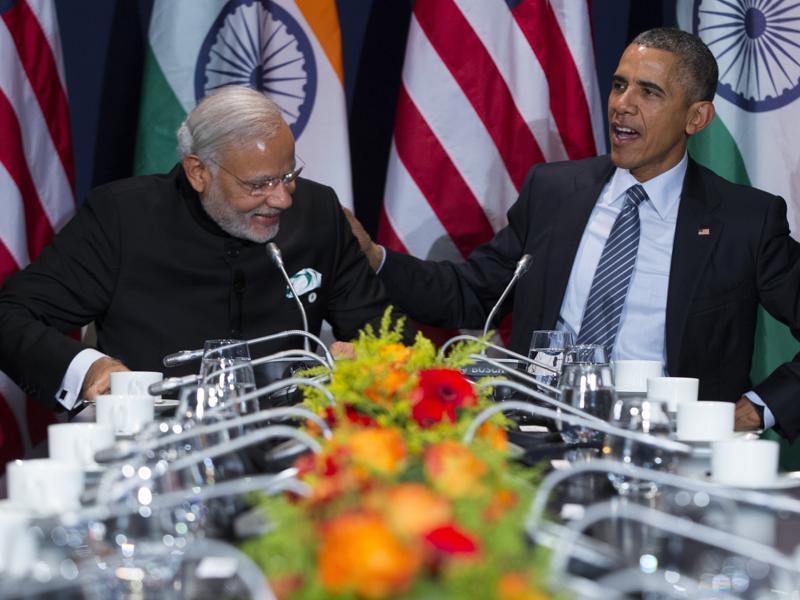
The call from the US President, who had identified Modi as his “close friend” on last Monday during a bilateral in Paris, came hours after a 45-minute long meeting between US Secretary for State John Kerry and Environment Minister Prakash Javadekar in Paris.
Sources said that the two had failed to reach a compromise on a large number of issues including re-defining differentiation between rich and the developing world in “changed circumstances” and proposed review and verification of climate action plans.
“The conversation focused on the ongoing Conference of Parties (CoP21) in Paris. Both leaders underscored their strong commitment to address issues related to Climate Change being discussed in the Paris conference through constructive engagement, without impeding the progress of developing countries. They agreed to stay in regular touch,” a statement by Prime Minister’s Office said on the conversation between Modi and Obama said.
French President Francois Hollande is said to have called some head of the states taking climate diplomacy at the highest level in a bid to resolve sticky issues on which the ministers have not moved forward much.
“There is very little agreement on issues,” a developing country negotiator said.
The fear is that Paris may not be able to deliver an ambitious agreement by Friday, the last day of the conference, and there could be a minimalistic agreement in Paris, which may be described as a failure.
This came after the ministerial facilitators appointed by conference president and French Foreign Minister Laurent Fabius reported very less forward movement on climate finance, differentiation and long term goal of temperature rise by turn of the century.
Vivian Balakrishnan of Singapore told the conference on Tuesday night that the countries were “yet to place their final positions” on differentiation indicating that the issue was the biggest sticking point of the conference. India along with its partners in BASIC (China, Brazil and South Africa) had clearly identified differentiation in all “elements to be heart” of the Paris agreement.
There is also no resolution on how to reflect limiting temperature rise to 1.5 degree of the pre-industrialisation level by 2100 in Paris agreement. Emerging economies like India want it to remain inspirational goal with 2 degree rise as the real target but Europe and most vulnerable --- island and African --- nations wants 1.5 degree to be identified as the goal for all countries.
Studies show that having 1.5 degree goal will mean peaking of global carbon emissions in the next five years with a downward trend by 2030, which could have developmental imperatives for countries like India. Javadekar had agreed to 1.5 degree goal provided rich countries vacate the carbon space for India to achieve its poverty elimination and developmental goals. Vacating carbon space is more theoretical than practical.
Sources, however, said that Paris agreement will not be possible without India and United States converging on a range of issues. In this light, Obama-Modi telephonic conversation is considered significant to break ice.


