
 E-Paper



Ecostani | In the Swati Maliwal case, AAP gets a taste of its street politics
It is for the first time that Kejriwal is facing heat from his trusted party colleague, Swati Maliwal, his associate since the AAP leader’s RTI activism days

 Prefer HTon Google


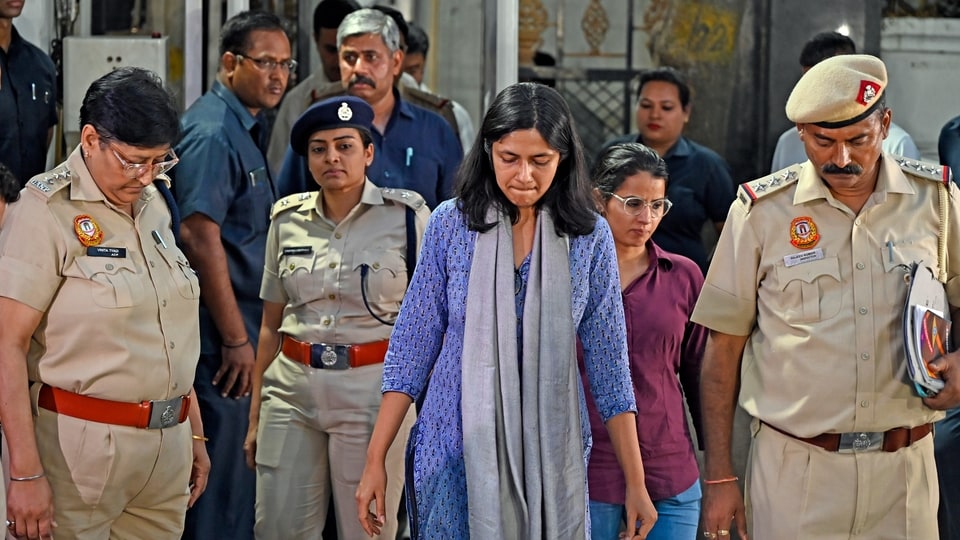
On Saturday, May 18, Delhi police arrested Bibhav Kumar, personal assistant to Delhi chief minister, Arvind Kejriwal, in a case of assault registered by the party’s Rajya Sabha member and former Delhi Commission for Women (DCW) chairperson, Swati Maliwal.
Soon after the arrest, Kejriwal announced a protest at the Bharatiya Janata Party’s (BJP) headquarters in Delhi, alleging that the BJP-led Central government wanted to arrest the party’s other leaders including Rajya Sabha MP, Raghav Chadha, Delhi ministers, Atishi Marlena and Saurabh Bharadwaj.
While leaders of other political parties have also been arrested in different cases including that of corruption, none have organised a protest at the BJP headquarters throwing a challenge to the ruling party to arrest Aam Aadmi Party (AAP) leaders.
One may recall that several AAP leaders including Kejriwal, its Rajya Sabha MP, Sanjay Singh, Manish Sisodia and Satyendra Jain have been arrested in different cases by the central investigating agencies. Kejriwal has repeatedly alleged that the arrests are politically motivated to “decimate” and “threaten” the young party even though the BJP has said that the arrests were on “legitimate” cases of corruption.
For Kejriwal, Maliwal’s attack was unexpected
It is for the first time that Kejriwal is facing heat from his trusted party colleague, Maliwal, who had been his associate since his Right To Information (RTI) activism days and who was part of the Kejriwal-run non-government organisation, Parivartan, which started its work in Delhi in the early 2000s.
Maliwal was a key member of India Against Corruption (IAC), which Kejriwal started with Anna Hazara to run a 100-day protest at Delhi’s Jantar Mantar against alleged corruption during the Congress-led United Progressive Alliance (UPA) government in 2011.
Maliwal held the fort for him when AAP co-founders lawyer, Prashant Bhushan, activist, Yogendra Yadav, and poet-turned-politician Kumar Vishwas, rebelled against Kejriwal and left the party.
Kejriwal made Maliwal, the Delhi Commission for Women (DCW) chairperson in 2015, which also made her the youngest chairperson of a woman’s commission; subsequently, the party nominated her for the Rajya Sabha from Delhi. However, former DCW chairperson Bharka Singh filed a complaint with the Delhi government’s anti-corruption bureau (ACB) alleging irregularities in the appointment of 223 people on contact in the commission. The ACB is conducting investigations into the complaint.
In February 2024, Delhi Lieutenant Governor V K Saxena told the Delhi High Court that Maliwal was not competent to make the appointments as it was done without his approval.
As per the National Capital Territory Act and subsequent Supreme Court orders, services (that cover appointments and transfer posting of officials) come under the purview of the LG as a nominee of the Central government. The DCW had told the court that all records pertaining to appointments were submitted to LG’s office in October 2016 and were returned in January 2017.
The case was pertaining to pending salary arrears of DCW employees. On May 2, 2024, Saxena ordered the sacking of these employees, saying they were hired in violation of the rules. Maliwal had termed the order as “Tuglaki Farman (arbitrary order)” from the LG. She got very little support from other AAP leaders.
Many in the AAP saw the confrontation brewing within the party as Maliwal remained silent on the arrest of its tallest leader Kejriwal in the excise policy case in March 2024 on the ground that she was in the United States with her ailing sister.
Since her return to Delhi, Maliwal has not seen at election campaign or protests against Kejriwal’s arrest. When asked, she maintained that she was “mentally disturbed” due to her sister’s illness. But senior AAP leaders saw it as her attempt to distance herself from the party.
On May 13, three days after Kejriwal was released from jail on bail for an election campaign, Maliwal reached his official residence at Civil Lines seeking to meet the chief minister. It was here she alleged that Bibhav assaulted her and levelled grave allegations against him. On Friday, police lodged a case against Bibhav on his complaint.
While the political controversy appears to have negated some ground sympathy generated for Kejriwal after his arrest, it indicates what ‘street politics’, for which Kejriwal was known, can do.
Maliwal resorted to, what could be called, ‘guerrilla politics’ against Kejriwal, her mentor in street politics. It was under Kejriwal’s leadership that Maliwal had sharpened his ‘guerrilla politics” skill, like barging into government offices in east Delhi over supply of subsidised food to the poor or at the first national RTI convention organised by the Central Information Commission at Vigyan Bhawan in 2006.
Kejriwal’s street politics was different from the conventional politics in some ways. First, what stood out, was his aggressive posturing against his political opponents even if it came at the cost of defamation and criminal cases.
Second, it was Kejriwal’s penchant for organising unconventional protests to catch the imagination of the visual media – similar to the ones organised by environmental NGO, Greenpeace – without worrying about the final outcome.
For instance, Parivartan members had once rushed towards the stage, with then Prime Minister, Manmohan Singh on it, wearing T-shirts, alleging that CIC was killing the RTI, disrupting Singh’s speech.
In January 2014, Kejriwal as chief minister of Delhi, had famously slept on the road outside Rail Bhawan, demanding jurisdictional control over Delhi police, which is under direct control of the Union home ministry.
In the case against Bibhav, Maliwal has shown similar grit as she barged into the CM’s residence despite being told that he was not available. She also has enough political acumen to understand that targeting Bibhav through a police case could “politically” harm Kejriwal
A police investigation will likely clear the air whether Maliwal’s allegations are true or not. But she has managed to prevent Kejriwal from soaking in national limelight after his release from Tihar Jail and has forced the Delhi chief minister to issue a video statement on Bibhav’s arrest, his first comments on the raging controversy. In all this, she has given her mentor a taste of his own political medicine.
Chetan Chauhan, national affairs editor, analyses the most important environment and political story in the country this week


