E-Paper



Bhopal lakes choke with filth as idol immersion rules flouted
Despite repeated attempts and elaborate arrangements, thousands of idols of Lord Ganesha and Goddess Durga found their way into the Bhopal’s water bodies — namely, Upper lake, Lower lake and Shahpura lake.


Be it Ganesha Chaturthi or Navratra, most guidelines issued by the Central Pollution Control Board (CPCB) to ensure eco-friendly idol immersion are blatantly ignored.
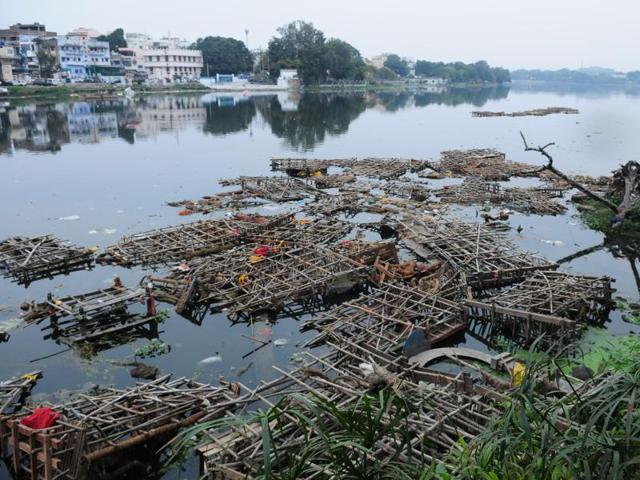
Despite repeated attempts and elaborate arrangements, thousands of idols of Lord Ganesha and Goddess Durga found their way into the Bhopal’s water bodies — namely, Upper lake, Lower lake and Shahpura lake.
As a consequence, these water bodies are now littered with remnants of floating debris that once was part of the idols. Both biodegradable and non-biodegradable materials form a slushy mess, with a lot of it sinking to the bottom.
The fringes of these water bodies are now emanating a foul smell from the decaying organic matter, especially floral offerings.
Aside from the blatant disregard for the immersion guidelines, the CPCB’s call urging people to use only natural materials as prescribed in holy scriptures in the construction of idols too fell on deaf ears.
In its survey, HT found that a vast majority of the idols were made of plaster of Paris and painted with synthetic colours. Only a small section of the city’s burgeoning population made eco-friendly idols.
“It is the duty of the government to ensure that water bodies here, one of which is even used for drinking water supply, are not polluted due to thousands of idols, with their synthetic colours. This not only disturbs the ecology of these water bodies, but affects aquatic life as well. Government has to ensure that CPCB’s guidelines are followed in letter and spirit,” said environmentalist Subhash Pandey, who had raised the issue of idol immersion in a case before the National Green Tribunal.
The CPCB had set up a committee to frame national guidelines for immersion of idols in February 2009. Subsequently, in June 2010, it came up with a set of guidelines on eco-friendly idol immersion, which had to be followed by all states.
Despite numerous initiatives to reach out to the people - including awareness workshops, advertisements, setting up artificial ponds and plastic water tanks in various parts of the city for idol immersion - the people continued to flout all rules.
In addition to the CPCB, the NGT too had taken a tough stand on the adverse effects of PoP idols in water bodies, and on August 18 directed the state government instruct all collectors to identify idols made of PoP in their respective areas and destroy them.
Madhya Pradesh State Pollution Control Board (MPSPCB) regional officer PS Bundela said they can just take water samples before and after immersions and organise awareness drives, but action against violators can only be taken by civic authorities.
“Ultimately, it is the people who have to change their mindset and start following eco-friendly ways. Being a religious and sensitive issue, authorities can’t push people too much,” he said.