Jains distribute booklets, try to justify Santhara ‘logically’
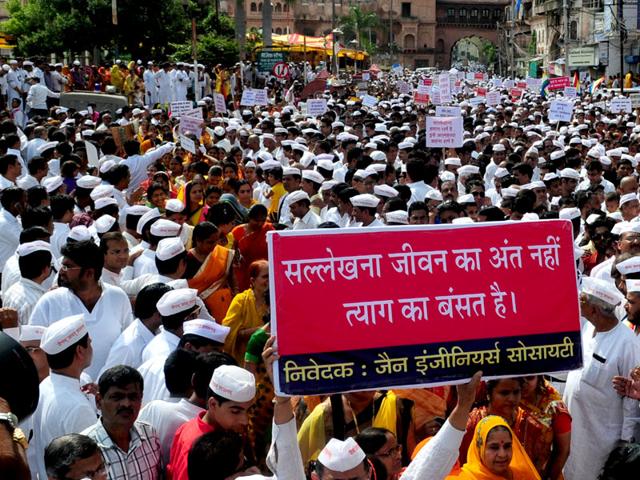
Jain community ditributed a booklet in Bhopal as part of their protest against Rajasthan high court’s recent judgment which termed Sanlekhna or Santhara as a suicidal act.
When a soldier sacrifices his life for the country why he is called a martyr, not a criminal? When hundreds of mountaineers don't ever return why they are not accused of committing suicide despite the fact they risked their life?
Jain community members at a rally to protest against the ban on Santhara in Bhopal. (Mujeeb Faruqui/ HT Photo)
{{^htLoading}} {{/htLoading}}
These are some of the questions which figure in a booklet being distributed in Bhopal as part of Jain community’s protest against Rajasthan high court’s recent judgment which termed Sanlekhna or Santhara as a suicidal act.
Needless to mention, the booklets comes with several ‘logics’ to justify Santhara.
Through these questions, writer and Jain saint Dhyansagar Maharaj tries to compare a soldier, a mother, a patient, a mountaineer and a sportsperson, who risked their life for different reasons, with a person, who embraces Santhara.
The questions suggest if Sanlekhna is termed as suicide then why does a soldier who lays his life for the sake of country is declared a martyr and not a criminal? Why does a mother who sacrifices her life to protect her children at the time of earthquake or for that sake a mountaineer who doesn’t come back alive are not treated as a criminal?
{{^htLoading}} {{/htLoading}}
{{^usCountry}}
Meanwhile, talking to HT, a community leader Pankaj Jain said, “The basic motive of comparison and raising questions is to make the people aware about the age old and scientific practice of Santhara. Ban on Santhara is unacceptable to us.”
{{/usCountry}}
{{#usCountry}}
Meanwhile, talking to HT, a community leader Pankaj Jain said, “The basic motive of comparison and raising questions is to make the people aware about the age old and scientific practice of Santhara. Ban on Santhara is unacceptable to us.”
{{/usCountry}}
Retired justice NK Jain said, “The Rajasthan high court’s judgment is unfortunate. Nobody can ban any religious ritual. The judgment is neither factually not legally correct.”
I have spent over a decade chronicling Madhya Pradesh’s political and social landscape, covering politics, investigative journalism, crime, human interest, and government policy, blending sharp insight with ground‑level depth. I have closely tracked three assembly elections, three Lok Sabha elections, leadership transitions in MP while exposing governance lapses, tender irregularities, and flawed policy rollouts. My reports have revealed gaps in the Cheetah project, irregularities in medical education, rigging in recruitment exams, and loopholes in policy implementation. In crime reporting, I have moved beyond FIRs to map systemic patterns — from organised crime networks and gender‑based violence to custodial accountability — balancing urgency with sensitivity. My journalism is defined by a commitment to human interest. I have profiled the marginalised Bancchda community, documented atrocities against tribal groups, and highlighted efforts to preserve their culture through heritage liquor and revival of spiritual practices. I have reported on farmers struggling with failed MSP promises, giving voice to those often reduced to statistics in policy files. Passionate about field reporting, I have reported on rampant sand mining in Chambal and Narmada, pharmaceutical companies supplying medicines under altered names, the dire condition of schools and colleges, the plight of commercial sex workers, and skewed sex ratios in specific districts. Beyond deadlines, and as HT’s state correspondent and assistant editor in Madhya Pradesh, I engage with ministers, farmers, students, and activists, believing the best policy stories begin with a single human voice. A postgraduate in Journalism and Mass Communication, I also hold a diploma in sports journalism.