...
...
Next Story

NGT asks empowered panel to visit industries around Rihand Sagar, file report in 2 weeks

The National Green Tribunal has directed the empowered core committee, set up to study the impact of pollution due to industrial activities in and around Gobind Vallabh Pant Sagar reservoir or the Rihand Sagar, to submit its final report within two weeks.
Updated on: May 01, 2015 06:04 PM IST
Hindustan Times | By , Bhopal
Prefer HTon Google
Advertisement

The National Green Tribunal has directed the empowered core committee, set up to study the impact of pollution due to industrial activities in and around Gobind Vallabh Pant Sagar reservoir or the Rihand Sagar, to submit its final report within two weeks.

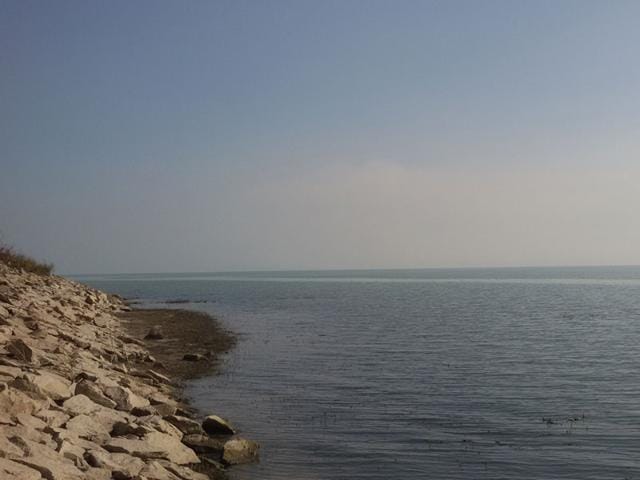
Rihand-Sagar-dam-HT-file-photo

The principal bench of the NGT, New Delhi, has also ordered the panel to visit major thermal power plants and industrial giants before tabling its complete report.

Set up last year with a mandate to conduct surveys of all the industries (thermal power plants, coal mines, etc) around the Rihand Sagar, the expert committee has been directed “to visit the Sasan Ultra Mega Power Project, Moher and Moher Coal Block, Essar MP Power Ltd, Mahan Aluminium Power Division and all mines of Northern Coal Fields Ltd, whichever of them falls in the critically polluted area.”

A three-member bench, including justice Swatanter Kumar, chairperson DK Agrawal and expert member Bikram Singh Sajwan issued the directions while hearing a case filed by advocate Ashwani Dubey on Wednesday.

Petitioner Ashwani Dubey, a Supreme Court lawyer, told Hindustan Times that the 15-member core committee under the chairmanship of Tapan Chakraborty, former director of Nagpur’s National Environmental Engineering Research Institute, has been directed to visit some industrial giants around Rihand Sagar and submit the final report within two weeks.

“The visit assumes importance as the NGT is likely to give its final verdict on May 26 after going through the final report,” he said.

The Rihand dam is built over river Rihand, a tributary of the Son, in UP’s Sonbhadra district. But its reservoir -Rihand Sagar- is located on the border of the two states -- MP and UP.

The reservoir, according to Ashwani Dubey, has been “polluted with discharge of fly ash and other effluents from nearby thermal power plants and other polluting industries.”

Around 500 villages around the reservoir in MP and UP have been affected due to the polluted waters from the reservoir, claims Dubey.

Last year the Central Pollution Control Board (CPCB) submitted a report to the NGT, saying that carcinogenic pollutants have been found in the air around Rihand Sagar.

 
ABOUT THE AUTHOR
Neeraj Santoshi

Neeraj Santoshi is the Chief of Bureau for Hindustan Times in Uttarakhand, where he leads the state reporting team while covering government, politics, environment, wildlife, Uttarakhand High Court, and issues shaping the Himalayan region. With more than two decades in journalism across conflict zones, he has covered politically sensitive regions and environmentally fragile landscapes, and focused on stories that combine public interest with in-depth storytelling. An alumnus of Pune University with a Master’s in Communication Studies, he has reported extensively from Jammu & Kashmir (2003-2010), Madhya Pradesh (2010 to 2018 ) and Uttarakhand (Since 2018), covering subjects ranging from insurgency, elections and governance to wildlife conservation, mining, climate change, agriculture, human rights and social justice. He has covered politics and legislative assemblies of both Jammu & Kashmir and Madhya Pradesh over more than a decade. Before taking over as Chief of Bureau in Uttarakhand, he served as Special Correspondent with Hindustan Times in Madhya Pradesh and earlier reported for both Hindustan Times and The Indian Express in Jammu & Kashmir, where he covered state politics, environment and insurgency-related developments. Over the years, his stories have focused on environmental degradation, wildlife, illegal mining, governance and the changing social fabric of Himalayan states and Central India. He is particularly interested in long-form explanatory journalism, and stories that explore the intersection of ecology, conservation, governance and society. Outside the newsroom, Neeraj enjoys reading widely on neuroscience, consciousness studies, Artificial Intelligence and quantum physics, with a special interest in Kashmiri Tantric Shaivist traditions. He is also passionate about wildlife, mountaineering and the Himalayas, interests that continue to inform his reporting and deepen his understanding of the region he covers.

SHARE THIS ARTICLE ON
Hindustantimes wants to start sending you push notifications. Click allow to subscribe