
 E-Paper



Anup Gupta picks his favourite read of 2025
An insightful guide that introduces the transformative HOPE framework that enunciates practical leadership qualities that help create environments where people feel valued, safe, and inspired to do their best work

 Prefer HTon Google


“Pleasure in the job puts perfection in the work,” said Aristotle. It is an idea that has echoed across centuries and continues to resonate powerfully in modern leadership thinking.
In a recent podcast, Garry Ridge, the wildly successful former CEO of WD-40, revealed that the quote had profoundly reshaped his understanding of leadership. Early in his tenure, Ridge realised that organisational success is not driven merely by targets or hierarchies but by people who are deeply connected to a shared purpose and nurtured within the right culture. For him, culture was not a vague concept — it was values plus behaviours multiplied by consistency and sustained by leaders who act as coaches rather than commanders. Such environments, he believed, create lasting memories and enduring success.
Ridge’s record speaks for itself. During his 25 years at WD-40, he led the company through extraordinary growth — expanding its market capitalisation from $300 million to $3.6 billion, and increasing its global footprint from 70 countries to an impressive 176. This success was not accidental; it was the outcome of a leadership philosophy rooted in trust, care, and human potential.
In today’s complex and fast-changing world — where conversations are increasingly dominated by artificial intelligence and automation — it is clear that leadership can no longer rely solely on good strategy and efficient execution. Nor is it enough to focus only on IQ and EQ. What truly distinguishes impactful leaders now is what may be called The Nurturing Quotient: the ability to nurture talent, cultivate skills, and enable the next generation to flourish.
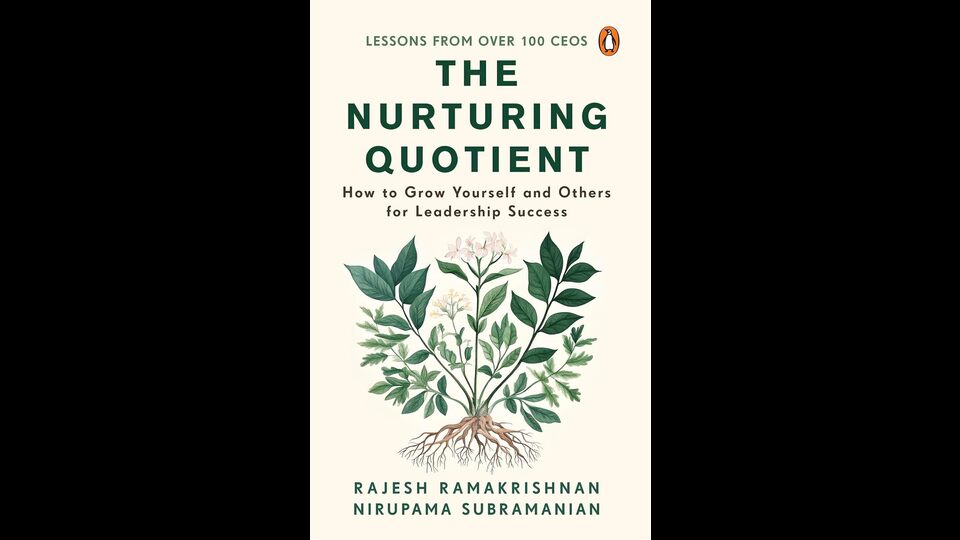
This is precisely the terrain explored in The Nurturing Quotient by Rajesh Ramakrishnan and Nirupama Subramanian. Drawing on decades of professional and personal experience, the authors introduce the transformative HOPE framework — Humility, Openness, Patience, and Empathy. These are not abstract ideals but practical leadership qualities that help create environments where people feel valued, safe, and inspired to do their best work.

The book serves as an insightful guide for leaders at all levels, offering practical strategies such as mentoring, coaching, active listening, inspiring purpose, and empowering teams. Through real-world examples and thoughtful reflection, it demonstrates how nurturing leadership fosters both individual growth and organisational resilience. Importantly, nurturing leadership is not a rigid formula for guaranteed success. Rather, it is an empathetic and compassionate approach that enables teams to flourish and organisations to thrive sustainably.
In the book’s advance praise, Sanjiv Mehta, former Chairman and CEO of Hindustan Lever and Executive Chairman of L Catterton India, aptly notes that in a rapidly changing world, effective leadership goes beyond authority — it requires a nurturing touch that encourages growth and collaboration. The Nurturing Quotient delivers precisely that: a thoughtful, experience-rich roadmap for leaders who aspire not just to lead, but to uplift.


