
 E-Paper



Dhiraj Rabha: “My life is not just a personal memory but a political condition”
The Assamese artist’s exhibit at the Kochi-Muziris Biennale 2026 has been shaped by his experience of living in the state’s ULFA detention camps

 Prefer HTon Google


You spent your childhood in a ULFA detention camp after your father surrendered his arms. Please talk about the moment when you realised your childhood wasn’t “normal”. How did that realization become the seed for this work?
For much of my childhood, life inside the camp felt unquestioned; it was simply the world I knew. Even while studying political science, my engagement with politics remained distant, disconnected from how authority and control shaped my own daily existence. That separation began to shift when I encountered art as a critical practice in Santiniketan, where I was encouraged to reflect on place, history, and my own lived position within them.
This awareness sharpened during the Covid lockdown, when I returned to Goalpara and was simultaneously asked to leave the camp, our only shelter, with no clear alternative. The instability of that moment forced me to confront what “home” actually meant, not as a fixed space, but as something conditional and fragile.
Conversations with former ULFA members added another layer. Many described entering the movement in search of a homeland, only to find that idea unravel after surrender, replaced by surveillance, camps, and prolonged uncertainty. These intersecting experiences of inheritance, loss, and suspended belonging, gradually shaped my practice, grounding it in memory, testimony, and the unresolved politics of living without a secure home.
You’ve mentioned that tall bamboo walls and watchtowers were just part of your everyday landscape as a child. How do you navigate the tension between your lived memory and the need for critical distance when creating this work?
I’d like to clarify first that the walls around the camp were concrete, not bamboo. But as a child, the material hardly mattered. Watchtowers, high walls, and constant surveillance were simply part of my everyday landscape; they felt ordinary, even invisible. The critical distance came much later. When I began studying art, I learned to look at my own life not just as personal memory but as a political condition. That shift allowed me to revisit these spaces with awareness, without trying to aestheticise or sentimentalise them. Instead of recreating the camp literally, I work with metaphors, watchtowers, structures, sound, and absence, to speak about power, control, and vulnerability.
My process moves back and forth between intimacy and distance. I rely on lived memory for emotional truth, but I constantly question it through research, conversations, and historical context. This tension is essential to the work; it allows me to hold both the child who accepted these structures as normal and the artist who now understands their violence.
The carnivorous plants glow seductively under ultraviolet light, but they represent media power that “consumes everything.” Please walk us through the evolution of this metaphor — why carnivorous plants specifically?
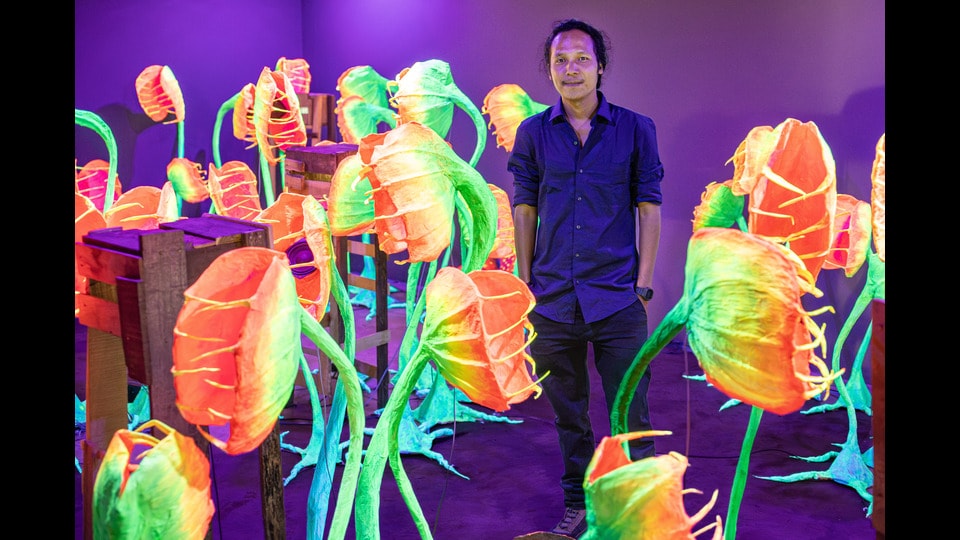
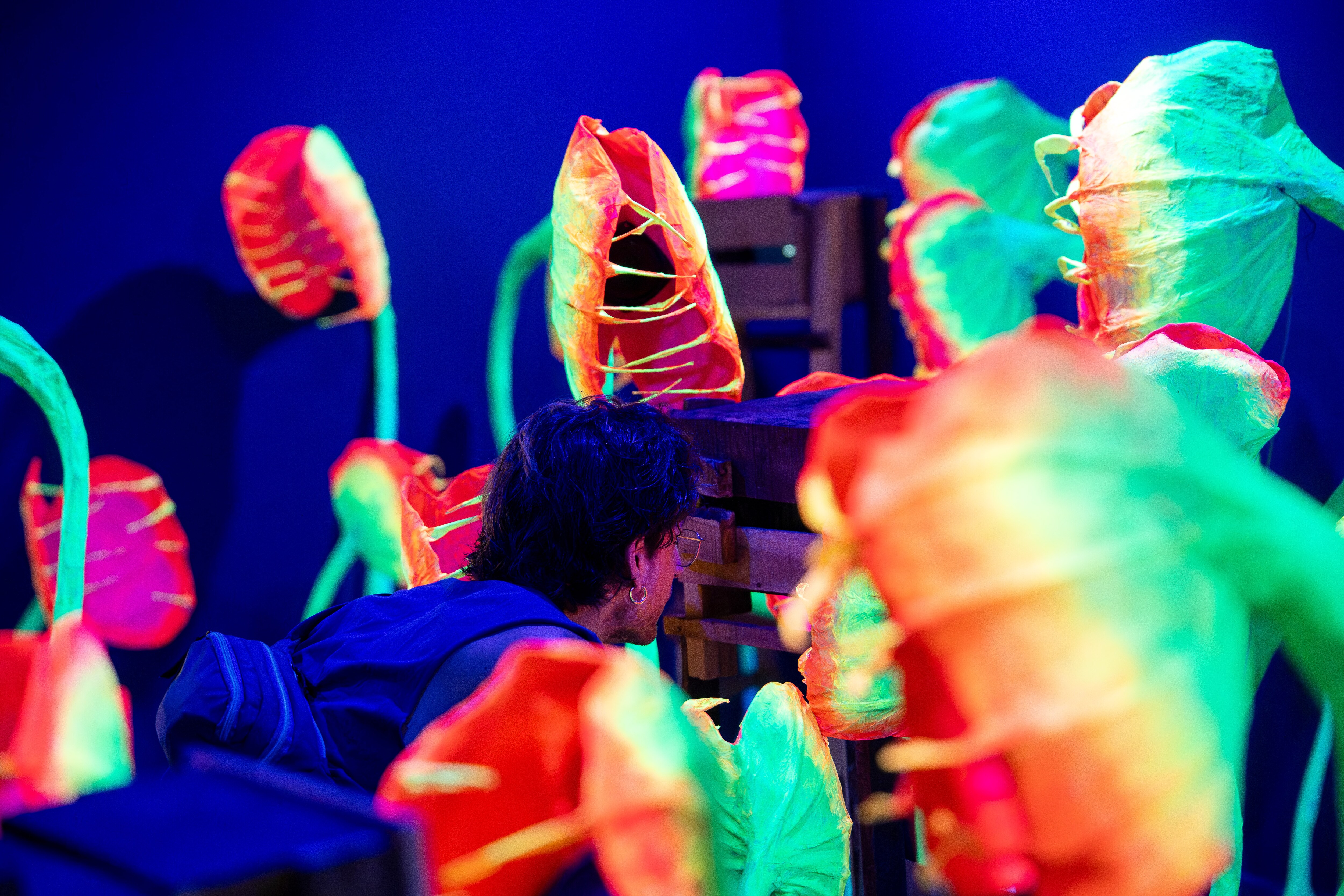
The metaphor came very organically. Growing up and later spending time in Meghalaya, carnivorous plants were part of the landscape — they are beautiful, strange, and quietly violent. They don’t attack openly; they seduce. That logic stayed with me. In the installation, the carnivorous plants form a glowing garden, each embedded with speakers broadcasting looping news audio. Their colour and ultraviolet glow are intentionally attractive. This mirrors how state and media narratives often operate, persuasive, aestheticised, and seemingly harmless, yet fundamentally predatory. Like the plants, these narratives lure attention first, and only later reveal how they consume complexity, dissent, and lived experience. At the centre, a watchtower holds intimate testimonies of former ULFA members, which demand closeness and time.
The overlapping news broadcasts in Assamese, Hindi, and English create a cacophony that “swallows meaning.” What do you want audiences to feel when those voices “collapse into one another”?
I wasn’t interested in transmitting meaning. These voices already belong to the public domain; they have been heard, repeated, and normalised. By distorting them, I wanted to strip them of authority and turn them into something spectral. They no longer speak; they hover. When the broadcasts collapse into one another, language fails. What emerges is a field of noise where no single voice can be trusted or fully grasped. This is intentional. Power rarely operates through truth; it operates through excess, repetition, and saturation. Meaning is swallowed not by silence, but by volume. I want the audience to feel disoriented, even uneasy, inside this collapse. In that disorientation, the work gestures toward a political condition where dominant narratives do not clarify reality, but obscure it, leaving lived experience unheard beneath the noise.
The burnt house contains real archival materials — newspapers, photographs, pamphlets from the 1990s. How did you source these documents, and what was the most haunting piece you discovered?
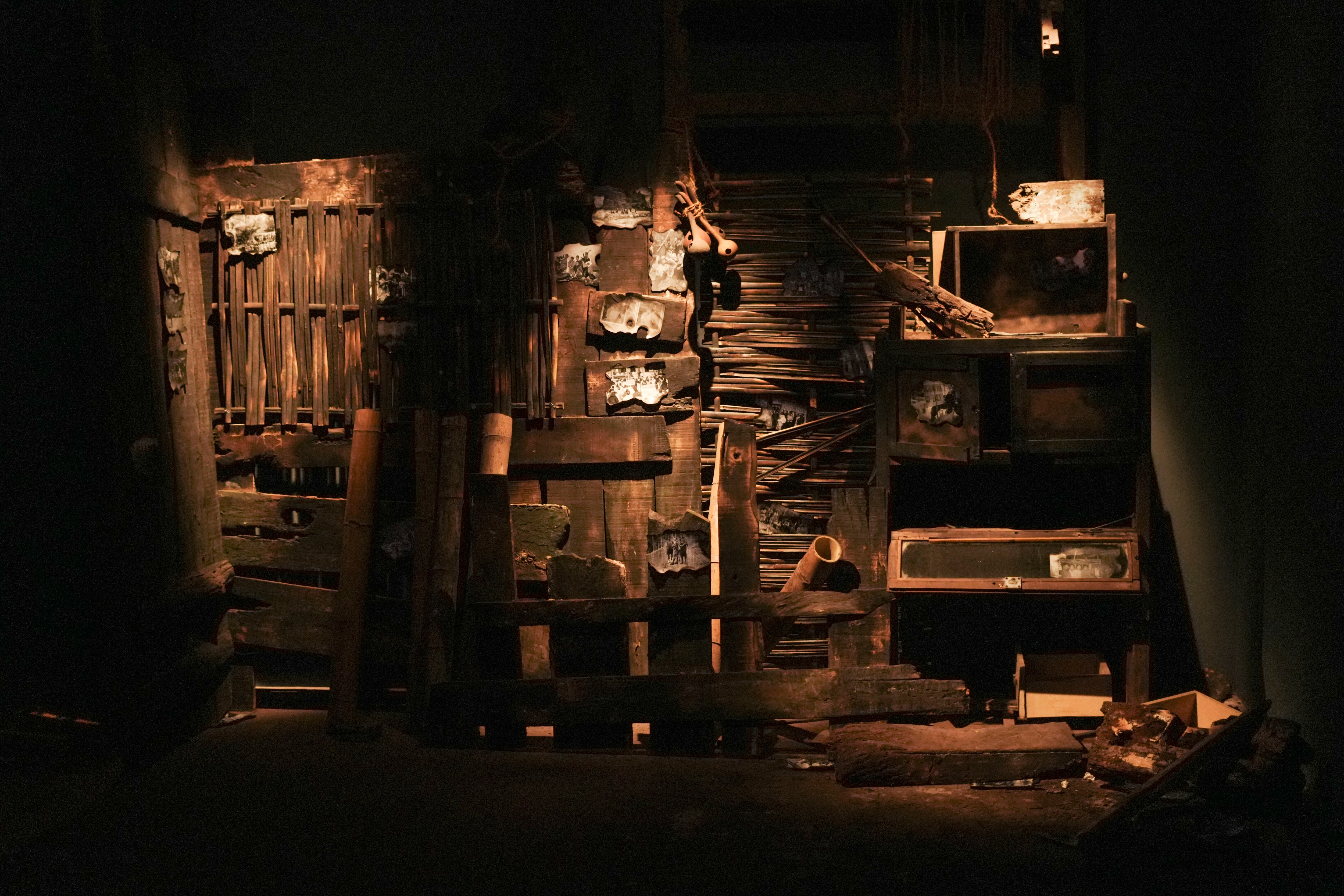
The archives emerged slowly through research and trust. While visiting former ULFA members — both inside the camp and in their homes, I would gently ask if anything remained from the time of the movement. In most cases, nothing did. Many people had already destroyed their materials, either to distance themselves from painful memories or out of fear. Even decades later, possessing such documents can still feel dangerous. Some materials survived only by chance, passed to me quietly and carefully. The burned house reflects this reality, not just loss, but deliberate erasure as a condition of survival.
Some pieces deeply haunted me, but I chose not to include them, and I won’t speak about them publicly. Trust and safety are central to this work. What matters to me is not exposing everything, but respecting the vulnerability of those who shared their histories with me.
The ULFA years shaped an entire generation in Assam, yet these stories “never came out,” as you’ve said. What response have you received from Assamese visitors versus those unfamiliar with this history?
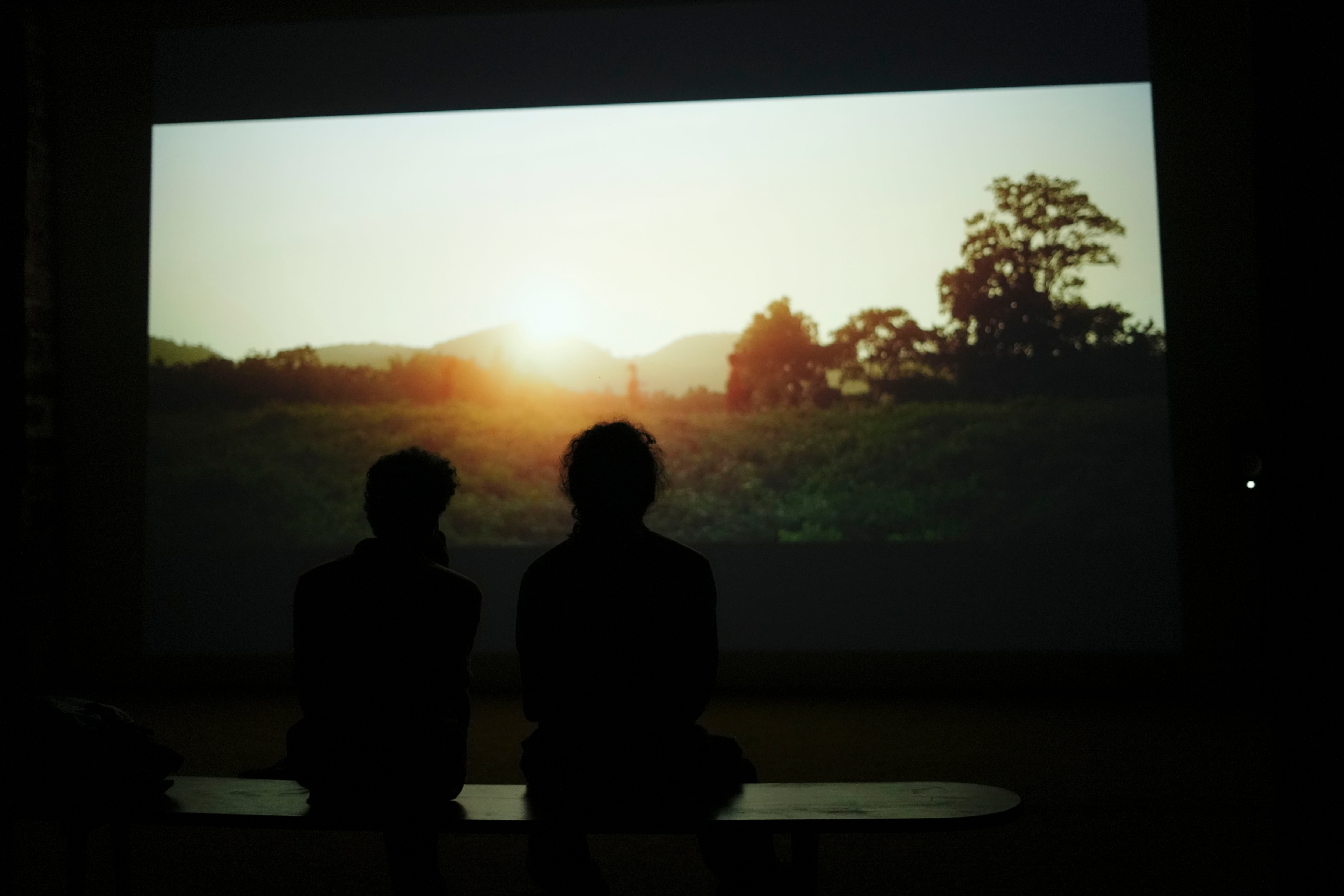
For many Assamese visitors, the work opens an emotional return — nostalgia, grief, and recognition surface almost immediately. Some share their own memories; others sit quietly with it. Those unfamiliar with this history respond with curiosity and urgency, wanting context, continuity, and access. Many ask for a book or a completed film — something that allows these silenced histories to travel beyond the space and remain available.
This work required you to revisit personal trauma while conducting rigorous research. How do you care for yourself as an artist working with such heavy material?
It was emotionally exhausting. Some of the stories stayed with me long after the conversations ended. Even now, there are interviews I haven’t been able to listen to again. When I was meeting people and recording their experiences, I often needed time before I could approach the next conversation. The weight of what they shared required stillness. The editing process was even more difficult. Returning to those voices — listening closely, repeatedly — meant reopening emotions I hadn’t fully processed. That’s why the work unfolded slowly. I had to respect my own limits. In between, I learned to step away. I am fortunate to have close friends who understood this process. Travelling to the mountains with them gave me silence and distance, a way to breathe again. Nature became a form of care — offering calm, grounding, and the space to return to the work with gentleness. For me, care became part of the practice, making this work meant learning how to listen deeply, not only to others, but also to myself.
What do you hope someone takes away from The Quiet Weight of Shadows — especially someone who has no prior knowledge of Assam’s insurgency?
I don’t expect viewers to arrive with knowledge of Assam’s insurgency. This work doesn’t demand understanding; it demands attention. While it emerges from a specific history, it speaks to a global condition where power decides what is visible, believable, and worth caring about.
What began as an exploration of personal and collective memory gradually became a question of how realities are manufactured. Power often presents a polished, consumable surface, while uncomfortable truths remain buried beneath it. The work invites viewers to sit with this tension and ask themselves what they choose to see and what they choose to ignore.
I noticed that some viewers were drawn only to the visual beauty, taking photographs and moving on, while others stayed, listened, and uncovered the layered contexts within the work. This difference is not accidental; it mirrors how power operates today, encouraging spectacle over depth, speed over reflection.
Ultimately, the project asks for effort. To engage with layered realities, one must slow down, listen, and stay present. Whatever viewers take away is their choice, but that choice itself becomes a political act.
Arunima Mazumdar is an independent writer. She is @sermoninstone on Twitter and @sermonsinstone on Instagram.


