
 E-Paper



HT Picks; New Reads
The reading list this week includes a study of Delhi’s “hybrid half-century” when the Mughal regime overlapped with that of the East India Company, an exploration of SH Raza’s artistic trajectory and his contribution to the development of modernism in the Indian subcontinent, and a book that portrays the life of a true thespian

 Prefer HTon Google


The Fall of The Mughal Dynasty
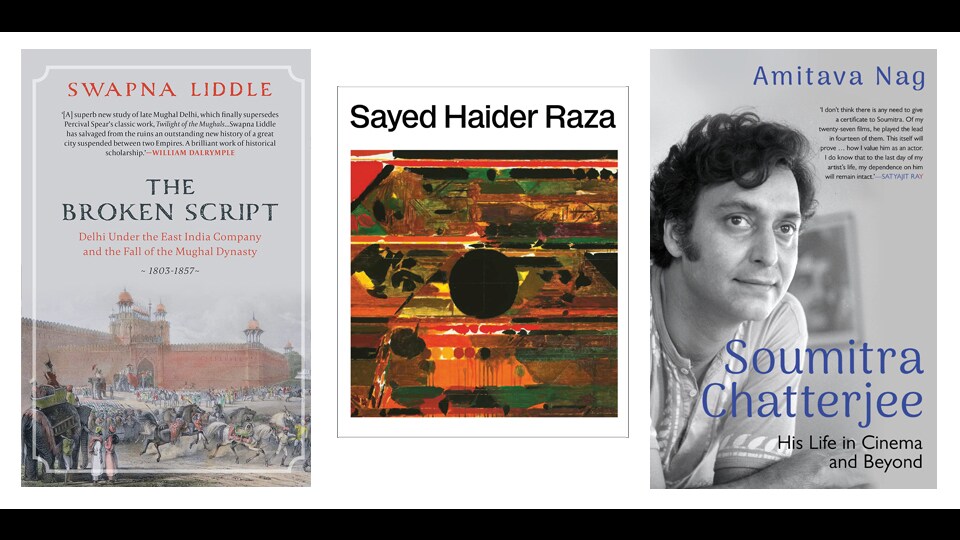

At the start of the nineteenth century, there was a Mughal emperor on the throne in Delhi, but the Mughal empire, in decline for almost a century, was practically gone. A new power had emerged — the British East India Company, which captured the Mughal capital in September 1803, becoming its de facto ruler. Swapna Liddle’s book is an unprecedented study of the “hybrid half-century” that followed — when the two regimes overlapped and Delhi was at the cusp of modernity, changing in profound ways.
With a ground-level view of the workings of early British rule in India, The Broken Script describes in rich detail the complex tussle between the last two Mughal emperors and the East India Company, one wielding considerable symbolic authority, and the other a fast-growing military and political power. It is, above all, the story of the people of Delhi in this period, some already well known, such as the poet Ghalib, and others, like the mathematician Ram Chander, who are largely forgotten: the cultural and intellectual elite, business magnates, the old landed nobility and the exotic new ruling class — the British. Through them, it looks at the economic, social and cultural climate that evolved over six decades. It examines the great flowering of poetry in Urdu, even as attempts to use the language for scientific education faltered; the fascinating history of the Delhi College, and how it represented a radically new model for higher education in India; the rise of modern journalism in Urdu, and various printing presses and publications, exemplified by papers like the Dehli Urdu Akhbar; and the founding of remarkable institutions like the Archeological Society — all of which point to a fast-modernizing society that was being shaped to a significant extent by Western ideas and institutions, but was also rooted strongly in indigenous systems of thought and learning.
The Revolt of 1857 and its aftermath violently disrupted this distinctive modernity. The book draws upon a variety of records — including Urdu poetry written after the revolt was brutally suppressed, proceedings of the trials conducted by the British, private letters and newspaper reports — for a nuanced examination of the events of 1857, challenging many commonly held and often simplistic assumptions. In the process, it details not only the destruction wreaked upon Delhi, but also strategies for survival and early attempts to rebuild and revive individual lives and institutions.
Combining immaculate scholarship with extraordinary storytelling, Swapna Liddle has produced an outstanding book of narrative history — on a great city in transition, and on early modern India — that will be read and discussed for decades.*
The man who unlearnt everything

One of the most prominent painters of his generation, SH Raza changed the course of modernism in India. After an early stint in Bombay, where he was a founding member of the Progressive Artists’ Group, he moved to France, where he spent the next 60 years. This volume explores Raza’s artistic trajectory from the time of his arrival in Paris, as well as his contribution to the development of modernism in the Indian subcontinent.Beginning with early works developed in India before 1947, the essays in this volume analyse Raza’s later abstraction processes and landscapes. His strong thrust towards non-figurative art, and subsequent influences from European and American modernism, combined with Raza’s own memories and impressions of India and led him to a skilful negotiation between Indian spirituality and Western abstraction. Raza’s bold, failed experiment with the French Cubist style is also explored here, leading to the crucial moment when he decided he had to unlearn everything he knew. In addition to the essays, an anthology of previously unpublished letters offer glimpses of the master at work, and a detailed chrono-biography situates him within the transcultural dynamics of the 1950s to the 1980s.Accompanying the SH Raza exhibition at the Centre Pompidou in Paris in 2023, this catalogue presents a compelling overview of Raza’s work and the highlights of his journey.*
An intimate portrait of the thespian

When Soumitra Chatterjee debuted in Satyajit Ray’s Apur Sansar in 1959 — the final part of Ray’s Apu trilogy — a star was born in Bengali cinema. Soumitra soon transcended the boundaries of the Bengali film industry to become an internationally celebrated actor who was compared to the best in the business, from Max von Sydow to Marcello Mastroianni. Famously known as “Ray’s actor”, in a career spanning six decades, Soumitra worked with practically every Bengali director worth the name — Mrinal Sen, Tapan Sinha, Chidananda Dasgupta, Aparna Sen, Tarun Majumdar, Rituparno Ghosh and Goutam Ghose, to name but a few.
Following Apur Sansar, Soumitra played the lead in another Ray film, Devi, in 1960. From then until the posthumously released Abhijan and Belashuru (2022), the more than 300 films in which he acted rank among the best in Bengali cinema, and won him a string of awards, including the Filmfare Lifetime Achievement Award (1995), the Sangeet Natak Akademi Award (1999), the Padma Bhushan (2004), the Dadasaheb Phalke Award (2012) and the Legion d’Honour awarded by the French Government (2018). But it was not just on the silver screen that Soumitra shone. He was also an accomplished playwright and theatre actor, a poet, a painter, the literary editor of the magazine, Ekshan, and an elocutionist.
Soumitra Chatterjee: His Life in Cinema and Beyond, is the first comprehensive attempt to portray the life of the actor in all its facets. It traces Soumitra’s initial years of searching for identities to the final decades when he reached the pinnacle of his career as an actor and an artist. Written from the vantage point of someone who shared an exceptionally close relationship with the actor, film journalist Amitava Nag has drawn an intimate portrait of the star thespian and his art beyond acting, which will be essential reading for his legion of fans, and for all those interested in cinema.*
*All copy from book flap.


