
 E-Paper



HT Picks; New Reads
This week’s pick of interesting reads includes a book of powerful comics that critique injustice, a volume on the downfall of two Muslim dynasties in the early twentieth century, and another on the terrible consequences of the rush for green energy

 Prefer HTon Google


Comics to fight brain rot
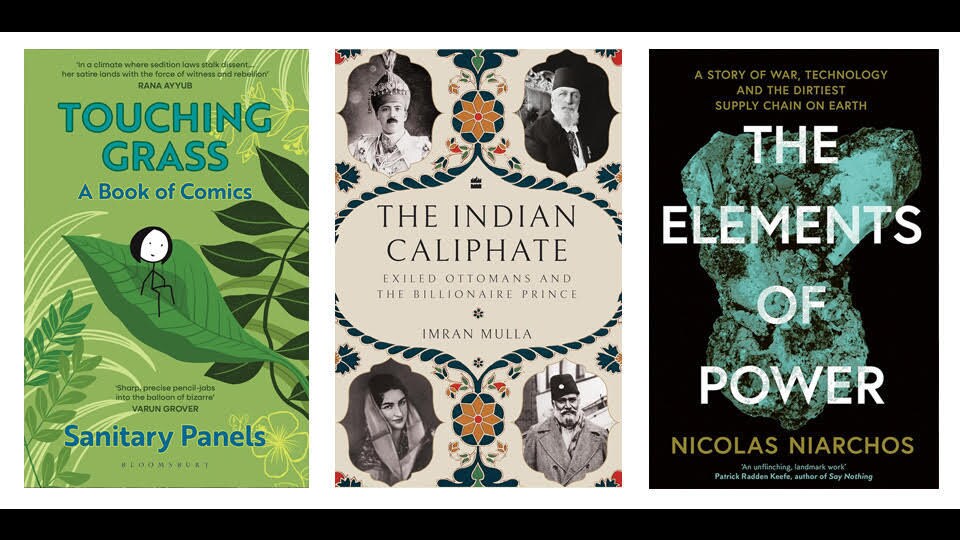

In Touching Grass, Sanitary Panels goes beyond viral moments to offer a raw and powerful critique of authoritarianism, the great injustices of the world and the many social ills of our times. These resonant and deceptively simple comics and political cartoons are a mirror to the world we live in. Through her pressing political art, Rachita Taneja, aka Sanitary Panels, explores casteism, Islamophobia, transphobia, economic inequality and climate anxiety, among other pressing issues. She examines the perpetual paradox of staying informed and being politically active while not being overwhelmed by algorithmic systems designed to overstimulate and exhaust us. Sanitary Panels insists we rise through the fog of doomscrolling, brain rot, and hopelessness towards a world that is more equal, liveable and just. At its heart, Touching Grass offers something precious: hope. Hope found in community building and solidarity, and in the fierce, unwavering spirit of ordinary people who refuse to give up. This book of comics is a reminder that while the world may be on fire, we are never truly alone.*
The Ottomans and Hyderabad

The remarkable story of the last Ottoman Caliph, exiled by Ataturk, who tried to recreate the Caliphate in the Indian princely state of Hyderabad. Abdulmejid II was a talented painter, music enthusiast and Francophile. He was also the last Ottoman Caliph, expelled from Istanbul in March 1924 when Turkey abolished the 1,300-year-old Caliphate.From his villa on the French Riviera, Abdulmejid launched a plan to resurrect the institution and transform world history. Indian politician Shaukat Ali brokered a marital alliance between the Ottomans and the Nizam of Hyderabad, the world’s richest prince, who governed a state the size of Italy in the Indian subcontinent.This saw the union of Islam’s two greatest houses, and of the Islamic west and east. It cemented Hyderabad’s status as a global Muslim capital, and left Abdulmejid’s grandson, the Ottoman prince and the designated Nizam-in-waiting, perfectly placed to claim the Caliphate. But Partition in 1947 and the annexation of Hyderabad the following year spelled the end of this prospect.Exploring the lives, cultures and sensibilities of an amazing cast of players, The Indian Caliphate details this extraordinary history, which for decades has been consigned to near oblivion. This story of the downfall of two Muslim dynasties reveals a forgotten fact: that India was, in many ways, the very epicentre of the Islamic world in the early twentieth century.*
The war for the supply of battery metals

The Elements of Power tells the story of the war for the global supply of battery metals – essential for the decarbonization of our economies – and the terrible human cost of this badly misunderstood industry.Congo is rich. Swaths of the war-torn African country lack basic infrastructure, and, after many decades of colonial occupation, its people are officially among the poorest in the world. But hidden beneath the soil are vast quantities of cobalt, lithium, copper, tin, tantalum, tungsten, and other treasures. Recently, this veritable periodic table of resources has become extremely valuable because these metals are essential for the global “energy transition” ― the plan for wealthy nations to wean themselves off fossil fuels by shifting to sustainable forms of energy, such as solar and wind. The race to electrify the world’s economy has begun, and China has a considerable head start. From Indonesia to South America to Central Africa, Beijing has invested in mines and infrastructure for decades. But the U.S. has begun fighting back with massive investments of its own, as well as sanctions and disruptive tariffs.In this rush for green energy, the world has become utterly reliant on resources unearthed far away and willfully blind to the terrible political, environmental, and social consequences of their extraction. If the Democratic Republic of the Congo possesses such riches, why are its children routinely descending deep into treacherous mines to dig with the most rudimentary of tools, or in some cases their bare hands? Why are Indonesia’s seas and skies being polluted in a rush for battery metals? Why is the Western Sahara, a source for phosphates, still being treated like a colony? Who must pay the price for progress?With unparalleled, original reporting, Nicolas Niarchos reveals how the scramble to control these metals and their production is overturning the world order, just as the global race to drill for oil shaped the twentieth century. Exploring the advent of the lithium-ion battery and tracing the supply chain for its production, Niarchos tells the story both of the people driving these tectonic changes and those whose lives are being upended. He reveals the true, devastating consequences of our best intentions and helps us prepare for an uncertain future. If you have ever used a smartphone or driven an electric vehicle, you are implicated.*
*All copy from book flap.


