
 E-Paper



Jonathan Gil Harris: “Whether we like it or not, we are all syncretic”
On the author’s memoir of his mother, whose story encompasses the twentieth century and the history of her merchant family and of peoples across Asia and Europe

 Prefer HTon Google


How did you decide to write a memoir about your mother?
In a way, I didn’t choose to write it. It chose to be written. I had known for a long time that my mother’s story was extraordinary. A girl forced to flee from Warsaw to Lvov, then deported to a Siberian labour camp before being resettled for five years in the Fergana Valley in Central Asia, then moving to Palestine and, later, to New Zealand: the sheer global scope of that story was astonishing, and the storms of twentieth-century history that blew through it – the rise of fascism, World War 2, the Holocaust, and three political partitions (of Poland, Soviet Central Asia, and Palestine) – had haunted me all my life. But I didn’t know all the details of the story, and that initially stopped me from writing it.
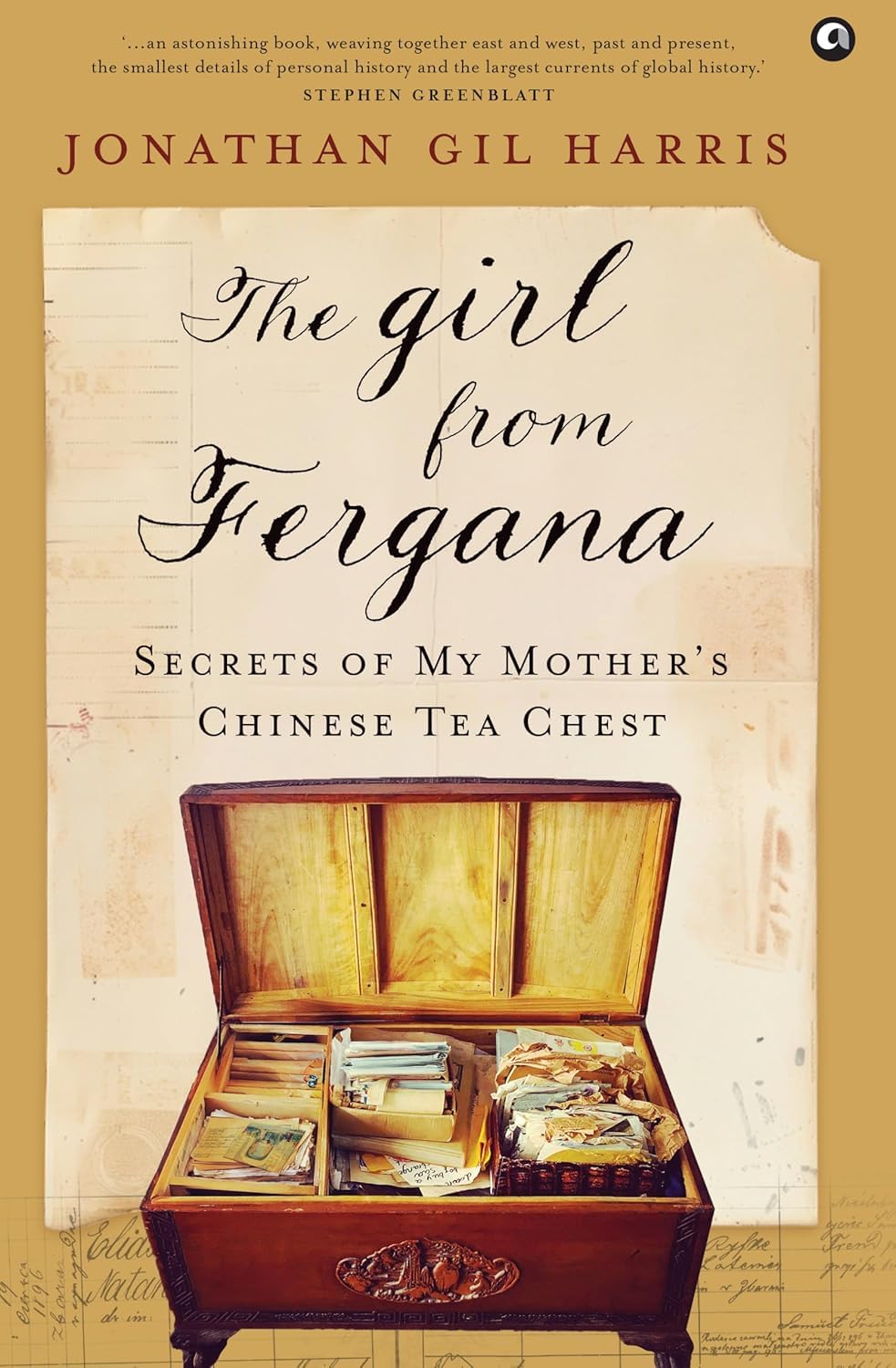
It was only after my mother succumbed to Alzheimer’s disease in about 2017 that I was finally able to sift through the contents of her old Chinese tea-chest and flesh out the details of her story. But it began to dawn on me that her story wasn’t just of the twentieth century: it was part of a much older one. In the Fergana Valley, my mother had lived at the heart of what had once been the ancient Silk Roads trade network linking China, Persia and India. The multi-ethnic, multi-faith ghosts of the Silk Roads were a big part of her experiences there. Even more, I began to realise that these ghosts had always been a presence in her life, even before she lived in the Fergana Valley; they had shaped the history not just of her merchant family but also of peoples across Asia and Europe.
How did you come up with the title?
The working title of the book was The Jewish Silk Roads. But that title sounded too academic, and too misleadingly focused on Jewishness, for a book about the history of intimacies across boundaries of culture and faith that we now regard as incommensurate. The Girl from Fergana appealed to me as a title because it refers to not one but two people – my mother, of course, but also her best friend in the Fergana Valley, an Uzbek girl named Kamrakhan. The title points simultaneously in Jewish and Muslim directions and, by doing so, quietly reminds us that behind what we might think of as a single entity lurks a plurality. Cultures as much as girls from Fergana are products of conversation with others.
This is a gripping memoir about your mother but did you also intend to capture the history of displaced Jews at large?
I did. But it’s not Jewish history as we might assume it to be. It’s not a history of a unique people who against enormous odds have preserved a single identity for millennia. It is, rather, a history of cultural confluences with non-Jewish neighbours that have constantly shaped and reshaped what it means to be Jewish. Perhaps the most radical discovery I made while writing the book is that the first Jews did not live in ancient Israel. Jewish identity was a diaspora creation, in Persian-ruled Babylon, following the liberation of the captive Israelites by Cyrus the Great. The Israelites sought to codify the tenets and rituals of their faith, and they did so in dialogue with Persian Zoroastrians from whom they acquired belief in Heaven and Hell, the idea of a Messiah, and certain distinctive practices like burying clipped fingernails. That dialogue prompted the composition of the Torah, the sacred text of Judaism, and the first formulation of what it means to be Jewish. Even the Hebrew script that we think of as uniquely Jewish was derived from the script used by speakers of Aramaic, the lingua franca of the ancient Achaemenid Persian Empire. What it has meant to be a Jew over the past two millennia has consistently been the product of such conversations and borrowings, especially with peoples from the so-called Muslim world.
You have excavated your mother Stella’s life. How did you do it?
As you may have noted, the book’s narrative moves back and forth across time. That non-linearity was suggested to me by the contents of my mother’s tea chest, in which she had stockpiled souvenirs from her childhood years – photos, letters, paintings, official papers. These had been thrown into the chest willy nilly, without any attention to time or place. At first, I had tried to organise them into a conventional biography of my mother, one that followed an orderly chronological sequence. But that proved impossible. Gradually, I found myself admiring the scattered, disparate nature of the chest’s contents. Their lack of order seemed to me closer to how memory works and, indeed, to how we live in space and time. We are contradictory assortments of bits and parts from many different moments, encased in oblivion; without warning, this or that fragment from this or that time can suddenly obtrude on our consciousness before receding again. Fragments of multiple times co-exist within us. So, I began to conceive of the book as a collection of fragments, each prompted by an object from the chest. Honouring the fragments of the chest as fragments, rather than trying to impose a chronological coherence on them, seemed to me a more honest way of reckoning with my mother’s shattered memory and life.
How did your visits to those places, where Stella had lived, impact the writing of this book?
My visits to Central Asia had a huge impact on the book. A Bukhara bazaar vendor singing to me, when he discovered that I live in India, Awaara Hoon; a synagogue in Bukhara called ‘Sinagoga Masjidi’ (Synagogue Mosque); a synagogue in Samarqand that combines Persian-style art on its blue dome and Turkic-style wooden carving on its front door – encounters like these impressed on me how any Central Asian history is not just the single story of a nation or a culture or a religion. It is also the more than 2000 years of conversations conducted across trade routes that passed through bazaars, caravanserais, and holy sites.
You’ve drawn out the cultural and linguistic affinities of the past between Jews and Persians. Israel and Iran are at loggerheads today. What is the significance of such affinities in contemporary times?
These affinities can remind us that a people we think of as entirely ‘other’ may have been part of who ‘we’ are all along. The interconnectedness of the Silk Roads has resulted in Persian elements leaving countless traces not just in Jewish culture and identity, as I have mentioned, but also in Central Asian and Indian cultures and identities. People who think their traditions should be ‘pure’ have made concerted attempts to repudiate and even erase such traces. But these, far from being foreign contaminants, are inextricable parts of who we are. They can’t be washed out: whether we like it or not, we are all syncretic. Religious Jews who believe that their faith is grounded in law use a word for the latter, dat, which is Persian. And Indians who advocate speaking a shuddh Sanskritised Hindi would find their world strangely colourless without ‘rang’, struggle to cook a meal without sabzi, and have difficulty falling asleep at night without a bistar. All these – and many more words – come from Persian. That they do so is less because of foreign invasions than because of encounters with Silk Roads traders across Asia’s bazaars – another Persian word.
What drove you to consistently establish syncretic historical connections between Jews and other religio-cultural identities?
The danger of longing for a ‘pure’ tradition, whether by Jews or Indians or by any others, is that it all too readily responds to the reality of our syncretism with ethnonationalist violence. We are now seeing the consequences of that violence in Western Asia and closer to home.
How do you look at the idea of ‘ethnic nations’? It caused the arbitrary partition of Fergana Valley among three different nations.
I think the idea of the bounded ethnic nation state is the most toxic import bequeathed to us by the West. So many of the trouble spots in Asia, from Palestine and Syria to the Indian subcontinent, are the result of borders arbitrarily drawn by the European architects of modern nation states; the partitions that have produced these too often have served to sunder bonds between peoples who had for centuries lived together as neighbours, even though they spoke different languages and prayed to different gods. This is certainly true of the Fergana Valley. For centuries, Tajiks, Uzbeks and Kyrgyz – and Jews, Kazakhs, Chinese, gypsies and others – had lived side by side. After its partition, the valley has endured communal violence and ethnic cleansing, which it never had in the two thousand years of its borderless multiculturalism.
When writing this book, did you face any fraught moments?
It’s not easy to put a book about your mother out in the world. It’s not just that I was making public what was deeply personal. I always feared that I wasn’t doing right by her, and that often gave me pause. I’m sure that my mother, as a Zionist, would have been deeply upset by what I have to say about the genocide in Gaza. She’d certainly have argued against my claim that it was the inevitable consequence of the partition of British Mandate Palestine and the founding of a Jewish ethnic nation-state. Many in my extended family are upset by my position on this, and that has been hard. It has also led to a more practical difficulty: I’ve struggled to find a publisher for the book in the US and the UK, where my mentions of ‘Gaza’ and ‘genocide’ in the same sentence have made press editors nervous that they will face accusations of antisemitism, even though I am Jewish.
This is a rich memoir that incorporates a lot of history. Please name three books that influenced the writing of it.
Let me first mention two books that have influenced me less as sources and more as models of the histories of syncretism: first, Amitav Ghosh’s In An Antique Land, which I worship to the point of fevered devotion. It tells of the medieval trader Abraham Ben Yiju, a Jew based in Cairo and Aden, who had business interests in India’s Malabar Coast, married a Nair Hindu woman, and wrote Sufi poetry in Arabic. And second, Alf Layla Wa Layla, which we know in English as The Thousand and One Nights. I love that its tales, the product of intimate exchanges in the caravanserais of Baghdad between travelling merchants from across the lands of the Silk Roads, are framed by a story of political injustice – King Shahryar’s tyrannical acts against his wives and his subjects that his brilliant wife Shahrazad, slowly works to overcome. I also want to mention a book that came out only as I was editing my final proofs: Arundhati Roy’s Mother Mary Comes to Me. That book has moved me like no other; it has shown me how a good ‘mumoir’ can artfully wed the personal and the political, even as it treats one’s larger-than-life mother, in her warts-and-all historical complexity, with the deepest love.
Mohd. Farhan teaches English at Jamia Millia Islamia, a Central University in New Delhi.


