
 E-Paper



Leo Varadkar: “It is easier to be an activist than to be a politician”
At the Jaipur Literature Festival, the former Prime Minister of Ireland spoke about being gay, growing up mixed race, and why Ireland supports writers

 Prefer HTon Google


Your memoir is called Speaking My Mind. How did you find your voice?
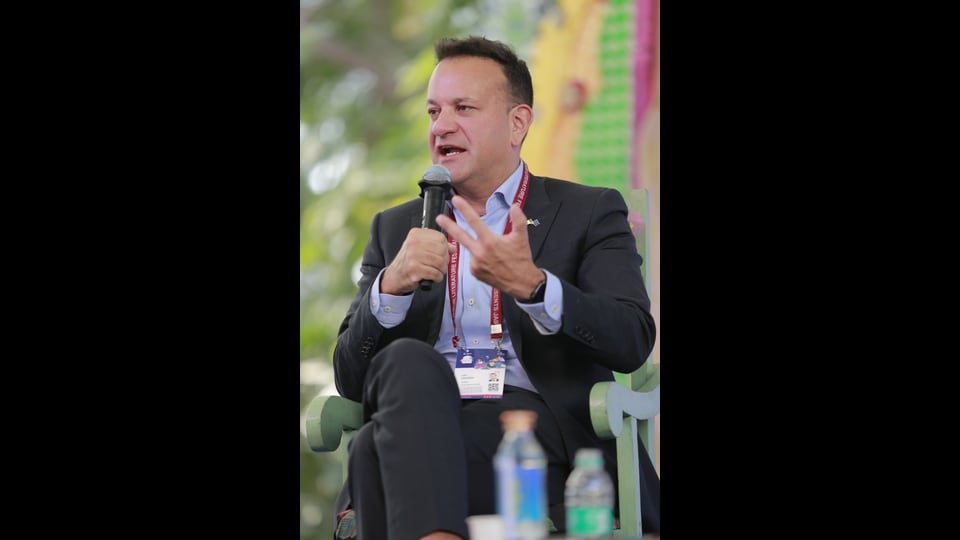
Well, it took a bit of work because this happened to be my first time writing a book. I found it very useful to be able to write down my thoughts immediately when something struck me as worthy of putting into the book. As a politician, I wrote speeches, memos and articles but never a narrative with dialogue like this one. Because I am not a professional writer, I also got some help from Deirdre Nuttall. She was kind of my co-writer. After each chapter, she would come in, speak to me, then rewrite it with me to make it more readable and then I would write again. It was quite a slow process but it worked really well for me and eventually for the book.
How did you find your voice as a gay man of Irish and Indian heritage, possibly encountering homophobia and racism as you grew up in Europe?
That’s a really good question. Thank you for asking me this. It is a bit of a complex subject so I don’t have any straight answer for you but allow me to think through this.

I am not expecting a straight answer from a gay politician. Go ahead, tell me.
(Laughs) You are so funny! I don’t have a bent answer either. I grew up in Ireland as a person of colour, so I realised pretty early that I was different. And being gay added another dimension to that. These two things made me stand apart from most of the other boys and young men I grew up around. I am not really sure how I found my voice because I am very comfortable right now with who I am, being an Irish person of colour and Indian heritage, and being a gay man but that wasn’t the case when I was maybe 25 or 30 years old. I need to think about this.
You were 36 years old and the Minister of Health when you found the courage to come out publicly just as Ireland was preparing for a referendum to legalize same-sex marriage. Mental health is still a major challenge for LGBTQ people in India, Ireland and across the world. What would you say to people struggling with suicidal ideation to give them strength?
First of all, I want to acknowledge that everyone’s experience is different, and this could depend on the cultural context. Some people have very supportive families. Others are rejected by their families. I was lucky to be able to come out at a time when my country had become much more liberal. I had support from family and friends. My political party was supportive too. That wouldn’t have been the case 20 years before in Ireland, or in some other parts of the world.
I know a lot of people who have had coming out experiences that were very different from mine but I don’t know a single individual who regrets coming out. If I can give any encouragement or advice to people who are struggling, it would be this: Coming out might be a good or bad experience or a bad one. It could be better or worse than you imagine but I don’t know any person who is sorry that they went ahead and did it. When people are driven to a bad place in terms of mental health, it is often a result of not being able to come out to oneself and others.
What kind of books did you grow up reading? A lot of gay people speak of how they first encountered someone like themselves in a book. Was it like that for you?
Not really! But, as a younger person, fantasy was the genre that I enjoyed most. That, to me, meant a lot of Roald Dahl’s books and, of course, JRR Tolkien’s Lord of the Rings trilogy. I also have fond memories of reading Salman Rushdie’s book Midnight’s Children when I was in India for two months. When you study for a medical degree in Ireland, like I did, you are encouraged to get some experience abroad. Many years ago, I spent a summer at KEM Hospital in Bombay (now Mumbai). There was something special about reading Rushdie in that city. Looking back, I don’t think I came across any queer or gay authors while growing up.
Ireland has produced five Booker Prize winners, and close to 40 Irish writers have featured on the shortlists and longlists. What makes the government prioritize support for writers through bursaries, mentorships and professional development funds?
This is part of Ireland’s soft power policy. We are a small country that wants to be a cultural superpower. For a lot of people in India, China and Latin America, their first encounter with Ireland is through culture. Support for art, literature, music, dance, and cinema is a good investment for diplomatic reasons but it is also good for people’s lives and their souls.
What are you reading at the moment?
I have more time to read now, and I love that. I still mainly read non-fiction, but I am keen to change that by reading more novels this year. The last one that I read was Colum McCann’s Apeirogon. It is about two fathers, one Israeli and the other Palestinian. Both lose their daughters in the conflict, and their grief brings them together. It is so beautifully written! Before reading it, I didn’t know that the title meant a shape that is a polygon with an infinite number of sides. That, of course, is a way of looking at the conflict itself. What I am keen to read next is a book called For and Against a United Ireland. It is written by Fintan O’Toole and Sam McBride.
During your session with Georgina Goodwin at the Jaipur Literature Festival, you said that the Irish people feel a strong sense of solidarity with Palestinians. What’s the reason behind this? How do you see your role in advocating for justice and liberation?
I think it is much easier to be an activist than to be a politician. And, in some ways, I can now be more of an activist than a politician because a politician often has to balance competing interests. Ireland has some really good, strong principles around democracy, human rights, and rule of law but we also have a strong economic relationship with the United States, which we don’t want to jeopardize. Also, arguments aren’t always won by the people who shout the loudest. What I have tried to do within the European Union is bring member countries closer to our position, which is support for Palestine. But a lot of activists couldn’t understand that being hasty or raising all imaginable demands at the same time would not achieve anything. It was hard to explain. This happens in queer activism too. Some believe that progress needs to happen in an incremental way whereas others insist that our rights are absolutely non-negotiable.
Queer activists have been speaking and writing about how Israel uses its sparkling record on gay rights to silence the criticism of its human rights violations in Palestine. What are your thoughts on this ‘pinkwashing’?
I think it is important to acknowledge that, when it comes to LGBT rights, Israel is much more progressive than most countries in the world. When there are UN resolutions supporting LGBT rights, Israel always votes in favour of them and aligns itself with European countries. The Arab and Muslim countries usually vote the other way. The Tel Aviv Pride is one of the biggest pride parades in the world. But Israel’s glowing record on LGBT rights should never be an excuse for war crimes. By the way, Israel does not recognise marriage equality because marriage is regulated by Jewish religious law. Gay couples in Israel have to leave the country and get married in Cyprus, which is a pity. A few years ago, a minister in the Israeli government went on record, comparing sexual relations between gay people to incest. In so many ways, Israel is going backwards in terms of democracy, rule of law and human rights.
You have been vocal about your intention to help advance ties between Ireland and India. Same-sex couples in India do not have the legal right to get married. What lessons can India draw from the Irish experience on the subject of marriage equality?
I never go to another country and tell them what they should do. It is a decision for India to make. What I would say to the Indian people is that it was only in the 1990s that Ireland decriminalized homosexuality and legalized divorce. It was only in the last decade that we have allowed marriage equality and abortion. As these changes were taking place, there were people who said that families would be destroyed. Some have changed their mind, some haven’t. But the truth is that no one has been harmed. Our society has progressed. Rights have been won. There are two forms of marriage in Ireland. One of these takes place in a church or a mosque or synagogue, and it is a private religious matter. And then there is civil marriage, which is legally recognised by the state. This can be between any two people, including same-sex couples.
What would you say to people who are trying to figure out where you stand politically, whether you are on the left or the right or somewhere in the centre?
I would tell them: Don’t think about it too much because that linear view of politics is too simplistic. I think of political ideology as three-dimensional. You have people who are very liberal on social questions but might be very conservative on economic policy, and that’s okay. I feel it is important to stand by what you believe in and what is good for your country, and not be too hung up on a framework that doesn’t fully explain the complexity of human thought.
Chintan Girish Modi is a writer, journalist, educator, artist, literary critic and tree hugger.


