Your wordless picture book When The Sun Sets got you the Mehlli Gobhai Award for the Best Illustrator of Children’s Books, and was also shortlisted for the Neev Book Award. How does this sort of public recognition make you feel about your work?
Actually, while working on When The Sun Sets, I told Canato Jimo, my art director at Pratham Books, that I am not a writer and do not want to pretend to be one. During the storyboarding process, we realised that it would work perfectly as a picture book. I am glad that we could tell this story in a way that has connected with readers across different age groups.
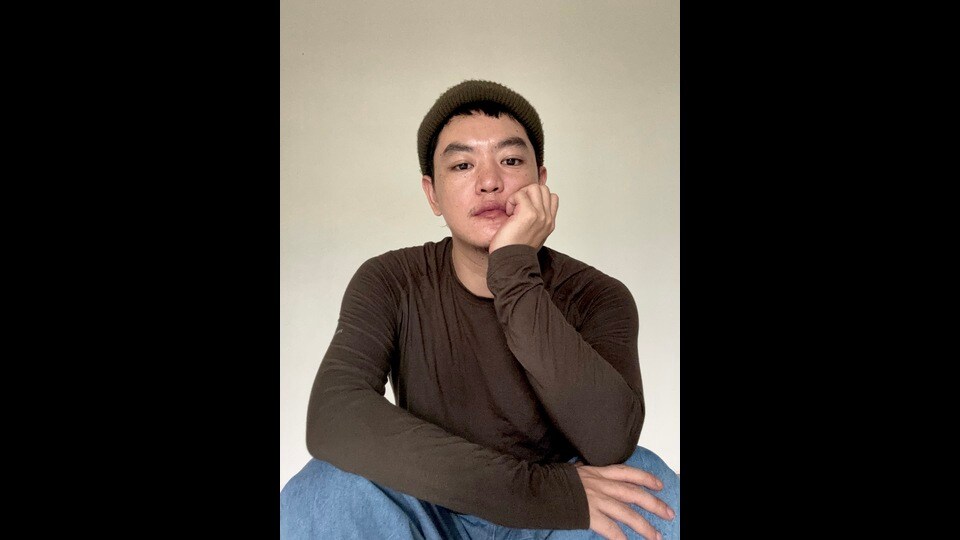
Illustrator Ogin Nayam (Courtesy the subject)
Winning the Mehlli Gobhai Award and getting shortlisted for the Neev Book Award has given me a sense of validation and encouragement. While growing up, I had no idea what picture books were. I did not know that one could be an illustrator and taken seriously. I owe my whole career to Pratham Books. We have had a beautiful journey, and made several books including Asamo, Is That You?, The Travelling Bug, The Tiffin Gang, This is How I Draw.
As a self-taught artist, who learnt from YouTube, I feel grateful that I get to do this work.
At the Neev Literature Festival, I heard you telling children that they must feel free to interpret your art in any way. Many artists struggle with letting go of the desire to control how audiences respond to their work. How do you distance yourself from your art?
I listen to a lot of podcasts while working on my illustrations. Once I heard an author saying that, when a reader buys a book, it becomes theirs. I go by that philosophy. I am, intrinsically, a chill person. I am not very uptight, and this works well for me and for others.
Children are far more imaginative than I am and the interpretations that they come up with are a lot more intelligent than mine. I don’t mind how they react to what I have created. I welcome it.
₹92; Pratham Books
While interacting with children, one is surprised at times by how deeply they engage with images at the literal, symbolic, and metaphorical levels. What are some of the delightful or shocking ways in which they have responded to When the Sun Sets?
I am super introverted, and I do not function very well in public places, so I have had very few interactions with children around the book. When I was asked to speak at the White Owl Literature Festival in Nagaland, I felt this crippling fear of public speaking but my illustrator friends Canato Jimo and Pankaj Saikia were going to be there so I thought that they would be my pillars of support. Once I reached, I realised that everyone was nervous to some extent. That helped me calm down. I was relieved that I was not the only uncomfortable one.
The children that I interacted with, both in Nagaland, and at the Neev Literature Festival in Bengaluru, had no problem with the sun in my book being female. This is usually something that confuses adults, who have very fixed ideas about the gender of the sun, who, according to them, is male. The children were fascinated with my visual language, and they took to it quite easily.
During one of my sessions, I divided the children into groups and gave one copy of the book to each table. They were asked to write the story based on the images. At the end, we had four different stories. Some of them interpreted the clouds as sheep, and the rainbow as a monster. I did not feel any compulsion to correct them because I do not see any interpretation as wrong.
How did you come up with the visual language for this book?
Initially, I saw the whole story as a short film in my head. It was very melancholic in terms of the tone and the feel. There were no characters in it other than the sun. I thought of the sun as alone but not lonely. Apart from my art director Canato, I got constructive feedback from Bijal Vachharajani, who commissioned the book, and Radhika Shenoy, who edited the book.
The conversations with them helped me populate the universe of the book with more characters. I thought, “Whom would the sun hang out with?” That’s how the rainbow came in. I wondered, “When the sun needs a break from work, who can help out?” That’s when the clouds entered the story. You might wonder why the clouds in my book wear sweaters. My sister is the inspiration behind this. I remember how she cried when her sweater once went missing. That made me create a back story in my head where clouds cry when they lose their sweaters, and it rains.
I was struck by your depiction of the sun as a goddess who enjoys working at her day job, wearing jewellery, looking at herself in the mirror, braiding her hair, knitting and reading. How do you look back at the process that went into creating this? Were you led primarily by your thoughts, hands, the materials that you worked with, or your intuition?
I get a lot of applause for depicting the sun as a woman. In Arunachal Pradesh, where I grew up, there are a lot of tribes with their own myths, legends and folktales. I was raised with stories where the sun was depicted as a woman because the focus of the storytellers was on the sun’s nurturing qualities. It is because of the sun that we can grow crops and have food to eat.
I gave her a necktie to indicate that she is on official duty. Also, when she is at work, she wears a mask because people do put on a professional persona when they go to their workplace. I gave her silver jewellery to wear because I thought the sun needed something to keep her calm. Having her do house chores felt natural when I decided to show her in a private setting.
When we visit somebody’s house, we often see photo frames celebrating their loved ones, so I thought of having a wall where the sun’s favourite yellow things are put out on display. The house where she lives is the kind of house that I would like to live in. The windows are inspired from the jharokhas that I saw on a trip to Jaipur. Her bedroom is based on a place I saw in Fort Kochi. The architecture, clothes and accessories show influences from Arunachal Pradesh.
You could say that I was led by who I am, and how I perceive the world. I do not underestimate the intelligence of children, so I do not agree with the idea that creating books for children is all about dumbing things down. They are highly creative and critical, if adults let them be.
Living in a country with plenty of sunlight, one often takes the sun for granted but your book makes one pause and think about the sun from a completely new perspective. How do you feel when your readers’ eyes sparkle with the joy of discovery?
I am a biotechnology student who loves fantasy. I do not like reading non-fiction, so I don’t make illustrations that people can look at and say, “Hey, that’s me!” I am not too interested in day-to-day life, or in representing a particular region. I tend to like the world of make-believe. And I want to create worlds where readers can enter, immerse themselves, and get completely lost. If they go back with a fresh perspective, that is the best compliment for me as an illustrator.
Your artist bio mentions that you love working in the company of the moon, and sleeping when the sun is out. Any thoughts on a sequel with the moon as your protagonist?
I have been in conversation with Pratham Books about doing a moon book. I don’t see it happening anytime soon. It will happen organically when I sit and daydream. I cannot force a book out of myself. I respect the creative process, and find a lot of joy in it. It cannot be rushed.
Chintan Girish Modi writes about books, films, art and music. He can be reached @chintanwriting on Instagram and X.
Explore the latest Books News, author interviews, book reviews, literary events and new releases. Discover recommendations, reading lists and updates from the world of literature on Hindustan Times.
Home/Books/Ogin Nayam: “I Am Not A Writer And Do Not Want To Pretend To Be One”

 E-Paper