
 E-Paper



Report: Jaipur Literature Festival 2026
Apart from musical performances, art exhibits and the festival bazaar, the event had a range of discussions that brought together literary and cultural voices from across geographical and linguistic contexts

 Prefer HTon Google


It is a truth, now universally acknowledged, that not a single reader in possession of caste and class privilege in India must ever be in want of a literary festival to attend. The Indian literati recently went up in arms against an international publication for suggesting that this country doesn’t have enough readers to justify the number of literary festivals held here annually. The now-altered article (they changed the clickbaity headline) came across as a condescending judgement passed by the self-proclaimed literary (read colonial) centre of the world, London. It also revealed a limited understanding of the readership in a country as diverse as ours. The point of this piece is not to add to the debate but to provide an insight into the latest edition of the festival that has endured the longest (the now infamous article referred to it as the ‘T-Rex of them all’), the Jaipur Literature Festival. This year, the event that has launched a thousand controversies in the course of its existence was held at the Clarks Amer, Jaipur, from January 15 to 19. About 400,000 people attended with “over 44,000 books” being sold according to a statement on X by author and festival co-producer William Dalrymple.
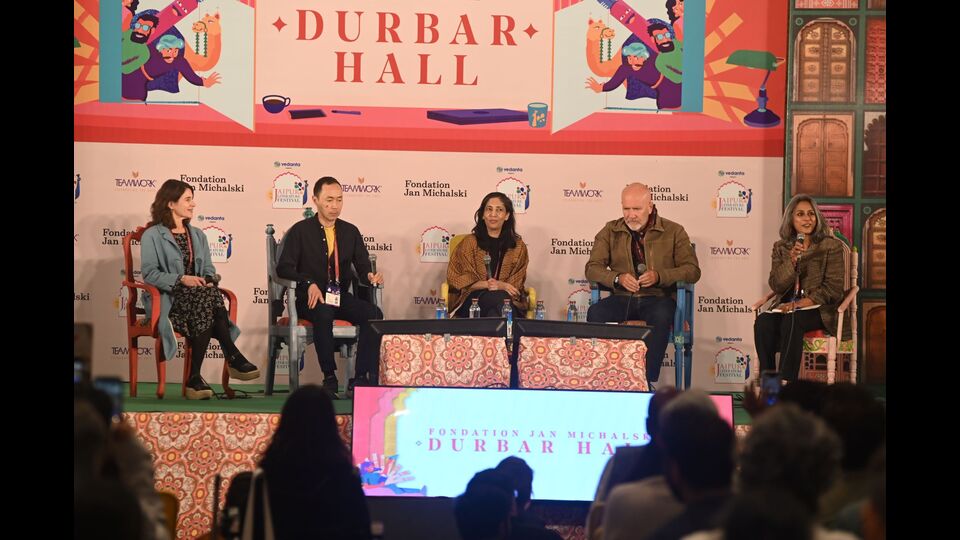

Apart from musical performances, art exhibits and the festival bazaar, the main draw for this writer, who has been covering the event since 2016, was the diversity of the panel discussions that brought together literary and cultural voices from across geographical and linguistic contexts. Recurring panels like Where Does Fiction Come From had celebrity authors discussing their writing processes, inspirations and publishing journeys. This year, the panel included Kiran Desai, Tash Aw, Richard Flanagan and Esther Freud in a conversation moderated by Anuradha Roy. Attendees stuck around for the panel which was rescheduled twice and finally held in the evening of the second day. This perseverance can be ascribed to Percival Everett’s online presence. In fact, sections of the audience insisted he be given more time to speak as the panel discussed everything from hilarious anecdotes to contentious literary categorizations such as ‘autofiction’.
This year, another annually recurring panel, Hyphenated Worlds, which brings together writers who occupy more than one linguistic sphere, included Vivek Shanbhag and Rita Kothari with Arunava Sinha as moderator. The discussion quickly turned into an analysis of translation practices in the contemporary world and of publishing in late-stage capitalism. Shanbag raised important questions on what the term “good translation” implies. “Good for whom?” he asked; for the Anglophone readership in India, for those reading abroad, or for the regional literary landscape as a whole? Kothari noted that a gharelupan (sense of intimate familiarity) has been discarded from translation for “neoliberalness”.
Despite being held on a Sunday morning, Accelerations: Days of Future Past, which featured Ali Eslami (Google DeepMind), politician Palanivel Thiaga Rajan and mathematician Marcus du Sautoy in conversation with Meru Gokhale, on the future and uses of AI and also the possibility of universal basic income in India, was very well attended. Eslami noted that “society has gone through similar revolutions before” and that a greater engagement with history is required to gain a better sense of where civilisation may be headed. du Sautoy compared the fear mongering that drives anti-immigrant rhetoric in Global North cityscapes to the rhetoric of resistance to AI, suggesting that a lack of awareness was behind both. Other dissonant moments during panel sessions included Pallavi Aiyyar aligning caste discrimination with passport discrimination during a conversation with Hanako Footman (moderated by Shunali Khullar Shroff) and Dalrymple skirting William Sieghart’s question on anti-Semitism being a European invention during a politically-charged session on Coexistence: How Arabs and Jews Can Live Together that included Ussama Makdisi and Noa Avishag Schnall.
There were brilliant sessions dedicated to Palestine, where activists and writers such as Schnall, who was a part of the Freedom Flotilla Coalition (she was aboard the Conscience) and Lena Khalaf Tuffaha spoke at length on the ongoing genocide.
Other strong sessions included the one featuring Volga and Salma discussing their journeys as authors who exercised activism not just through their books but in their lives as the latter did when she chose to write despite facing death threats. A session featuring Vrinda Grover, Ketu Shah and Ashwani Kumar and moderated by Sudha Sadanand discussed the cases of Umar Khalid and Sharjeel Imam. A panel on Gen Z as a social category had podcaster and author Anurag Minus Verma noting that though members of the cohort may lead protests even in India - for instance, during paper leaks in some states – these events haven’t been “aesthetic enough for widespread media coverage”.
Literature’s ability to foster human connection was a recurring theme. A session moderated by Karuna Ezara Parikh had Sumanto Chattopadhyay reading from William Sieghart’s poetry and the latter speaking about his Poetry Pharmacy initiative, which has him prescribing poems for various human ailments. He spoke about the power of poetry to make sense of loss, particularly in a post pandemic world. At the end, there was barely a dry eye in the audience. Another therapeutic session was A Home in the Himalayas, which had Anuradha Roy and Stephen Alter discussing how silence in the mountains is not for everyone and how nature enables writing and art.

As always, celebrity sessions drew large crowds. One had Kiran Desai speaking about her Booker shortlisted The Loneliness of Sonia and Sunny and how, like a worker bee, she views writing as a daily act of discipline. While she proclaimed that “literature gives us a vocabulary for our own lives”, Stephen Fry spoke of how “language” has been his “salvation”. Other popular draws included Vir Das and his double (sometimes triple) entendres and Javed Akhtar being his articulate self.
With a lineup that was somewhat light on celebrity authors this year, JLF 2026 did present important conversations though it steered clear of contentious discussions pertaining to national politics. The festival ended with a debate that explored the question of free speech being a dangerous idea. The topic emerged from Faramerz Dabhoiwala’s What is Free Speech? The History of a Dangerous Idea. The historian, who was one of the participants, did not take an active stance for or against the motion. This concluding activity was moderated by Vir Sanghvi, who maintained that “sometimes dissent can be dangerous” but “it’s worth it”. Hopefully, this impulse will be more pronounced in the 20th edition of the festival, next year.
Simar Bhasin is a literary critic and research scholar who lives in Delhi. Her essay ‘A Qissa of Resistance: Desire and Dissent in Selma Dabbagh’s Short Fiction’ was awarded ‘Highly Commended’ by the Wasafiri Essay Prize 2024.


