
 E-Paper



Review: A Secret History of Compassion by Paul Zacharia
The freewheeling conversations on Marxism, religion and sex in A Secret History of Compassion are conduits of compassion


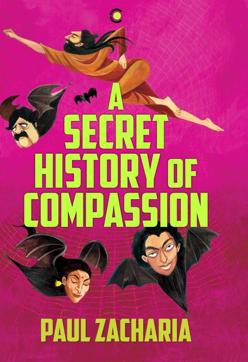
The reviews for Paul Zacharia’s A Secret History of Compassion are overwhelmingly deferential. Some reviewers imply they were just a bit befuddled by the text. Some praise its heavyweight intellectualism but warn readers against density, as if to say, “I chuckled at every single esoteric reference in the 431 pages of this novel, all of which I instantaneously understood. But it’s not for philistine Indian readers, no, you may not get it.” One actually went on to specify that it “would choke the brains of a millennial reader even if she is a student of art and literature.”
A Secret History of Compassion is a ridiculously clever novel – too clever for its own good. It’s about a writer, a philosopher and a hangman collaborating to write an essay.
Spider, a famous, best-selling novelist, is asked to write an essay on compassion, by the communist party. He’s anxious about making the Paradigm Shift from Fiction to Non Fiction, from Imagination to Thought. “Rosi, can we make love tonight in such a manner as to compel the universe to force upon my life a turning point – a major shift to non-fiction?” he asks his wife Rosi, a long time freelance philosopher. She tells him to just write, to “penetrate the communist philosophy of lovemaking.” Lovemaking, she says, is essentially fiction.
Read more: Review: Tell Her Everything by Mirza Waheed
This is a great setting for literary nonsense – the genre of fiction in which anything can happen. And it does. A crow flies into Spider’s study. It is a shape-shifting hangman called Jesus Lambodara Pillai, an obsequious admirer of Spider’s work, who usually metamorphoses into a bat and sees the world upside down. He showed up to learn the art of writing fiction and is roped into collaborating on the essay.
Two thirds of the novel is a freewheeling conversation between these two idiotic men talking about Marxism, religion and sex, often as conduits of compassion. They meet a bunch of madcap characters and tell each other about others – there’s Mary who wants to discuss her divorce settlement, her scientist husband, a bull called Tarzan, a snake who was “one of the greatest fathers alive,” Stalin who was a woman, God who is a woman, Jesus… They also talk excessively about breasts, erections, virginity, sex, women’s bodies in general – Rosi’s especially.
Zacharia is a prominent writer who has received the Kendra Sahitya Akademi and the Kerala Sahitya Akademi awards for his fiction. He is also an established journalist. Until this book, which is his first fictional work in English, he wrote short stories and novellas in Malayalam, and non-fiction in English.
He began writing this in Malayalam in 2005 but later realized it was meant to be written in English. He felt self conscious about writing in Malayalam because the language “has a way of demeaning sex,” he has said in interviews, and that the humour of this novel may not work in Malayalam.
It doesn’t quite work in English either. It is presumptuous to think that the objectification of women’s bodies and concepts of sexuality are somehow sanitized in English. In several instances, the explicitness – Pillai, a “meditative voyeur,” describing Rosi oiling her body, Spider lusting after women in his family, including the naked body of a dead sister-in-law – is cringe worthy.

The other problem is size. Several sections of the novel, especially the beginning and the end, are sublime. The long parts in the middle weigh the whole thing down.
There is humour in the insights into ideology. Take the exchanges between Spider and a scientist: “Are you a self-made Marxist or man-made?” “Oh, I think I’m a scientifically-constituted Marxist,” the scientist says. “I’m home-made,” Spider says. And into the insanity of our times: “Pillai said he wondered if the cameras were experiencing eschatological anxiety, because once the world ended, they would have nothing to shoot. So they were shooting everything before the End of Days.”
But this is insufficient to sustain interest through the length of the novel. Or maybe it is just that the novel dips whenever Rosi disappears – because it picks up later when she joins them to finish the essay.
When they’re done, she says – and this is a review of the novel in two sentences as well – “I can’t say I understand what it means, but it sounds impressive. I think it has the capability to shake up those comrades who will read the essay to the end.”


