
 E-Paper



Review: Boats in a Storm by Kalyani Ramnath
Documenting the experiences of people whose lives were upended by legal and political changes in the wake of the decolonization of South and Southeast Asia

 Prefer HTon Google


When Ceylon (Sri Lanka today) became independent in 1948, a law passed that year did not recognise about 800,000 people of Tamil Indian origin as citizens, even though many had lived there for most of their lives. A new citizenship act in 1949 provided the community, comprising a tenth of the country’s population at the time, an opportunity to claim their rights.
However, the burden of legal proof was so high that few could fulfil it. They had to build a paperwork trail from years ago — when there was no concept of nation-states in the region, nor the need to prove belonging. Many furnished extensive proof of residence and employment, but the State often declared these inadequate. The new law brought into scrutiny past actions and decisions: why they travelled, sent money abroad, or preserved receipts for certain purchases but not others. A Member of Parliament claimed that even Dudley Senanayake, a statesman who would go on to become Ceylon’s Prime Minister, would not be able to prove his citizenship, given the law’s demanding requirements.
After years of legal wrangling, most found their applications denied. By the 1960s, more than half of them had been sent to south India. Having lived most of their lives in Ceylon, many had few links to the region and also encountered hostility there. The rest remained stateless or internally displaced in Ceylon and even faced violence.
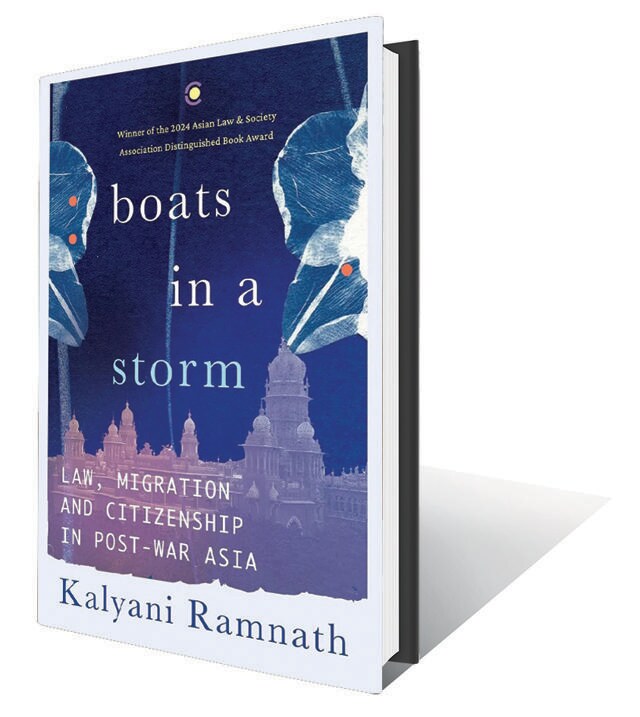
However, this was not an anomaly. In her book Boats in a Storm: Law, Migration and Citizenship in Post-War Asia, Kalyani Ramnath documents the experiences of people whose lives were upended by legal and political changes as South and Southeast Asian countries decolonised.
Under the British empire, merchants, bankers, and labourers freely travelled across India, Ceylon, and Burma, among other territories, for work and trade. As a result, economic and familial ties spread across regions.
The Japanese invasion during World War II and the subsequent independence of countries from British rule disrupted their way of life. As many Asian nations became sovereign, the arbitrary drawing up of borders and efforts to construct a national identity turned residents into outsiders overnight.
Ramnath delineates this phenomenon through people’s encounters with the law — while filing taxes, collecting debts, remitting money to relatives, or navigating paperwork. Her research is expansive and her narrative-building cogent. Given the lack of comprehensive, catalogued legal records, the range of sources she delves into to piece together histories is impressive.
Although legal issues (taxation, immigration, detention, etc) rather than litigant types (labourers, traders, etc) form the book’s organising principle, there is some overlap between the two. So, while the chapter Tax Receipts is about taxation laws, it largely focuses on the Nattukottai Chettiars, a Tamil mercantile community whose significant assets and financial networks made their tax revenues much sought after. Perhaps as a result of this structure, some of the book’s earlier sections seem reiterative. Subsequent chapters, however, are more streamlined.
The discussion of various affected groups highlights how experiences differed across class lines. Although the laws impacted several immigrant or minority groups, the Chettiar traders had better negotiating power and access to legal resources as compared to, say, plantation workers in Ceylon.
Ramnath brings to the forefront stories that are not acknowledged in the triumphalist histories of decolonising nations. As these countries charted their own, separate destinies and tried to build solidarity with each other through initiatives such as the Non-Aligned Movement, they forsook aspects of their shared histories. The casualties were the hundreds of thousands of people who did not fit their narrow conceptions of nationhood.
The book focuses on the period from 1942 to 1962. While the legal issues and regimes have changed since then, the schisms riven during that time continue to have ramifications. The Biharis who had moved to East Pakistan (now Bangladesh) during the Partition of India were stateless for decades. While a 2008 court ruling granted citizenship to many, others remain stateless, live in refugee camps, or face persecution. What Ceylon did in 1948, Bhutan replicated in 1985. A discriminatory citizenship act paved the way for the ethnic cleansing of people of Nepalese descent — about a sixth of the country’s population. So, along with the “Land of Happiness”, Bhutan has also been dubbed as the “world’s biggest creator of refugees per capita”.
There are other instances too where Ramnath’s historical account foreshadows the present. As Ceylon made Indian-origin people plod through paperwork, workers in Malaya and Singapore were being deported to India on the suspicion of harbouring Communist sympathies. While they were of Indian origin, many of them had never been to the country. In India, they were imprisoned for their supposed political leanings, despite it not being a legally valid ground for detention.

“Trials do harm because of the publicity that accompanies them and the martyrs they make… Detention without trial is therefore the remedy.” This statement was made by the Colonial Office in London in 1948 and yet, it seems to be a guiding practice in many countries that have avowedly decolonised.
Ramnath writes that a straight line cannot and should not be drawn from 1942 to the present. Her revelatory scholarship, however, draws a tapestry of lines, illuminating overlooked stories, our complex past, and its afterlife in the present.
The narratives around migration have largely been unidimensional, featuring people of colour, mostly poor, moving from the Global South to the richer, Whiter Global North. But the reality is — and has historically been — more diverse and multidirectional. A blindness to facts is why countries built by migrants after decimating indigenous populations now harp on stopping immigration to preserve their culture. Or why people from rich countries who move abroad insist on calling themselves expats and others immigrants.
Many museums, especially in Europe, are questioning received ideas about migration and belonging, such as the Red Star Line museum in Antwerp, the Ghent City Museum, and Fenix in Rotterdam. Amitav Ghosh’s Gun Island looks at contemporary migration through the lenses of historical trade routes, colonialism, and the ecological crisis the latter precipitated. In a similar vein, Boats in a Storm invites us to question whom we consider a migrant, whom a native, and how these categories can arbitrarily change contours.
Syed Saad Ahmed is a Boston Congress of Public Health Thought Leadership Fellow 2024. He speaks five languages and has taught English in France.


