
 E-Paper



Review: Hug Yourself; Body Positivity and Empowerment Stories for Teenagers
Edited by Vinitha, this new book, that deals with body hair, colourism, size discrimination and more, helps teen girls tackle body image issues

 Prefer HTon Google


I have always been fat and people have never ceased to remind me of it. The barbs came from my own parents, from fellow students and teachers, and random strangers on the road. For much of my teen years, I hated my body – hated how it pleated and folded; hated how it developed earlier than those of my peers. It was a difficult time. The Anglo-Saxons called one’s body one’s flesh-house; it’s difficult to live in a house you hate.
But there were two great saving graces: one, that I could go home and be safe in my own space; and two, that there were books that helped me. I have fond memories of walking into a Scholastic book fair at school, eagerly buying half a dozen or so books at a time, and then rushing home to start reading immediately.
And that’s how I found books such as Chicken Soup for the Teenage Soul: Stories of Life, Love and Learning by Jack Canfield, Mark Victor Hansen, and Kimberly Kirberger, and No Body’s Perfect, also by Kirberger. They were non-fiction anthologies of books by “real” teens – albeit American ones – who went through many of the same issues as I did. They were somewhat like today’s influencers, who talk about body positivity on social media, and they spoke directly to me about an issue that wounded me every day. All this was in the aughts when social media wasn’t really a thing in India.
In today’s world, however, all our spaces overlap. We carry both the loving voices and the hateful ones on social media right into our bedrooms, via that rectangular screen in our pockets – our phones. Bullying doesn’t end at home; social media amplifies the hate as much as it amplifies the comfort. What is a teen, acutely conscious of their body and how they present it to the world, to do?
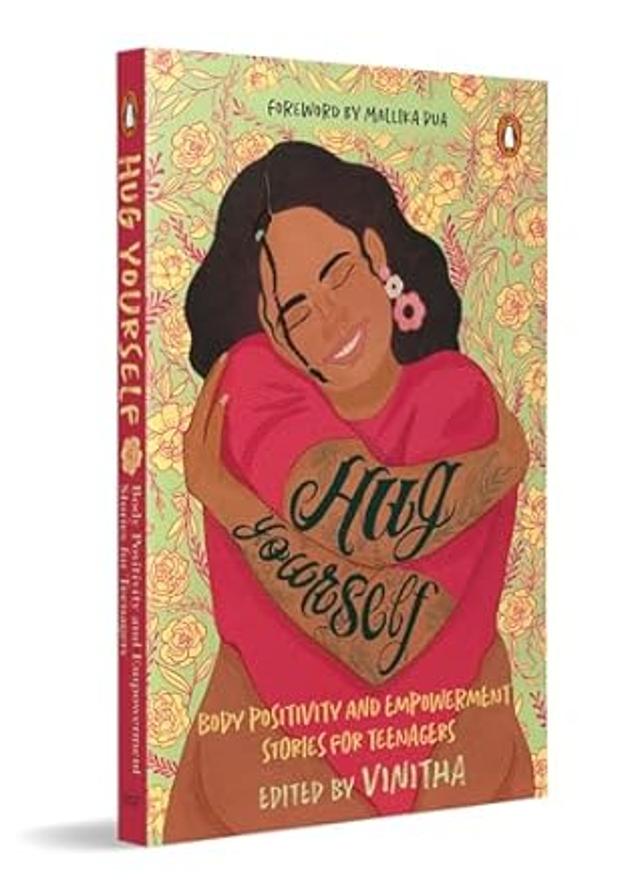
This is the question that Hug Yourself: Body Positivity and Empowerment Stories for Teenagers tries to answer.
Compiled by award-winning author, journalist and editor Vinitha, this anthology of 16 stories addresses issues such as colourism, fat-shaming, acne scars and body hair – things that can undermine a teenage girl’s self-confidence faster than you can say “beauty standards”. The mostly fictional pieces of prose, poetry and graphic novellas aim to empower the reader to face an unkind world with pride and joy. Vinitha conceived of this book during a chat with a friend, when they realised how difficult it is for teenaged girls to deal with their insecurities, and how, in India, very few books have really tackled this issue head-on.
Several stories stand out. The second in the collection, Anuja Chandramouli’s Fatty Batty and The Fat Demon is one of them. This is a first-person narrative that captures the harshness with which teenage girls think of themselves: “I am the only Fatty Batty… who might be attacked for the crime of corpulence… with pitchforks and flaming torches,” says the heroine. It sharply counteracts the light-heartedness of the first story in book, Neha Singh’s contribution, which deals with the issue of teenage girls getting groomed online. It will seem familiar to teen readers, many of whom have probably had adult men sliding into their DMs.
Janani Balaji’s Raw, about acne scars, is another beautifully written standout, with prose that seems almost melodious. “Home is any place where I’m not in this skin,” says Balaji’s protagonist. Her anxiety attack and self-soothing is viscerally described, as is the only triumph she can claim in that moment: “I am struggle itself, but I am alive.”
Nandini Nayar’s Life in the Headlines captures a narrative similar to Chandramouli’s – the story of a girl whose worth is questioned due to her being fat. But while Chandramouli’s protagonist is all thorns and barbs towards herself, Nayar’s Shalu is tormented by classmates and teachers. It is within these forces that she finds her salvation, too – when her new friends stand up against the bullying she experiences. The story has a slightly feel-good Utopian ending, but why shouldn’t our stories end the same way we wish real life did?
Raaga, the main character in Rajani Thindiath’s Sinking Into My Skin, battles an eczema-like condition that causes dry, itchy skin; her family cannot afford a moisturiser to help her. She finds release in dance and notices how the judgemental eyes she feared only focus on her rhythm and grace. Santhini Govindan’s This Isn’t Fair shows a grandmother overcoming her own ugly memories of being bullied by elders for her skin colour and athleticism, to support her loving, headstrong granddaughter’s dreams.
Perhaps the most striking of all the stories is the one that’s told through both words and pictures: Suha Riyaz Khopatkar’s Darken My Kajal. The black and white illustrations tell the story of a fifteen-year-old girl struggling to come to terms with a body that is more grown-up than she feels, and that brings her attention that she enjoys and reviles by turns. Like many girls, she attaches a lot of worth to her looks, and yet feels shame for doing so. “Why am I filled with shame?” she asks. “How is this my fault?”
There were a few misses in the book in terms of who it was aimed at. Although its focus on girls makes sense as the violence against girls is non-stop and extremely visible, body image issues also affect growing boys, queer people and the disabled, who are regularly harassed due to their appearance. A boy who prefers to present in a feminine way gets teased and is sometimes subjected to physical and verbal violence. Girls who are tomboys and present in a masculine way experience bullying for not being feminine enough.
Apart from the ‘right’ way to perform gender, there’s also the ‘right’ way to be a gender – a boy not being tall or athletic leads to bullying; a tall or broad-shouldered girl is laughed at. This is especially harmful for teenagers who realise they may be part of the LGBTQIA+ community. And this is not even counting those who look truly different – someone in a wheelchair, for example, or someone with Down’s Syndrome.
Vinitha, during our chat, says that when she put the call out for stories, none from these perspectives arrived. To bring queer representation, the editors asked Shals Mahajan to write. And clearly, there are “innumerable narratives that could go in this space,” she adds. “I think books should just be able to start conversations. And I think this is a great starting point.”
Even as I think a lot more work needs to be done – I would agree.
Rush Mukherjee is an independent journalist based in Kolkata.


