
 E-Paper



Review: I’m Not Lazy, I’m On Energy Saving Mode by Dancing Snail
The latest book by the South Korean author and illustrator known only by their whimsical pseudonym gives the reader emotional validation but also a lot of misguided advice

 Prefer HTon Google


In the Korean bestseller I’m Not Lazy, I’m On Energy Saving Mode (translated by Clare Richards), Dancing Snail writes prose with the aim of making mental health struggles visible and legible. The text is punctuated by cutesy illustrations that outline the dichotomy of mental illness — the urge to simultaneously go out and stay at home, or the urge to be productive all while procrastinating. The illustrations, though charming, are frequently simplistic. Their origin on the author’s Instagram — and subsequent compilation into book form — raises the question of whether the shift in medium has diluted their impact, or whether that impact was limited to begin with.

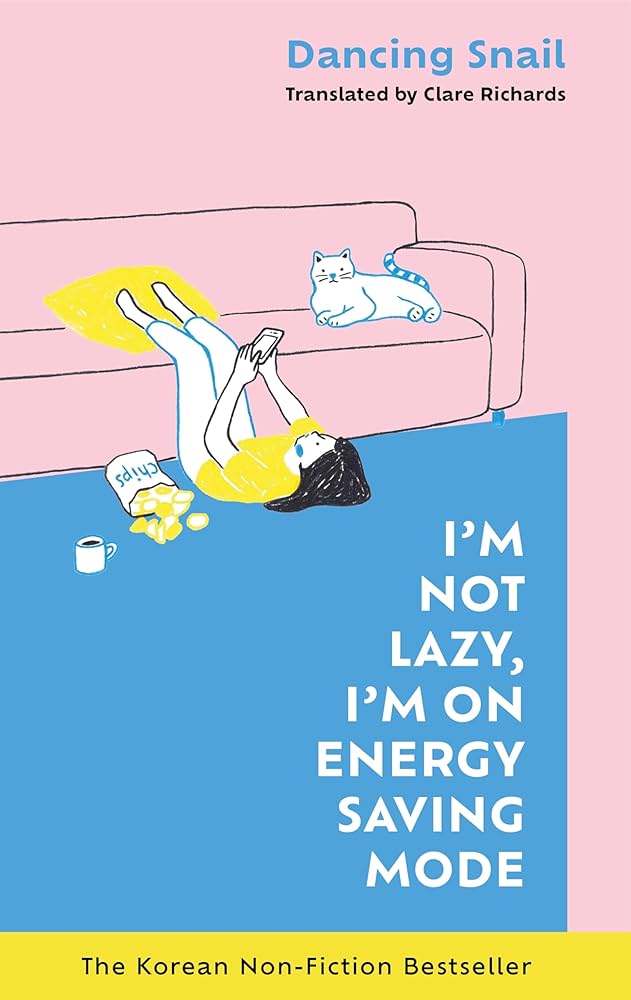
In the book, Dancing Snail talks plenty about mental health struggles but is careful not to assign diagnoses to any of them. In the chapter where she discusses her compulsion to keep her phone battery to 100%, she is careful not to use the term OCD. This reluctance to pathologize feelings and emotions seems intentional rather than incidental — and for good reason. Books, after all, cannot replace therapy. They can come close — as this book does — to helping readers identify their triggers and patterns. But can a book help readers grow out of these patterns over time? This critic feels otherwise.
To be fair, the book isn’t exactly positioned as a mental health guide or even self-help. Neither does the author claim to be a mental health expert. On a spectrum that runs from light-touch reassurance to structured intervention, the book sits firmly in the former camp. It will give you emotional validation but to expect actionable steps on bettering your mental health condition would lead to disappointment.
You see, even the best self-help books have their limitations. They can certainly scratch the surface of the giant water body that is your trauma but can they swim in the deep end? I’m Not Lazy, I’m On Energy Saving Mode functions more as a companion than a guide. It helps readers arrive at the truth (identification) and stop fighting it (acceptance), but it stops short of offering concrete steps toward the next crucial stage: integration — learning to live with these realities without allowing them to define you.
Some of the advice that the author offers seems surface-level, at times even bordering on toxic positivity. In Part One, Dancing Snail writes about “using negative emotion to our advantage” where she makes a case for “using the negative emotions triggered by unpleasant situations as motivation”. To view negative emotions as fuel for motivation and as a state of mind that can be programmed to one’s advantage seems entirely counter-productive, at best. At worst, it is misguided and aligns perfectly with the hustle culture where everything has to be optimized and gamified. Forcing a positive spin to something downright negative is rarely helpful. More often, it is futile.
In the same section, the author advises processing negative emotions so they don’t pile up but doesn’t explain how to process those emotions. The intent is good, the direction is broadly correct but the solution fails to account for the practical realities of living in a world that doesn’t offer you time to think or feel your emotions.
A lot of the advice is also misguided. At one point, the author point blank encourages readers to blame others instead of being critical towards themselves. There is no missing context here, nor is this a bad-faith reading. The advice appears in a section titled “blaming others is better than self-reproach” where the author argues exactly that. It may indeed be correct to seek external accountability instead of being self-critical in scenarios that call for it, but to state this as general advice, though well-intentioned, feels outright reductive if not harmful.
At times, it felt as if I wasn’t reading a Korean bestseller but an Indian uncle’s WhatsApp forward that asks “Are you sad? Be happy”. The book retains a moralistic and preachy tone throughout without offering the depth or the nuance that goes into navigating the genuine complexities of life. While there are several pitfalls of the self-help genre, the book doesn’t work even on its own terms: the advice is so generic and context-blind that it proves largely unhelpful, despite the reader’s sophistication.
One piece of advice that fits all approaches doesn’t work. It ignores the practical reality that all our needs are deeply individual and this fact is entirely lost on the author. Don’t take the advice in I’m Not Lazy, I’m On Energy Saving Mode with a grain but rather a bag of salt. And then some more. That the book doesn’t have a disclaimer that it shouldn’t be used as a replacement for Cognitive Behavioural Therapy doesn’t help its cause.
Deepansh Duggal writes on art and culture. He tweets at Deepansh75.


