
 E-Paper



Review: India-Pakistan Relations: A Saga of Unending Disputes by Satish Chandra
This book is a concise compendium of issues like terrorism and disputes over evacuee property that continue to bedevil the relationship between the two countries

 Prefer HTon Google


India-Pakistan Relations by Satish Chandra, aptly subtitled A Saga of Unending Disputes, is very timely. Its 18 chapters cover all the key issues that have bedevilled bilateral relations, some since 1947. Many books have been written on Pakistan by erudite scholars and diplomats but this one stands out for being a concise and easy-to-read compendium of issues ranging from Jammu and Kashmir, the sharing of river waters and terrorism to lesser explored subjects such as the disputes over Junagadh, Hyderabad, evacuee property including Jinnah House in Mumbai, Rann of Kutch and the No War Declaration. Interestingly, the book also covers topics that are not bilateral in nature but are significant for a better understanding of Pakistan’s duplicitous actions on key issues such as the merger under duress of the State of Kalat, the saga of amalgamation of the NWFP (now Kyber Pakhtunkhwa) with Pakistan, and the appalling treatment of the country’s minorities.
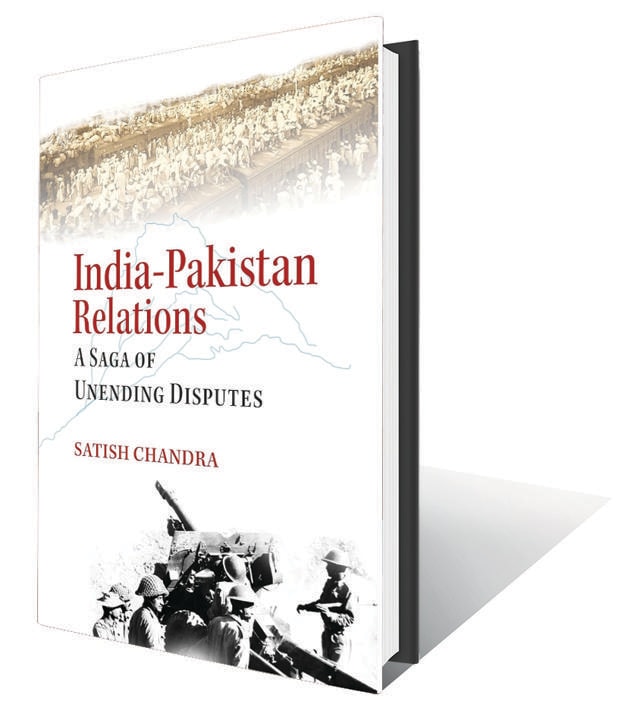
Satish Chandra’s vast experience in several key governmental positions including as the High Commissioner to Pakistan and the founding Secretary of the National Security Council Secretariat (NSCS) of India (in 1998, the erstwhile Joint Intelligence Committee (JIC) was restructured into the NSCS) places him in a distinctively unique position to review a relationship which is, by far, India’s most difficult to manage.
When I opened the book, the first page that presented itself happened to be one relating to the erstwhile principality of Mangrol, which, along with Babariawad, had acceded to India in 1947 even though Pakistan claimed it alongside Manavadar on the basis of specious claims made by the Nawab of Junagadh.
My family traces its origins to Mangrol on the coast of the Kathiawar peninsula. My grandfather Barrister CN Chinoy, the Dewan of Rajkot State in the late 1930s and during the early 1940s, often advised the Sheikh of Mangrol on state matters. We had close friendship with the Sheikh and his family. For the record, Major Mohammed Ali Raaz Sheikh of the 16 Light Cavalry, scion of the princely state of Mangrol, earned a Vir Chakra (posthumous) for bravery in action against enemy armour in the Sialkot Sector on 8 September 1965. I recall reading in Lt General (Retd) Harbaksh Singh’s memoirs that when he visited the hospital as GOC-in-C Western Command, a mortally wounded Major Mohammed Ali Raaz Sheikh tried to stiffen his body in a salute to his commander even as he lay there drawing his last few breaths. So much for Pakistan’s fantasy about a two-nation theory!
Junagadh too is covered in some detail. In April 1947, its Dewan, Khan Bahadur Abdul Kadir Mohammed Hussain, had repudiated allegations of Junagadh wanting to join Pakistan and an impression had been given that its constitutional adviser, Nabi Baksh, would advise the Nawab to accede to India. Significantly, it was in May 1947 when Sir Shah Nawaz Bhuttoo (Benazir’s grandfather) was appointed the Dewan and continued in that office during the crucial run-up to independence in mid-August, that Junagadh did a complete volte-face. Interestingly, the book states that after the Nawab fled to Pakistan, the Begum of Junagadh met India’s first High Commissioner to Pakistan, Sri Prakasa, to convey that her son wished to opt for India. She requested that he be installed as the Nawab. Delhi saw no merit in this idea, though in the case of the Nizam Mir Osman Ali Khan of Hyderabad the following year, after Operation Polo, he was brought into the political mainstream of independent India under a constitutional role, marking Hyderabad’s formal integration into the Indian Union. The difference in the two situations was that the Nizam had not fled India.
Operation Polo in Hyderabad was a great success and ended in the Nizam being allowed to return and continue as a constitutional head. The Commander of Operation Polo was none other than General Rajendrasinhji, later the first COAS.
There is a popular story in Junagadh. When the Nawab fled in the face of popular demonstrations led by Samaldas Gandhi (Mahatma Gandhi’s nephew), he not only left behind one of his begums who had to rush back from the tarmac at the last minute to collect her child but apparently filled her space with one of his favourite dogs. Clearly, the Begum was not among the favourites of the eccentric Nawab Muhammad Mahabat Khanji III. The author writes that his interest in Junagadh after fleeing centered exclusively around the fate of the many dogs he left behind. When India’s representatives entered the Nawab’s palace they found “a dog on every chair of the drawing room”.
The story of Jammu and Kashmir and its accession to India is well known but the bias and prejudice of Western powers needs to be retold for the record. After Pakistan made a counter complaint to the UN Secretary General, the UNSC changed the agenda item from one involving Pakistani Aggression to a wider India-Pakistan Question under which even UNCIP’s mandate was expanded to cover irrelevant issues such as Junagadh.
As an aside, Josef Korbel, the UNCIP Chairman and Madeleine Albright’s father, proved to be among the most prejudiced. This can be gauged from his book, Danger in Kashmir.
The author mentions that the presence of UNMOGIP in the subcontinent after the Shimla Agreement is completely unwarranted. A body set up to monitor the Ceasefire Line of 1949, it has had no locus standi once the CFL was converted to the Line of Control (LOC) through a bilateral agreement in 1972. Winding up UNMOGIP, however, is the sole prerogative of the UN Security Council and it has chosen not to do so acting due to vested interests. India has done well to deny any special privileges to UNMOGIP even as Pakistan curries favour with it.
The author narrates an extraordinary fact, how at a time when Pakistan was waging war against India in Kashmir after independence, the Reserve Bank of India paid ₹75 crores from its cash balances and a total of ₹228 crores (partly in pound sterling) from its Issue and Banking Departments to the aggressor. Mahatma Gandhi went on a fast to ensure that Pakistan’s demand was met, and the government of India caved in. Astonishingly, India also took over Pakistan’s pre-Partition debt and gave the latter the facility to repay it in 50 instalments from 1952 onwards. It is a different matter that the “mutilated, truncated and moth-eaten” state, as Jinnah himself described it in lament, reneged on its obligations.
Another irony of history pointed out by the author is that following the signing of the Kalat-Pakistan Standstill Agreement in 1947, the Kalat State invited India to enter into a similar agreement recognising its independence and requested Delhi to permit the establishment of a trade agency. In fact, Ghaus Baksh Bizzenjo, President of the Kalat State National Party met the President of the Indian National Congress, Maulana Abul Kalam Azad in Delhi to plead for help to retain its independence. Kalam agreed that Balochistan was an independent entity and never really a part of undivided India but advised that India could do nothing in the matter. The author lambasts the Congress’ line of thinking as “devoid of any sense of real politik”. Pakistan backtracked and later forced the Khan of Kalat through military coercion to sign the instrument of accession even as the Standstill Agreement remained operative.
The author narrates the many twists and turns of the NWFP saga, the important role of “Frontier Gandhi” Khan Abdul Gaffar Khan (also known as Badshah Khan), British chicanery, the Muslim League’s use of communal violence for territorial gain and the failure of the Congress to maintain its hold on the Province when it could have opted for India had its Legislative Assembly voted on this issue. He states that if Congress had not walked out of the provincial governments, thus severing Badshah Khan’s popular links with the people, the Muslim League would never have acquired the traction that it did with the support of officials like Olaf Caroe. Nehru eventually gave in to Mountbatten’s repeated exhortation to agree to a referendum in the NWFP on the issue of “Pakistan or the new India” and the rest is history!
The author details Pakistan’s appalling record of abusing its minorities since inception, especially the bulk of the exodus that took place from West Pakistan in 1947-48. The outflow from East Pakistan was gradual by contrast, peaking in 1971 when the Pakistani Army conducted genocide against the East Pakistanis, especially the Hindu minority. The author attributes the root cause to the politics of hatred and violence unleashed by the Muslim League and its two-nation theory. The perfidy of British officers fanned this sentiment.
The author avers that Pakistan is beyond redemption on this aspect and that it will spare no effort to undermine India, leaving the latter with little choice but to adopt punitive policies to deter Pak-sponsored terrorism. In his view, the disintegration of Pakistan in its present form is the only enduring solution to the problem.
The Chapter on Evacuee Property also throws new light on Jinnah’s properties particularly the specious claims made by Pakistan even as it was unwilling to accord justice to refugees that fled from Pakistan, particularly the property of Seth Shivratan Chandralal Mohatta in Karachi. Contrary to Pakistan’s duplicitous stand, India sought to work in the interest of the evacuees, irrespective of religion.
The Chapter on Financial and Commercial Issues reveals how ridiculous it was that India should inherit all the external debt of undivided India and also have to pay Pakistan more than a fair share of the Reserve Bank’s balances even as Pakistan was attacking Kashmir in 1948.
The chapter on the Rann of Kutch conflict is interesting. It is one of the few disputes that India agreed to subject to arbitration in the 1960s because Pakistan kept raking it up even though the alignment had been settled decades before between the Maharao of Kutch and Sind. I dealt with coastal security and the Harami Nala issue during my stint with the NSCS and have visited the disputed areas along the G-pillar line that stretches westwards from BoP 1175. Having secured India’s agreement to the alignment of the vertical line between BoP 1175 and BoP 1153, Pakistan challenged the horizontal G-pillar line to promote its own fiction of claims further eastwards in the Creek area.
On Durand Line, Satish Chandra has rightly underlined that the line was never clearly defined and the oft referred 1893 Agreement did not make it a sacrosanct international border. Soon after the departure of the British, the Afghans repudiated all the treaties made with them including the Durand Line and called for an independent Pakhtunistan. It was the only country that opposed Pakistan’s admission to the United Nations. None of the Afghan governments/regimes over the years, including the Taliban, have ever recognised the Durand Line. I was pleasantly surprised to see a reference attributed to me and a mention of ‘colonial cartographic caper’ used for the Durand Line issue.
Sujan Chinoy, a former ambassador, is the Director General of the Manohar Parrikar Institute for Defence Studies and Analyses)


