
 E-Paper



Review: The CEO Factory by Sudhir Sitapati
Sudhir Sitapati’s semi-autobiographical book shows that delegation and the freedom to chart its own course lie at the heart of HUL’s enormous success

 Prefer HTon Google



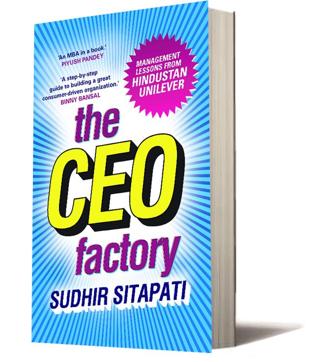
For a company that has always excelled in spotting new markets early, it is surprising that Hindustan Unilever (HUL) missed cashing in on what may well have been its most value-added opportunity – selling leaders to the world of business. Over 400 CEOs/CXOs who are now an integral part of Indian business have honed their skills in the HUL leadership foundry.
So when Sudhir Sitapati, two decades into the company that he nearly quit within months of joining, and now its executive director (foods and refreshments), offers that as the opening salvo of his semi-autobiographical book The CEO Factory, it seems like we are in for a dull recounting of a well-known fact.
Within the first few pages that notion is dispelled by the sheer depth of his enquiry into what makes this company so unique, one whose success transcends sheer numbers. Not that those are anything to sniff at for this is a company whose return on capital employed (ROCE), a measure of how efficiently it uses its capital, at 93% puts into the shade not just its peers in the consumer goods business but also firms in other industries. For comparison, TCS and Asian Paints, two of India’s best- run companies, have a ROCE of 45% and 31.2% respectively as of September 2019.
Sitapati, though, uses the numbers purely to provide context. His real aim is to lay out the process of forging these leaders. Right upfront he provides a gem, one which lies at the heart of why HUL has emerged as the jewel in its Anglo-Dutch parent’s crown. In the 1950s, Unilever chairman Geoffrey Heyworth felt that as Unilever expanded globally it needed “delegation to the end of the limbs”. That delegation and the freedom to chart its own course lie at the heart of the Indian subsidiary’s enormous success over the years. In terms of its sheer reach, it is a juggernaut that covers 1.5 million sales outlets across the country every week. You could push grains of sand through such a network. Except that HUL doesn’t do so. As Sitapati explains in his book, its massive distribution network gives the company an advantage in the market, but its core competence remains building great brands.
The CEO Factory is a systematic detailing of just how this is achieved every single day and what comes through is a company that has institutionalised change by carefully mapping every aspect of the product life cycle and yet allowed itself to remain flexible enough to respond rapidly to changes in the market.
It isn’t an easy task chronicling such an extensive framework, but the author does it adroitly and precisely. The outcome of his hard work is a real tour de force, a book so completely honest, insightful and well-written, that you wonder why the company hasn’t got into the publishing business.
Laced as it is with anecdotes, both personal and gleaned from conversations with the best people, it is difficult to slot this book into any specific category. There are some truly remarkable management lessons, pithily delivered. Sample this: “What matters is the quality the consumer gets and not the quality you design in the laboratory.” There are also some valuable tips on pricing some of which might seem preposterous to e-commerce companies. Gross margins, for instance, are sacrosanct at HUL and costs have to be constantly bent to ensure that, which is where ingenuity and innovation come in. Faced with the high cost of fabricating the caps of its many diverse bottles, the company just changed things around such that it used the same caps for differently shaped and sized bottles. It is one of the several deep insights the author slips into the book ostensibly about leadership.
Yet, just as you find yourself in danger of reading it like a management tome, a how-to book on marketing smarts, Sitapati, reveals a delightfully wicked turn of the phrase. For this is also a larrikin tale of inseminating cows in the villages of UP as well as the many travails of commuting by buses into the interiors of Tamil Nadu. For good measure, there are a few mother-in-law stories thrown in as well.

Sitapati also writes candidly about some of the idiosyncrasies of the company, the infamous carpet and tea rule for instance, in which promotees to a certain level were rewarded with these two goodies. He is equally candid in illustrating a point by turning the lens on his own company. Thus, a fascinating examination of the dynamics of pricing in volatile market conditions uses as an example a time when HUL got it horribly wrong.
While reading this book on a flight from Bengaluru to Delhi I wondered about the author’s affinity for popular Hindi film analogies to explain complex management issues until I looked around only to find several co-passengers watching Hindi films or film shows on their devices. Sitapati clearly knows the potential consumers of his book well enough!
Read more: Opinion | The hope for businesses that this decade might herald
What he succeeds in doing is to lay out a very nuanced understanding of leadership, one which differs from the great leader syndrome perpetrated by most MNCs. In the HUL scheme of things, understanding of the business at a granular level is the key to successful leadership.
It would be utterly appropriate if this book becomes a part of the course curriculum at the Indian Institute of Management, Ahmedabad, an institution Sitapati credits not just for being his alma mater but also one with which HUL itself has had a profound connection.
Sundeep Khanna is a business columnist and author. He was earlier the executive editor of Mint.


