In 2023, ethnic violence erupted between the Meiteis and the Kuki-Zo tribal community in Manipur. Since then, nearly 60,000 people have been internally displaced and 7894 homes have been destroyed. Despite the loss of lives and repeated violence, not enough attention has been paid to the issue. Such apathy is often attributed to the lack of connection between the North-Eastern states and “mainland” India. At such moments, it is fiction that can cross the borders of indifference and this is exactly what Jim Wungramyao Kasom’s The Last Free Naga, a collection of 12 short stories, does.
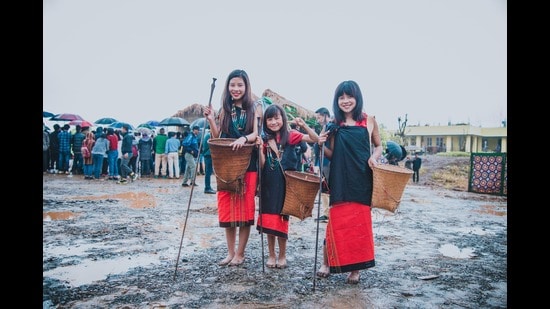
Set in Manipur in the 1990s, these stories describe the lives of Tangkhul Nagas living in remote villages. Back then, every parent wanted their child to study in boarding schools in the hill district headquarters of Ukhrul and grow up to be a government officer. Nagas have lived in a climate of violence for a long time. They have had conflicts with the Kukis, the Assam Rifles, India’s oldest central paramilitary force, been part of the Naga national movement, and seen peace efforts between the NSCN-IM (National Socialist Council of Nagaland-Isak-Muivah, a Naga nationalist group) and the Indian government, that lead to a tenuous ceasefire. This atmosphere of violence lingers at the periphery of Kasom’s stories that present the complexities of lives in villages, the notion of towns as paths to freedom, and the idea that perhaps modernity itself is a prison.
Kasom introduces readers to the atmosphere of the village surrounded by forests and hills in Season of Cicadas where an old man returning with his buffalo is being hunted by a supernatural being. He tries to recall what others in the close-knit community have said about these beings, and acts accordingly. The seemingly simple story introduces the reader to the milieu of the Tangkhul Nagas, their beliefs, myths and legends.
{{/usCountry}}Kasom introduces readers to the atmosphere of the village surrounded by forests and hills in Season of Cicadas where an old man returning with his buffalo is being hunted by a supernatural being. He tries to recall what others in the close-knit community have said about these beings, and acts accordingly. The seemingly simple story introduces the reader to the milieu of the Tangkhul Nagas, their beliefs, myths and legends.
{{/usCountry}}In Good Samaritan on a Rainy Day, the reader is told more: “The Tangkhul Naga living in the villages were industrious people. They treated laziness like a sin. It didn’t matter if they succeeded in life. If they worked hard and tormented themselves enough, they felt fulfilled. More than unsuccessful people, they ridiculed lazy people. It was as if they were born and destined to live arduous lives and thereby allowed it to seep into the fabric of their understanding of life.”
Interestingly, while each story in the collection is distinct, they are all connected with elements of one story becoming the subject of another. Though the first two stories are completely different from each other, they share a similar setting, that of a trial. They also include the element of being hunted. In A Village Boy’s Dream, a boy’s dog is sold for money, which instantly takes the reader back to the first story where the old man recalls how his father sold his dog. In another story, a character buys a horse and tends to his potato field. This is followed by another piece where a horse becomes the bone of contention with other villagers who believe its rider is socially aloof.
In The Mountain Man, we see villagers travelling for hours and across valleys to reach to Ukhrul to buy salt, sugar, and ammunition — things that city dwellers don’t have to even think about because there’s no scarcity of salt and sugar and they don’t need ammunition. There’s no direct engagement with the ongoing violence of the era but the aftermath is evident: a son is considered lost when he decides to join the Naga national movement; a stranger who accompanies a mother-son duo on a rainy day to the town, carrying their luggage, tells them it’s better if they pretend that they never knew him; a potato-farmer is interrogated and robbed at gun-point; for years, a mother waits for closure after receiving news of her son’s death. The all-pervasive violence doesn’t just kill people, it changes them intergenerationally.
In Salt, on learning how life in the state converges on Imphal, the college-returned narrator longs to live like his great grandfathers did. “All lives intersected here, at the crossroads of life and death, chaos and corruption. It’s a hard place for anyone aiming to live a simple life. Even living as a recluse has a price,” he says questioning the price to be paid for comfort. He adds that he “wanted to sing folk songs of seed sowing, harvest, and headhunting” like his forefathers “who were independent and didn’t need anything from the outside world except salt, which they bartered occasionally.” There is the suggestion that the modernity seeping into the villages is doing more harm than good. In the titular story, the AFSPA (The Armed Forces (Special Powers) Act) comes into force and villagers are asked to show proof of identity. The grandmother thinks the demand is ridiculous and asks: “Why would anyone ask for a piece of paper to identify you when you are there in person?”
Kasom’s stories capture the heart of a people whose lives have been deeply intertwined with violence but have resisted making it their sole identity, whose resilient spirit is shaped by and connected to the surrounding nature and to their community. Amazingly, though the hills and valleys of Manipur have long been deeply affected by violence, the author tells these stories in a calm and inviting manner — as if his readers are children gathering around the kitchen hearth to listen to their grandmother’s tales. This, then, is what makes The Last Free Naga an exceptional read.
Akankshya Abismruta is an independent writer.