
 E-Paper



Review: The Maker of Filmmakers by Radha Chadha
A volume that offers a deep insight into the life and work of the author’s father, Jagat Murari, who moulded the FTII during its early years

 Prefer HTon Google


What can be said about the biography of an eminent administrator-academic characterised by exclusive primary archival research, extensive interviews, international fieldwork, and proprietary access to personal correspondence and official records? Nothing but an admiring wow.
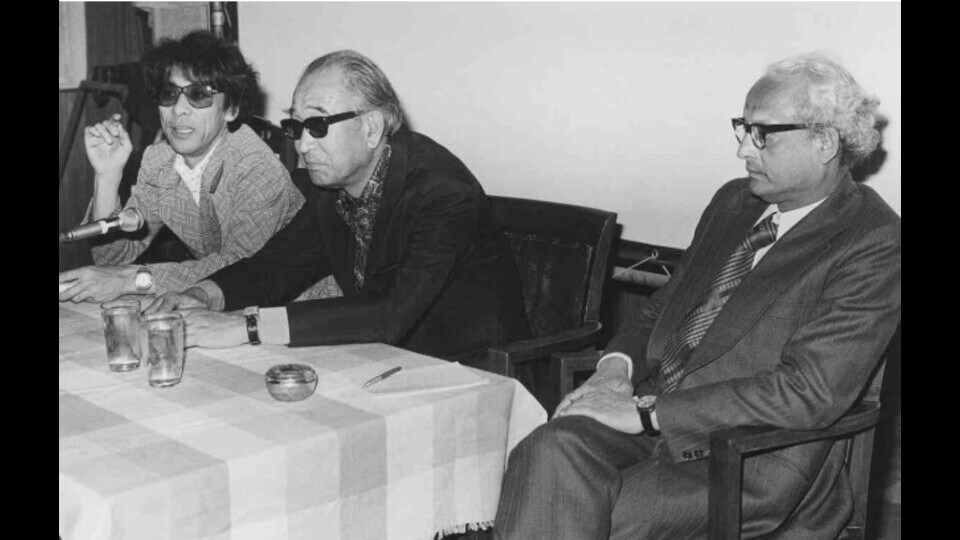

Radha Chadha’s The Maker of Filmmakers offers an emotional yet deeply researched insight into the life and work of her father, the visionary Jagat Murari, best known for taking the reins of the Film Institute (then FTI) from Gajanand Jagirdar and engineering it, in a continuous tenure of roughly 10 years and again a few years post the mid-1970s, into one of the most respected film schools globally. The roll-call of the alumni of that era – Adoor Gopalakrishnan, KK Mahajan, Narinder Singh, Mani Kaul, Kumar Shahani, Vikash Desai, Aruna Raje, AK Bir, Binod Pradhan, Virendra Saini, Renu Saluja, Saeed Mirza, Subhash Ghai, Asrani, Rehana Sultan, Shatrughan Sinha, Navin Nischol, Jaya Bhaduri, Danny, Anil Dhawan, Raza Murad, Kiran Kumar, Shabana Azmi, Zarina Wahab, Mithun Chakraborty, Tom Alter, Benjamin Gilani, Ranjeeta, Naseeruddin Shah, Talluri Rameshwari, Shakti Kapoor, Om Puri, Satish Shah, Rakesh Bedi, and countless others – is not merely a list, but a powerful testament that Murari created, cultivated, and nurtured.
The biographical promise is two-fold: One, to chart and explore Murari’s professional life, from a young science enthusiast forced into earning his bread as a Deputy Superintendent in the Central Excise Department to his divergence into a then unexplored field called “cinematography”, and ultimately finding his calling in documentary films, academics, administration; and second, to elucidate his strength of character in working astutely within the confines of senseless sarkari policies, subverting proverbial red tape.
Chadha employs a popular narrative style, organising the material thematically but anchoring it to a standard chronological progression. This approach allows the reader to follow the development of events and the introduction of numerous individuals without becoming disoriented. Given the substantial volume of the book, which exceeds 500 pages and involves a large cast of significant and lesser-known figures, this is effectively supported by a comprehensive index and detailed endnotes.
The book is divided into four major sections: Murari’s Early Years, the Founding Period of the Film Institute, theApex and Challenges of the FTII, and his Later Life following his tenure at the institute.
Chapter One is dedicated to Murari’s formative years, detailing his upbringing and education in Patna, followed by specialised cinema studies at the University of Southern California, including a high-intensity internship under Orson Welles, observing the filming of Macbeth in 21 days flat. The chapter concludes with his return, marriage to Lakshmi, over a decade of filmmaking at the Films Division, and his pivotal professional transition to the Film Institute, Poona, in December 1961.
Here, one might note that an interesting aspect of Murari’s career, the departure from collecting government revenue to cinema studies, was a historical disruption. The coveted Civil Services, an expected career trajectory for most students from Bihar, eluded him as the exams had been suspended for some time. In 1945, the government of India was planning to send 1000 students abroad for an “advanced course in technical and scientific subjects”. During the interview, the only subject that was left was “Cinematography”. Murari had no other option. Divine intervention? One wonders.
Chapter Two is the stuff of dreams and offers essential primary data for the cinephile. It captures the genesis of the Film Institute, detailing the indispensable involvement of the foundational personalities from the ministry and the industry including, Satyajit Ray, the short, highly volatile, but extremely influential tenure of Ritwik Ghatak, the onboarding of the charismatic Roshan Taneja – the acknowledged guru of acting whose feet Shabana Azmi had touched out of reverence – and more. It takes the reader to a world that is so far and yet so near and dear. One visualises the transformation of the vast grounds of Prabhat Studios into a full-fledged acting institute. Images of Asrani’s camaraderie near the wisdom tree, Subhash Ghai rattling off long lines of dialogues, Ritwik Ghatak walking around the campus, lost in his world of universal bliss, only to suddenly turn temperamental, and many more.
The next chapter functions as a critical continuation, charting FTII’s growth and consequential operational turbulence, leading to Murari’s transfer to the Films Division in December 1971. The chapter is about egos surfacing, clashes becoming routine, and student strikes becoming almost a norm. The section also introduces new characters and elevates previously peripheral individuals, like Satish Bahadur, the acknowledged Film Appreciation expert at FTII, whose profound admiration of Ray is depicted as an academic advantage on one hand and an unfortunate liability on the other.

The last chapter chronicles Murari being pushed from one government unit to another, his return to the FTII, and his subsequent calling it a day. This is followed by his entrepreneurial tenure, including his work as a documentary filmmaker post-retirement.
This was a much-needed book that dispels a few myths. Chadha brings out the unknown Murari, his compassionate side, and provides detailed information and evidence of his work for FTII and the Films Division. Her research is monumental, and has been properly catalogued, serving as a strong reference for future work. The writing style is accessible, though the tone could have been more humorous given that Jagat Murari himself was known for his almost belly-shaking, uninhibited, laughter. A few editing lapses, including misspellings of well-documented proper nouns -- for example, of Salil Chowdhury (not Chaudhary) and Basu Chatterji (not Chatterjee) – and redundant contextual recurrence occasionally impede the narrative.
Still, it is a pleasure to read The Maker of Filmmakers, which also features some extremely rare photographs, including one of Gina Lollobrigida in a saree. I would have bought this excellent book just for that.
Anirudha Bhattacharjee is a twice National Award (Swarna Kamal) winner for Best Book on Cinema and the inaugural MAMI winner for Best Writing on Cinema.


