For almost a century, Panther Panchali and Aparajito — the bildungsromans tracing the journey of the protagonist Apu — have represented the high noon of Bengali literature. Writer Bibhutibhushan Bandyopadhyay etches an evocative picture of village life as he follows Apu, or Apurba Ray, through his coming-of-age, complex relationships with his brahmin family and eventual piercing through the veil of poverty through his merit and establishing himself as a celebrated novelist. It is a deeply personal story of three generations of an Indian family that resonates not just in its beauty, but also hope.
In many ways, Manoranjan Byapari’s Chandal Jibon trilogy is its counterpoint. Despite his best efforts, the protagonist, Jibon, is never able to escape the accident of his birth and its circumstances: as a dalit boy displaced by Partition and tossed around Bengal in post-independence chaos and government apathy. Unlike Apu, Jibon never manages to go to school, is never able to study or prove himself, or even get himself a fistful of rice every day. His caste seals his fate – there is no arc of redemption, and Byapari’s writing is devoid of any hope.
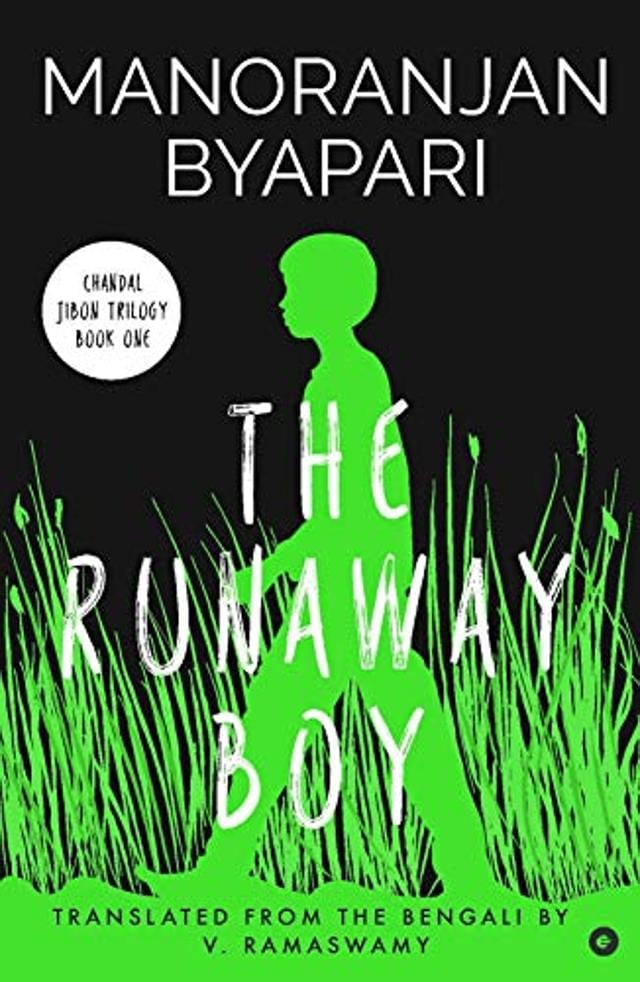
The first part of the trilogy, The Runaway Boy, goes back and forth as it traces the life of Jibon’s father Garib, literally meaning poor, as the family is forced to flee their home in erstwhile East Bengal and take shelter in a refugee camp. Eventually, Jibon leaves home in an attempt to escape the misery of poverty but finds himself incapable of securing the amenities that many of us take for granted. The language is plain but pointed, shorn of any ornaments – though English smoothes the edges and blunts the force of the caste connotations of some words.
The novel, first serialised in a Bengali magazine, is semi-autobiographical and shares some similarities with Byapari’s celebrated autobiography, Interrogating My Chandal Life. In Bengal, Byapari is known for his powerful writing on hunger and food, and in this book, he is unrelenting in exploring what hunger does to families and people, and what the fear of starvation can push people to become.
{{/usCountry}}The novel, first serialised in a Bengali magazine, is semi-autobiographical and shares some similarities with Byapari’s celebrated autobiography, Interrogating My Chandal Life. In Bengal, Byapari is known for his powerful writing on hunger and food, and in this book, he is unrelenting in exploring what hunger does to families and people, and what the fear of starvation can push people to become.
{{/usCountry}}In his short life – we are not told how old Jibon turns by the end of the novel, because who has the leisure to measure age when there is no food – the protagonist travels thousands of miles ticketless in trains, gets beaten up, cheated of his money, abandoned, sexually abused and humiliated every day. There is no restitution, no love, no tenderness, no letting up of misery – making it a difficult read. Byapari repeatedly explores humans and animals, and seems to suggest that hunger and the response of society to starvation makes up the line demarcating the two. More than once, Jibon snatches food from animals.
The spectre of caste is omnipresent. No matter where Jibon travels – Lucknow, Guwahati or Darjeeling – he is immediately identified by his namashudra caste; his emaciated body, helplessness, hunger become proxies for his caste. Who else but a nama could be this wretched, one character thinks out loud.
It is by this reasoning that Byapari distinguishes himself from other writers on realism, and south Asia. The characters and their predicament aren’t imaginary and their travails cannot be explained away by mere poverty – it is their caste location that not only determines their circumstances but also holds them back from climbing out of it. Intergenerational mobility is an ambition denied to those from the lowest trenches of society.
Byapari pushes back against the notion of Bengal’s bhadralok egalitarianism, and bares the realities of high-caste networks that determine not only an individual’s fate but also how dalit communities of displaced refugees were treated in India.
In doing so, he underlines an often-forgotten fact: that Partition refugees too had caste, and were treated accordingly. The high caste refugees were settled in Calcutta, in colonies facilitated by the government while dalit refugees were pushed to the peripheries of the state, in refugee camps with little food or water, or forced to scavenge by putting up shanties alongside railway tracks. Don’t miss the chapter titled Flight, which follows the interplay of caste, birth and death in a ramshackle Bedford truck stuffed with refugees travelling from the border to the hinterlands.
There is suppressed anger in Byapari’s words, and the translation is commendable for retaining it, though I wondered if some transphobic references could have been removed. Byapari is both upset and resigned to the fate of his fellow dalits. Sample this description of an upper-caste character: he knew that it was laid down in the shastras that the chandal was just another lowly creature, not unlike crows and dogs. He had done nothing wrong by inviting him to eat the stale food... he would have done wrong if he had given them hot food to eat instead.”
Ultimately, the book asks universal questions through its searing descriptions of suffering and human folly: Why does caste strip people of humanism, how can we build just societies on unjust foundations and which groups of people have the ability to escape their fate? As Jibon roars at his assaulter: My name’s Jibon, I am a chandal. What more do you want to know?”