
 E-Paper



Review: Water Days by Sundar Sarukkai
Set in Bangalore at the turn of the century, this novel that examines ideas of masculine honour and urban stress, laments a lost way of life

 Prefer HTon Google


I moved to Bengaluru in 2023. Sarukkai’s novel is set at the turn of the century. Many of the turnings he has noted in it have amplified in these 25 years. He talks about the garden city becoming a ‘compooter city’. A huge chunk of the metropolis now houses ‘techies’ primarily. In fact, I was recently told by an ‘old Bangalorean’ at Bob’s Bar to move to that part of town so I could “be with my people”. And that reflects the divide between old Bangalore and the new one. Well-meaning friends also often ask me to speak incorrect Hindi with autowallahs and shopkeepers to avoid being fleeced. This change is also captured in the novel.
The city is no melting pot. Its ingredients are in conflict with each other in their attempt to stake claim to it. At one point, a character is worried that the place will soon be overrun by north Indian food joints with no idli or dosas to be found. Interestingly, ‘chow-chow’ bath, a mix of sweet rava and savoury vermicelli, we are told, is a Bangalore invention. No other intermingling seems to be allowed. One character even states that a Malayali girl could not have fallen in love with a non-Malayali.

At the heart of Water Days is our simpleton Kannadiga protagonist Raghavendra, whose connection with Udupi is repeatedly stressed. Udupi is almost like the utopia his father foolishly left to come to the big, bad city with its corrupt police, drying taps and miserly neighbours. Raghavendra’s nemesis Nagaraj and his buddies are also Kannadigas and the novel revolves around all the people who intersect his life. This includes his woman-of-action wife Poornima, his daughters Suhasini and Sanjeevani, the water supply-coveting immediate neighbour Baale and his shy wife, another hateful neighbour the Malayali Prasanna and his wife, and their helpful tenant Rajesh, among many others.
Raghavendra’s change from being a man of inaction to one of action which leads to violence in the novel can be read as a lament for a bygone way of life. This is marked in the Tamilian neighbour’s surprised comment to Prasanna about Kannadigas turning aggressive because Raghavendra refuses to be cowed down by him. By the end of the novel, Raghavendra revels in his new-found confidence and achieves his dream of opening a grocery shop and thrives. However, he has also gone from being the man who had stopped his wife from revealing the name of Archana’s lover to the latter’s mother to one who takes great pleasure in revealing it to her father. His actions also precipitate Meghalata entering a complicated marriage 13 days after her sister’s death. Both these incidents cement the ‘greyification’ of Raghavendra and by extension of Bangalore.
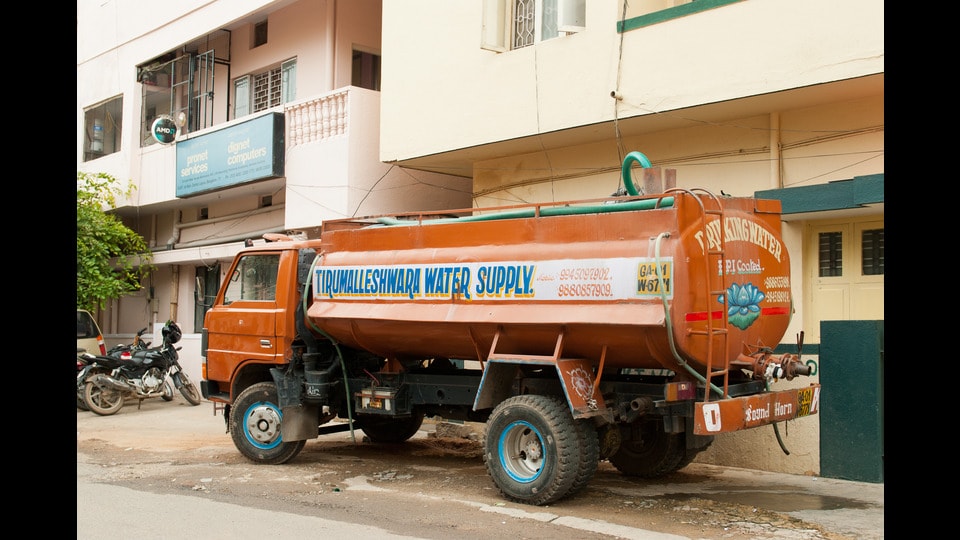
The tragi-comic novel is framed around the 13 days after Prasanna’s daughter, Archana’s death by suicide and also around the days that the mighty Bangalore Water Supply and Sewerage Board (BWSSB) deigns to give water to the city. Those days have become more special now, rarer, as most of Bangalore relies on tankers from private sources. Power cuts have increased too with most citizens of the tech city relying on generators.

Other than the theme of these damning social and infrastructural changes is the examination of notions of masculine honour. Even Poornima, Raghavendra’s wife, seems to have these ideas. In such a setting, there is no letting go; there is only revenge. Poornima and Raghavendra aren’t the only ones. Prasanna’s sense of ‘honour’ is a big part of the complications. Then, there is the honour of the Biharis, upheld in Rajesh’s name, that leads to an attempted murder.
But there is also acceptance and inclusion. A big expression of that is the ceremony at the taps at the dawn of the 13th day of mourning for Archana when all the women in Mathikere Extension come together to pray for peace for the girl’s soul. It’s a peace that was symbolically denied to her by her father. Perhaps there is an element of revenge here too. Because it is the men, the masculine, the patriarchal, who are not invited to the wedding later in the day.
In the end, Water Days shows that family and community are made up of those who support you rather than those who might belong to the same linguistic or kinship group.
Priyanka Sarkar is an editor, translator and writer.


