
 E-Paper



Review: A for Prayagraj: A Short Biography of Allahabad by Udbhav Agarwal
A wry account of the city now called Prayagraj, reeling under urbanization and stripped of its glorious past, thickening with buildings that have converted it into, in the author’s words, “a battleground of old cliches”

 Prefer HTon Google


The last time I thought about Allahabad, a city that has been a strong proponent of Ganga-Jamuni tehzeeb, was when the BJP-led government renamed it. Coming as the change did just before the 2019 elections, it seemed like yet another step towards the establishment of a Hindu Rashtra. For Allahabadis, this step was not only political but deeply personal. Udbhav Agarwal’s A for Prayagraj describes how the saffronisation of the city is tearing into its social fabric:
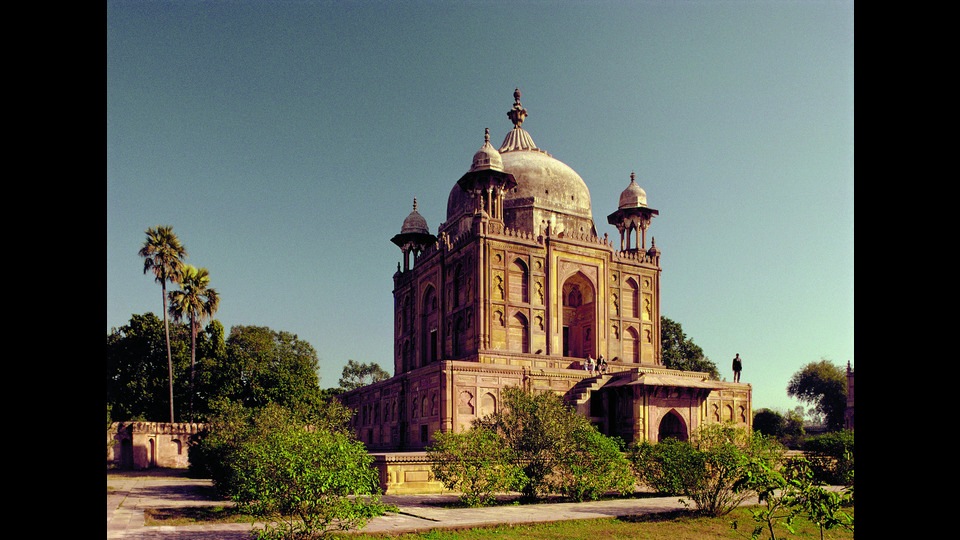
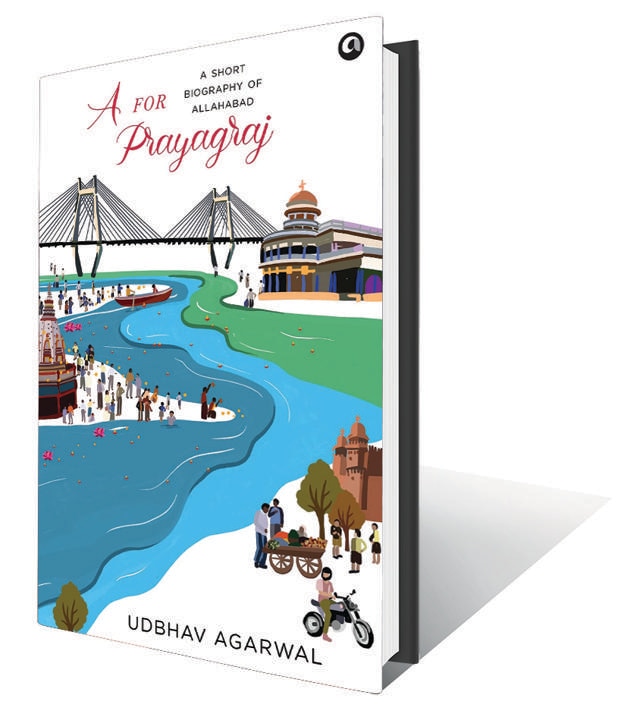
“Boundary walls, bridges, and trees were painted in cartoonish Hindu motifs. Crossing the Subhash chauraha one day, I noticed an odd traffic sign. It was in five languages — Hindi, English, Bangla, Tamil, Telugu, but no Urdu — and it marked the way to another city: Saraswati Hi-Tech City”
The author presents us with a wry account of the city reeling under urbanization, stripped of its glorious past, thickening with buildings that have converted it into “a battleground of old cliches.” A PhD candidate in Political Science at Johns Hopkins University and desperate to find a thesis topic, Agarwal returns to the city to grapple with the question: What makes a city smart? For an entire summer, he tries to chronicle it in atypical ways — by talking to a parkour artist, setting up a Grindr date, and poring over the autobiography of a migrant writer.
While Agarwal is despondent to see the place changing, the book doesn’t rely much on memory with only a slight mention in the prologue of the strange ways in which Allahabad remained knotted inside him:
“I’d introduce myself as an Allahabadi, even if saying ‘I am from India’ made more sense... On one of my returns to the city some years ago, after waking up, I waited and waited for [the siren of the 6 o’clock train]. Allahabad had become so dense with buildings, I didn’t hear anything.”
In the chapter, Saam Daam Gun Bhed, Agarwal describes the rampant crime and corruption. He writes about a district magistrate who bulldozed a resident’s house because the latter didn’t pay the demanded bribe, and about a lawyer who fights for the powerful and believes the law is meant to rein in the herd. Then there is the humorous eight-part story of Balu Raja, a zamindar from Mahua who trades in silt, and his cat-fight with the local District Magistrate-Member of Parliament syndicate intent on gifting the tender to a son-in-law. The sad reality is that it is impossible to get anything done without a bribe and the victim is always an average man with no political connections.
In Bakaiti, Agarwal gazes into the creative pasts, quoting from the memoirs of Arvind Krishna Mehrotra and Neelam Saran Gour, as he forages around libraries and bookshops to find the autobiography of Upendranath Ashk, Girti Deewarein. In 1948, Ashk moved from Jalandhar to Allahabad where he lived for the rest of his life. It is strange to Agarwal, as is to the reader, that an important book is missing from all city bookshelves.
The last two sections talk about two pertinent issues that face the young people of any small city. Apna Time Aayega deals with joblessness, the scarcity of professional choices, and the implications of choosing an unconventional career. The chapter starts with: “If the outsiders were impressed, the insiders wanted to get away.” Using the refrain ‘Yahan Koi Scope Nahi Hai’, Agarwal mentions the mushrooming of coaching institutes to help students ace entrance examinations and move to better places. He interviews a Latinist friend who teaches students etymology to make them proficient in English, and two parkour artists from Kydganj, who are slowly coming to the understanding that they won’t have the resources to pursue their passion on a larger scale.
The chapter F se Fyaar, F se Firaq is an allusion to Firaq Gorakhpuri, a famous gay-Urdu poet from Allahabad. Neelam Saran Gour mentions him in her book, Three Rivers and a Tree: The Story of Allahabad University: “He could stop the man come to deliver the gas cylinder with the disarmingly candid proposition: ‘Tum Mujhe mohabbat karoge?’” Through a Grindr date, Agarwal reveals the prevalent regressive attitudes towards homosexuality, and how young people have to choose between the fear of being ostracized or moving out of the city.
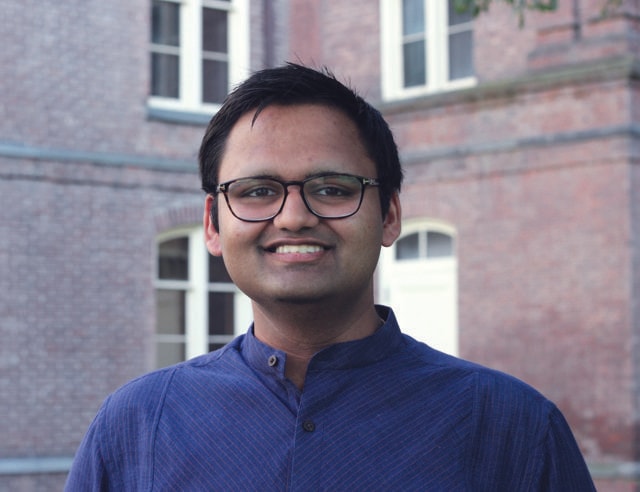
In The Descendants, Arvind K Mehrotra, a fellow Allahabadi, writes about the city’s mirage-like past: “Seen in this way, Allahabad is a terrible human story. It is a story of dust to dust, which may be one reason why some of us who live in it love it so much.”
Many writers have written about this city that resists easy theorizing. Its condition, attributed to the government’s insistence on dissolving all links of communal harmony and diversity, can be summed up by Agarwal’s sharp observation:
“A Hindu Rashtra needs Hindu metropolises. Our cities are being experimented upon, they are turning into laboratories…These are contagious tales, red, they demand our attention.”
Udbhav Agarwal’s precise detailing brings forth Allahabad-Prayagraj’s contradictions, its past slowly pushed to the corner by bustling malls even as its residents jostle hard to move out.
Kinshuk Gupta is the Associate Editor for Usawa Literary Review and the Poetry Editor for Jaggery Lit and Mithila Review.


