
 E-Paper



Review: Landscapes of Wilderness by Narendra
Based on recollections of the author’s time wandering in Abujhmad in the 1980s, this is a book on powerful truths about nature and humanity

 Prefer HTon Google


In the introduction to Landscapes of Wilderness, the author Narendra confesses that his book is “not a formal sociological work” and “more like a traveller’s tale”. The 39 chapters draw from his “wanderings” in Bastar, and Abujhmad, which he describes as “pre-society”. When he reached there in 1980, the three of four bamboo and thatch huts did not meet the “criteria of forming villages”. They lacked hierarchies and occupations. In Abujhmadia, the people, were “soft-footed and soft-spoken, never loud, assertive or intrusive.” Much of Abujhmad is “revealed-concealed” by the “ancient dark that comes each night.”
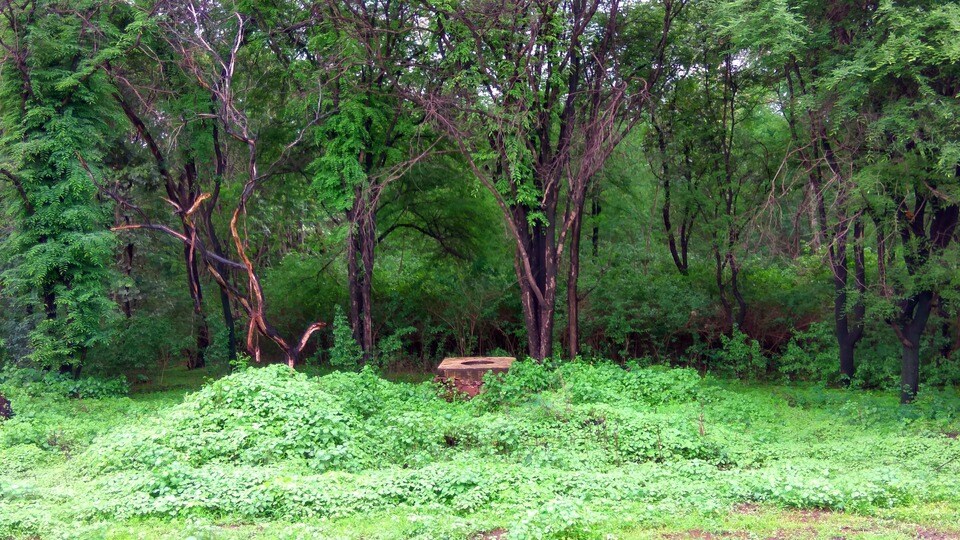

Once he began moving deeper into the interiors of Abujhmad, he experienced the “vast ancient silence of centuries.” Not surprisingly, he stopped taking field notes. He felt isolated, unprepared for “so much” solitude, and began “killing time”. He missed the comfort of “humdrum and everyday human activities”. Here, the rhythm was different and some of it shattered the stereotypes a city dweller has of the wild. “‘A walk in a deep forest’ is a misnomer”, he writes. “Walks do not fit into the wild’s scheme of things”.
The book then is about powerful truths. “Nature has the materials to create the atomic bomb but Nature by itself is not an atomic bomb.” “Human society is as much a human invention as the steam engine.” And yet, all of this is written without scorning or overtly critiquing “modernity”.
In Abujhmad, Narendra remembers his childhood village from the 1950s and ’60s. Anecdotes were educational, he recalls. People rarely left the village, when they did – to visit a daughter – they walked or went riding donkey. Bicyles were called “mechanical horses” and too few were around. The old life changed after the green revolution. In the same sentence, he talks of “felling of orchards”, “erosion of mounds of dung as manure” and the coming of “schools and formal education.” He describes a sparrow that “kept quarrelling with its reflection”. He describes doors that were oiled twice a year, but never shut and so “other people, dogs, cats, birds, winds, sounds, dust and the young buffaloes, cows and goats” freely walked in. Years later, the author revisited his native village innumerable times, but he could “never regain it.” But he brings it alive to the reader, just as he does Abujhmad.
Of Abujhmad in Bastar, his descriptions are delicate and detailed. One particular passage remains poignant. Why don’t you make your house larger, the author asks a resident, Banda, when he sees people and creatures crammed indoors. Banda however is puzzled. For him, home is the outside. The hut is a mere shelter. Cooking, eating, drinking, conversations and weddings all happen outside. That probably explains why there was no division of property in the region. Because there “exists neither property, nor the notion of ownership.”
Some tales are dramatic, wild. Once, he meets a big cat, “a hushed twenty yards lay in between – about a mid-sized leap for a tiger.” Another time, he rubs shoulders with a bear. He lived to write the tales as one was a rock and the other a bearskin.
A few decades ago, at an event in Delhi, Narendra got “an earful for wasting away in primitive Abujhmad”. The people at that premiere and progressive university, expected him to be elsewhere, a place they approved, that would have signalled, or maybe shouted, that he was in “solidarity with the progressives.” The essays in the book - bound by space and time - seem like a slow, soft rejoinder. In a gentle commentary that teaches you everything about gaze, Narendra says “words like ‘participation’ and ‘access’ come from vocabularies of power and inequality.” Coming from a world where both are not just commonplace but sadly central to our lives, the Abujhmadias may seem simple, people who need to be rescued, included. But, “no life is more traumatic than that regulated by those that despise, violate and denigrate it.”
In the early 1980s in Bastar, the government decided to construct houses and settle the adivasis. “That people would rush into free cement and brick houses was considered a foregone conclusion”. Except, people rushed out as quickly, back to the wilds, in the middle of the night. When they decided to introduce Abujhmad to a “better life of settled agriculture”, they were in for another surprise. Despite the formal training, the officials visited the target villages to follow up, they found “that the bullocks and rice had been eaten away” and the sarees and shirts became festoons as “respect to deities and ancestors.” At a time when a one-size-fits-all development is seen as a solution for all ills, Narendra quietly asserts that “much goes away when the landscape is torn apart”.
He gives the example of ghotuls (a space where unmarried youngsters live together and learn about emotional and physical relationships) which was violated and spoken about as “centres for indulgence of flesh and orgies.” But in Bastar, they “held their intimacies in utmost sacredness.”

The author struggled to speak about Abujhmad freely, both to friends and at formal events. He lacked a certain “something”, he muses, because Abujhmad “provided the material but, paradoxically, was not material.” When asked to write about the status of women in Abujhmad in 2017 for a magazine – and given a set of questions to frame them around – he was flummoxed. That wasn’t how the region could be “sensed and spoken about”, he writes. But he does elaborate. That both genders have the “same or overlapping tasks”. And that none of the “other manifestations of maladjusted societies” – rape, molestation, violence, teasing – existed there. Ironically, he says people there never grilled him about his life in Delhi. But 40 years after leaving Abujhmad, people in Delhi still do.
Throughout the book, Narendra’s voice is meditative, like a long chat with a family elder who has much to recount, a whole brood to enlighten. He candidly admits that some might accuse him of romanticising the village and the people. His own words describe the mood of the book better: a “human longing for the rhythm and flows, paces, conversations”. Abujhmad then cannot and “ought not be converted into the lowest denominator of latitudes, longtitudes, data or economic indices.”
“Perhaps the absence of clarity” the author wonders, “is also the book’s strength.” I’m tempted to agree. After a careful, close and slow read – and tamping down every other page, makes notes on the sides – I can’t describe the book in a line. At a time when everything is reduced to a meme, a reel, this book defies the trend.
Aparna Karthikeyan is an independent journalist and author based in Chennai.


