How did you grow up to be a writer and a filmmaker?
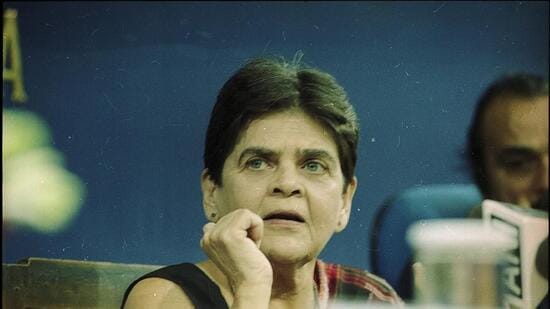
My childhood was a dream. It was spectacular. I had extreme privilege and at the same time extreme strictness. I was the only child and my mother, too, was the only child. My parents were divorced. My father was Russian. My mother studied at Cambridge. She was an extraordinary woman just like her father. My grandfather topped the Mathematics exam in Cambridge and he was the first Indian
How did you grow up to be a writer and a filmmaker?
My childhood was a dream. It was spectacular. I had extreme privilege and at the same time extreme strictness. I was the only child and my mother, too, was the only child. My parents were divorced. My father was Russian. My mother studied at Cambridge. She was an extraordinary woman just like her father. My grandfather topped the Mathematics exam in Cambridge and he was the first Indian to do so. He was a major celebrity in India and he was particularly revered in his own city which was Pune. My mother, on the other hand, was an enigma for people in Pune. They couldn’t figure her out. She was a rebel. I was an outcome of her marriage to a Russian, which was unheard of at the time. First, her marrying a Russian was sensational and then her divorcing him was even more sensational. After the divorce, she brought me back to Pune, when I was just two years old. Thereafter, my mother and my grandfather brought me up. And I really could not ask for a better upbringing.
My mother was extremely strict. I can’t remember a single day when I didn’t get soundly thrashed. In fact, on the road, where we lived, if any child misbehaved, their parents would tell them, “Hey, do you want to get thrashed like Sai?” And my ears would burn listening to all this. I would get so humiliated. So that was one aspect of my mother. But on the other hand, she spoilt me silly. I could ask for the moon and I would get it. Here was this brilliant woman, who was a Cambridge scholar, spoke Russian and French, among the other languages. She worked no job here and she focussed her entire energy on bringing up her child, which was me. Now, it can be very pressurising to grow up in an environment like that. You’d be surprised that I learnt horse-riding when I was a child. My mother sent me to painting classes as well. I would go to Mr Gondhalekar, who was a very senior artist, who had also spent some years in Paris. Then, believe it or not, she made me join classical music tuitions as well. The famous Mirashi Buwa, who eventually won a Sangit Natya Akademi award, would come every day at 7 o’clock to teach me. We never went beyond Raag Asawari, I remember. Because I couldn’t sing to save my soul. Eventually, Buwa mustered up the courage to tell my mother, “Shakuntalabai, Sai doesn’t have an iota of musical talent so please do not force her.” That’s when my singing stopped, mercifully. But, you know, this shows the height of my mother’s ambition for me. On top of this, every day, she insisted that I write Sanskrit shlokas. Even now, I know about a hundred Sanskrit shlokas by heart. Although, we were of an atheist background - my grandfather went to Cambridge and became a rationalist and my mother was an atheist too – and there were no gods in our house, I was made to learn all the stotras as well – Ravan stotra, Ganga stotra, you name it! Learning those at the age of seven gave me a firm base for the languages that I was to learn later on. Whether I spoke Marathi or English or Hindi or French, that early practice of Sanskrit helped me a lot.
My grandfather was a much gentler person than my mother. He never had crazy ambitions for me. However, he was quite disappointed when he learnt that I had no mathematical genes. I couldn’t pass algebra or geometry properly. But then he came to terms with it and realised that I had something else -- a talent for writing. He would tell me tales from Grimm and the Arabian Nights. My grandfather and I used to go for a walk along the canal in the mornings – there was a lovely canal in Pune in those days. Alas, it’s no more. What you call Canal Street today used to actually be a long canal back in the day. My grandfather used to tell me stories on these walks. I was an average student academically but I was always involved in elocution competitions and writing and directing plays. Then, when I was eight years old, my grandfather was appointed as the Indian High Commissioner of Australia. So we moved with him and spent four glorious years there. In Australia, I saw magnificent plays and film productions and read a lot of books. The world opened to me!
Another thing is that my mother used to read me stories to put me to sleep. One day, she told me she was bored of telling stories day and asked me to tell her one. I made up a story and told her. She realised it wasn’t a story that she had told me. Then she asked me to tell her another story and I did. That’s when she released that I had a talent for stories and that was my doom! From that day onwards, I had to write four pages every day. I had to write an essay or a story or anything. But four pages were compulsory and then my mother would give me marks. This was the kind of discipline that I grew up with. Since that day, I have never stopped writing.
Tell me a bit about your work before you got into films.
My major working span was in Delhi. I was one of India’s first six television producers. It’s an achievement I am really proud of. The six of us were Habib Tanvir, Kumar Vasudevan, A Pratap, Shama Zaidi and Swadesh Kumar. Initially, I was quite a flop but then I gradually started getting a hold of the medium. It widened my vision. I have done some of my best work on television. My film Chashme Baddoor was first a teleplay called Dhuan Dhuan. Sparsh was first a teleplay called Raina Beeti Jaye. I did teleplays, women’s programmes, children’s programme, art reviews, quizzes, VIP interviews – I did so many things for television and dare I say, I was quite good at it. Then my first documentary won an award in Tehran, which was a major thing for me and it got me excited.
Was it difficult to cut through the male-dominated world of cinema back in the 1980s?
A recent article in a Marathi newspaper said women entered cinema in India in the 1980s referring to me. While it is true in some sense, there have been women directors before me. There was Bhanumati in the south. Then there was a Bengali woman whose name I can’t recall. Then there was Shobhna Samarth and four-five others. However, unfortunately, none of them made an impact and none of them were really talked about. So when I made Sparsh in 1980, it made quite a noise. It won three National Awards – Best Screenplay, Best Actor (Naseeruddin Shah) and Best Hindi Film. Plus, it travelled to 16 film festivals across the world. It also was a commercial success. I suddenly was the flavour of the month.
You know, things are very different nowadays when there are women working in every aspect of films. Now even some technicians are women. In my day, I was more or less the only woman on the set or in the entire crew. And I was the director. But you know, I never paraded it around. I never behaved like “Hey, I am a woman and this is something great” or anything like that. I was always thoroughly respectful to my team, my fellow technicians. You know, you have your plusses and minuses. I am not a very good technical person. But as far as the imagination goes, nobody can hold a candle to me. Weaving stories, understanding characters, a sense of the narrative were my strengths. But if you asked me what lens should be used for a particular shot, I may not have the best answer. So I leant heavily on my fellow technicians. I used to tell them, “Look, this is what I want this shot to look like and please figure it out for me.” This way, my crew members felt challenged and loved working with me. They never felt like this woman is showing off. So I gained the respect of people. In some cases, I used to say, “Hey, I am stuck with this, please help.” Looking at a woman being in that situation, many men would help.
Men can be very gullible, you know. Women know how to handle them. Rather than feeling disadvantaged as a woman, I’d say, on the contrary I enjoyed so many advantages because of it. Because I’m a woman, I could go to any village for a shoot or for work on a project and I would be welcomed. If a male director or some typically filmy person went there, the villagers would have thrown them out! But the doors of those huts would open for me. I used to walk in, chat up the woman of the house, sometimes by complimenting the smell of the food she was making, for example, and eventually get what I wanted. They would think, “Who is this fair woman doing something with films!” They would be excited to see me. And at the other level, the doors of the ministers were always open for me. I used to get appointments or interviews in no time whereas many of my poor men colleagues would take years to get them. I used the fact that I was a woman to the hilt.
Of course there is a downside to this as well. For example, I don’t know now if it was because I was a woman or because I didn’t understand money, but I never really made too much money. I think it’s got to do with my upbringing. People in my house would only talk about education and knowledge. Nobody spoke money. My mother never asked me what my salary was when I got my first job. It was disrespectful to talk money. And that worked heavily against me in the years to come. People who used to be my fourth assistants at some point are now better off than me. It’s good for them, of course and I am happy for them. They did the hard work and they were savvy, they knew the tact of the business and they didn’t stick to only what they believed in. I, on the other hand, was only concerned with the work I wanted to make. I don’t regret it. Today, I am a name. There are people who respect me and my work, and I have gained a lot of love from my fans. So I am very happy about that. Of course, sometimes one tends to think, “Wish I had a bigger car or a bigger house!” but those are fleeting thoughts. I am certainly happy with what I have done and achieved.
Do you think the gender of a writer or a maker influences their work?
Yes, I do think that it makes a little bit of a difference. Not to say that people like Gulzar or lots of other men haven’t made sensitive films. But by and large, you see the output of women directors and you see a certain sensitivity. You see Prema Karanth’s Phaniyamma. It’s a story of a woman who refuses to get shaven when she becomes a widow. Such a beautiful film, that is. No man, I think, could make that film. Or a film like 36 Chowringhee Lane by Aparna Sen. Such a lyrical film. I don’t think a man would make a film like that. Or even my own film Sparsh. It had a lot of feminine aspects to it. However, having said that, Chashme Baddoor, I think, is a film that even a man could have made. So it’s a difficult thing to answer positively. But, by and large, you can say this. Also, I can’t recount a single film by a woman filmmaker that is about random violence or terror and stuff like that. But many men have made those kinds of films. I think women are more concerned with social aspects, family bonds and things like that instead of violence.
After Sparsh, you made what’s perhaps your most popular film, the light-hearted comedy Chashme Baddoor. Did you always want to be a multi-genre filmmaker or did it just happen?
I don’t think I sat down and calculated it like that. People ask me how I choose my subjects. I say, I don’t. My subjects choose me. Something just hits me suddenly and I start writing it. Like Chakachak, my children’s film, for example. It’s a very fun film about cleanliness. How the film happened was, one day, I came back home from somewhere and I was cribbing about how people spit on the road and how there is so much dirt on the streets. My daughter said, “Stop this cribbing, ma. Because when you do, you make life difficult for everyone around you.” She asked me why I didn’t do something about the problem. At first I thought, what can I do to stop people from spitting on the road but then she told me I am a filmmaker and there must be something I could do and I thought, well, I can actually do something. I immediately wrote Chakachak and I think it was great fun. Sparsh also came from an experience I had while visiting a school for the blind. Chashme Baddoor was a film that did not come from a particular incident in my life. At that time, I used to think, “What’s with the youth today? They are just smoking their days away, doing nothing, chasing girls and stuff like that”. And then this thing sort of shaped up. Initially, in the teleplay version of the film, that I had made earlier, all the three characters smoked and were no-gooders. I must give credit to my producer Gul Anand, who told me, I can’t have all the characters as no-gooders; at least one has to be hero material. I thought, well, I am a writer; I can switch it around. That’s how Farooq Shaikh’s character, which was very adorable, shaped up and it worked beautifully for the film. Farooq did justice to it. When I did Katha, I sent the script to Farooq and Naseer and they both thought they were going to play the other guy. Then when I told Farooq about the character I wanted him to play, he said, “Sai, I just did Chashme Baddoor. People think of me as a nice, lovable guy.” I said, “Farooq, zindagi bhar wahi karoge, kya?” And then Naseer told me, “You’ve forgotten what a smart chap I am. Nobody will accept me as an idiot.” Then I said, “Then what the hell are you an actor for? Don’t you want a challenge? Are you a poster boy or what?” I gave them a little spiel. Then they both accepted and later on, both of them told me they were very glad they did the roles because they were so challenging and fun to do. Naseer is so sweet in that film!
What’s the governing force behind the stories you have chosen to tell?
I do my work to make people happy. I feel that we in India have such a tough life to bear. We’re not blessed, you know. So call it escapism, call it what you like, but if I can make people feel good, albeit for a little while, I will have achieved what I want to. This feeling has always been at the back of my mind. And I am a positive person. I always see the glass half full. I try to see the sunny side of things. For example, in Disha, Raghubir Yadav believes that once a man comes to Bombay, he would never go back but in the end, his brother, Om Puri, finds water in the village and he does go back. Then, in the story of Disha, Nana Patekar has a shattering experience because his wife falls prey to a powerful man in the village but he decides to stay on.
What was special about the 1980s that a whole bunch of independent filmmakers, such as yourself, started working at the same time and brought about the much-talked about parallel cinema movement?
Well, that’s an interesting question because it’s difficult to pin point why all of us happened at the same time. Yes, some of us would meet occasionally and we also made one attempt to have an organization committee of the so-called good filmmakers. We met at Ken Rathod’s place -- he made just one or two films, but he was a part of it. Then there was Mani Kaul, Saeed Akhtar Mirza, Kumar Sahni, Virendra Saini, who was my cameraman; then Basu Chatterjee had also come. There were about 10 to 12 of us but nothing happened eventually. We just had one solitary meeting and that’s it. We did bond though. But I’d say there was no regular give and take amongst us. To answer your question about why it happened only in the 1980 -- at that time, gradually, all of us individually had come to a realization that something had to be done, something needed to be changed. Also, when you see someone do some good work, you get charged and even you want to create something. There was mutual admiration amongst us and we enjoyed each other’s work. That could be one of the things. But having said that, a lot of it was coincidence as well.
How do you define success as a writer and a filmmaker?
Why must one define anything? Success sweeps over you. It’s a nice feeling. You feel the warmth of it. If someone you don’t know, walks up to you on the street and tells you that they and their family enjoyed one of your films, it feels so good. It’s a feeling that lasts the whole day. You think all this trouble was worth it. That, to me, is success. I would assume that for every creative person, to be appreciated is an award in itself. And when I say appreciated, I don’t just mean people telling you, “Wow, very good, very good.” It also includes someone telling you, “Hey, what a trashy film you’ve made!” I have been told that too. Not so much about my films but I have been soundly criticised for one or two of my plays. But even in that, you know, you feel good that the other person cares about your work. The person is so dismally disappointed because he expects something from you. That feels good. I remember, one of my plays called Mogara Phoolala, which I feel is very good, but at that time it was quite criticised because it had a little bit of sexual play in it. At one of the play’s shows, in Pune, a guy walked up to me and told me that he had come down from Montreal the day before and had come to watch the play and was thoroughly disappointed with it. He said, “How could you write a play like that? This is just not done.” The reason for his disappointment was that he was expecting me to write goody-goody stuff. A woman writing about a subject like that, especially at that time, was not digestible for him.
How do you define failure as a writer and a filmmaker?
Would it be unacceptable if I said I haven’t tasted too much failure, except for some of the stuff I told you about?
You know, I accept failure if I know the reason why a play or a film or a telefilm failed. If I don’t find out the reason or if I am not convinced about it, then it becomes a bitter pill to swallow.
As a writer, how does your work in theatre talk to your work in cinema?
See, all this works at a subconscious level. For instance, when I am writing a play, I know that I can’t have a thousand-horse army marching in on stage. So you know what you’re doing. But all said and done, the relationships or the material that you’re working with remains the same. And that material is human beings. I am writing about mother-daughter relationships or father-son relationships. I am constantly interested in human beings and I love watching and understanding them. That’s why till very recently, I used to take the bus every now and then. You see so much of human life there; people who you normally would not meet, so many fascinating incidents to look at, to observe.
Do you think we have progressed or regressed in terms of quality in Hindi cinema?
Technically, the quality has improved. In terms of stories, well, very frankly, Mihir, I don’t see a lot of Hindi cinema. Because when I do, I am usually disappointed. So I try to save myself from the disappointment and not watch much of it. But then I also wonder if my disappointment is coming from the fact that I am not making films anymore. Is it a sour grapes situation? I don’t know. Of course, some of the new films are pretty good. I’d start with Lagaan. I thought it was a splendid film. Then, I liked Chak De India. Then, there was a film that Naseer did, A Wednesday; I thought that was a very powerful film. Then, I saw another film recently that really moved me. It was called Jalsa. Wonderful story! When I watch something like that, I think well, cinema is still alive.
READ MORE: On Sai Paranjpye, a key figure in India’s cultural life
Who have been your influences in cinema?
My favourite filmmaker of all time is Federico Fellini. I love his sense of the comic and of caricatures. Somewhere, I have always felt beholden to him. I am fascinated, really, by him. Then in Indian cinema, Satyajit Ray, to name the obvious. In Ray’s films, I particularly like the comic part. No one talks of Satyajit Ray’s comic sense. But what a fabulous comic sense he has! I remember some parts of Shatranj Ke Khiladi and they still make me laugh. You watch his characterization and you think, what a man is this! He was a major, major influence. Another filmmaker I loved very much is Tarun Majumdar. In one of his films is a delightful incident that is still very dear to me. Tarun died very recently, about two months ago.
What do you think is your greatest creative accomplishment?
Disha. In my opinion, it is an all-round success. From script to acting to editing to the ambience it creates to the effect it has, everything about Disha is of a certain quality. My most popular film, however, without a doubt, is Chashme Baddoor. It was a runaway success. Also, Chakachak reached a lot of people, especially school children. It’s quite popular among them. My last feature film, Saaz, which I made in 1997, is something I am happy with as well.
Is there something you wanted to make but couldn’t for some reason?
Yes, I have two or three unmade scripts. One of them, to be frank, I think, if it had been made would have been a milestone in Indian entertainment cinema. It’s called Xapai. Xapai means grandfather in Portuguese. The film is set in Goa. An old man is about to celebrate his 90th birthday and all his younger family members are coming back to attend it from different parts of the world. They also have a vested interest in the property. It’s a black comedy, filled with humour. I wrote it 10 years ago. Unfortunately, I could never get finance for this. When I was a nobody, when I made Sparsh and Katha, it was okay to knock on doors for money to make films. Today, I am not going to do that. I still think, if I can make Xapai, it would be wonderful. Then, there is another story about an eminent man called Mashlekar, who won India its patent for turmeric. Mashelkar read the script and said, “Sai, this would be your gift to the nation.” Even he tried but we just haven’t been able to make that film. Most studio people are so narrow-minded that you tell them about Ayurveda and turmeric and all of that, they flat-out refuse. They are only interested in clubs and rape scenes and all that. They are just not ready to listen to stories like this.
A hundred years from now, how would you like to be remembered?
As a happy filmmaker.
Mihir Chitre is the author of two books of poetry, ‘School of Age’ and ‘Hyphenated’. He is the brain behind the advertising campaigns ‘#LaughAtDeath’ and ‘#HarBhashaEqual’ and has made the short film ‘Hello Brick Road’.
One Subscription.
Get 360° coverage—from daily headlines
to 100 year archives.
Archives
HT App & Website