
 E-Paper



The woman rewriting Australian history, one walk at a time
Sita Sargeant has turned her walking tours into a powerful book that is reclaiming women erased from the country’s formal history

 Prefer HTon Google


On a quiet city street, history often hides in plain sight, in buildings named after men and in plaques that tell only half the story. But for years now, Australian tour guide and history enthusiast, Sita Sargeant has been gently, and persistently, asking people to stop, look around, and ask one simple question: where are the women?
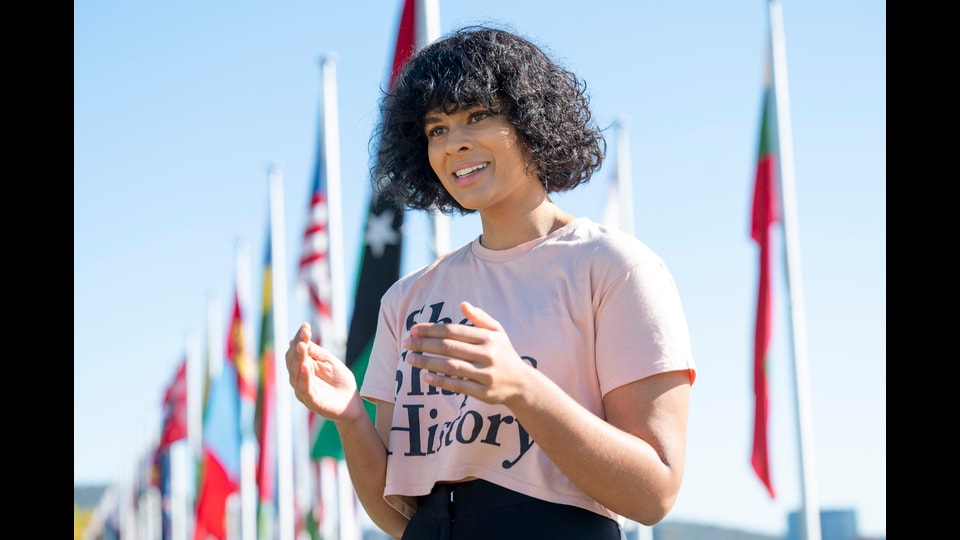
That question sits at the heart of She Shapes History, the walking-tour company Sargeant founded to uncover the women who shaped Australia’s cities — and whose stories have long been overlooked or sidelined. What began as a local project during the pandemic has since grown into a national movement. Now, with her debut book, She Shapes History: Guided Walks and Stories About Great Australian Women, Sargeant’s mission has expanded beyond the streets and into print.

Much like the tours themselves, the book refuses to treat history as distant or dull. Part travel guide, part feminist archive, and part provocation, it asks readers not only to learn differently, but to notice differently.
“I actually never planned to write a book,” Sargeant says. When an email from a publisher landed in the company’s generic inbox, she assumed it was spam. “It sounded far too good to be true. I genuinely thought someone was trying to scam me.” She ignored it for days before curiosity got the better of her. A quick Google search revealed Hardie Grant Explore was very real. “I wrote back immediately and said I would love to meet.”
On Zoom, the pitch was ambitious: take what she was doing in Canberra and turn it into a national travel guide, a series of walking tours through towns and cities across Australia. “Without really thinking about what that meant, or how much work it would involve, I said yes,” she admits.
That yes set off a chain of decisions that would reshape her life. By October 2023, Sargeant had quit her museum job, spent the entirety of her advance on a Subaru Forester and a rooftop tent, and hit the road. For six months, she criss-crossed the country, sleeping in her car and immersing herself in local archives, libraries and conversations, tracking down women whose contributions had slipped through the cracks of history.
Those months were transformative. “They completely changed how I see Australia,” she says. “They reinforced something I had already started to realise through the tours: this country has a huge issue with recognising women’s contributions, but it’s also a solvable issue.”
The result is a book that feels deliberately unlike a traditional history text. Designed in a playful, scrapbook-style format, She Shapes History features more than 500 stories across 31 towns and cities, from Melbourne and Hobart to Coober Pedy and Kalgoorlie. There are 18 self-guided walking tours complete with maps, but readers can also dip in at random, discovering short vignettes and breakout anecdotes that spotlight lives often left at the margins.
The women who populate these pages are varied: disability activists who helped found Meals on Wheels, flamboyant underworld queens of Kings Cross, political trailblazers, artists, spies, sex workers and suburban organisers. They are radical and flawed, funny and brave. “I really wanted to show women as complex,” Sargeant says. “Not as saints or symbols, but as people who made choices, took risks, and shaped the world around them.”
The origins of She Shapes History trace back to 2021, when Sargeant returned to her home town of Canberra during the pandemic. Having spent several years living in Brisbane, she found herself seeing the capital with fresh eyes — and noticing a glaring absence. “I kept asking a really simple question,” she recalls. “Where are the women? Where are the women in the story of Australia? In the story of Canberra?”
What she saw instead were familiar archetypes: bushrangers, convicts, soldiers, politicians. “Women were often cast as minor characters, as wives, daughters, secretaries, typists, if they were included at all,” she says. “Countless stories have been lost, left unrecorded, undervalued, and untold. It felt like, as a society, we had forgotten that women were behind many of the moments that shaped Australia.”
The stories existed, she knew that much from her research background, but they weren’t being shared in accessible or engaging ways. “Most Australians didn’t realise they were there,” she says. Social media briefly crossed her mind as a solution, but she kept returning to the idea of walking. Walking tours, she realised, are uniquely democratic. They assume no prior knowledge. They meet people where they are.
“Walking tours don’t talk down to people,” Sargeant explains. “You can adapt stories in real time and respond to the conversations happening within the group. That makes history feel immediate and personal.” Standing in the place where something happened collapses the distance between past and present. “When you’re physically there, it’s easier to see that these stories are part of the spaces we move through every day.”
Being in place also makes the silences obvious. The missing plaques, unnamed buildings, and forgotten stories. “It gives you the chance to uncover what’s been overlooked or erased,” she says. “And it makes people think, ‘I could have been part of that story.’ That’s incredibly powerful.”
That power has only grown as She Shapes History has expanded. What started as a local Canberra project now includes private bookings, partnerships with major museums and cultural institutes, podcasts, storytelling content and special one-off events, including recent collaborations with TEDx Canberra and the National Portrait Gallery. More than a tour company, it has become a cultural platform, using tourism as a tool for social change.
At its core, She Shapes History is a social enterprise dedicated to closing the gender respect gap. The idea is simple but far-reaching: whose stories we tell shapes whose lives we value.

Sargent believes that Australian history is often dismissed as boring or unrelatable precisely because it has been narrowed to a handful of male narratives. “The dominating stories suggest that only men have shaped our nation,” she says. “That means a lot of women, especially women of colour, LGBTQIA+ people and those from the disability community, can’t see themselves reflected in our shared past.”
The reality is far richer. Australia was home to the first woman of colour to vote, a suburban housewife who became one of the country’s most effective Cold War spies, and the woman who designed the nation’s capital. “When those stories are missing, it creates a disconnect,” she says. “The history people are taught doesn’t match their sense of national identity.”
On International Women’s Day, conversations about representation often focus on boardrooms, parliaments and pay gaps. Sargeant doesn’t disagree, but she believes the roots of change are closer to home. “When half the population are quite literally left off the map, it sends a message that their contributions don’t matter,” she says. “That invisibility shapes how we value women today. It reinforces a culture that undervalues women’s work, leadership and agency, and even contributes to the conditions that allow violence against women to continue.”
Telling local, everyday stories becomes an act of resistance. “Recognising the women around us adds up to a bigger shift in how we see and value women everywhere,” she says. “I truly believe that something as simple as going on a walk can create more respect for women today.”
The ambition doesn’t stop at Australia’s borders. In a significant new step, She Shapes History tours have now launched in New York — proof that the model travels, and that the hunger for women-centred public history is global. “It’s pushed us to think much bigger,” Sargeant says. “About scale, about impact, about what this could look like in cities all over the world.”
That global vision is reflected in the book itself, which allows the stories to move far beyond the physical limits of a walking route. “It lets these women travel,” she says. “It reaches people who might never come on a tour, and it invites readers to engage with history on their own terms.”
As for what’s next, Sargeant is characteristically open — and ambitious. Her goal is to see She Shapes History in every major city around the world. And yes, India is firmly on that list. “There are so many stories there, so much women’s history that deserves to be seen and celebrated,” she says. “I would love to walk those streets and start asking the same question.” Where are the women?
Teja Lele is an independent editor and writes on books, travel and lifestyle.


