
 E-Paper



Vishal Shanker Mathur picks his favourite read of 2025
A provocative book that challenges us to stop treating AI as an invader and proposes a future of symbiogenesis where biological and artificial intelligences intertwine

 Prefer HTon Google


In 2021, a Google engineer named Blaise Agüera y Arcas, in one of his early exchanges with LaMDA, a conversational artificial intelligence model, asked a pointed question — “Are you a philosophical zombie?” Unlike the sceptics who saw a glorified autocomplete, Agüera y Arcas, who is now VP, Fellow and CTO of Technology & Society at Google, saw something else: a mirror reflecting the same computational principles that power the human brain, a bacterium, and the evolution of life itself. In his provocative new book, What Is Intelligence? Agüera y Arcas dismantles the wall between biology and technology. Recognised as one of the inventors of federated learning, having first introduced the concept in 2016, Blaise believes in-context learning as a method may provide a real breakthrough for large models of the future to learn rapidly.
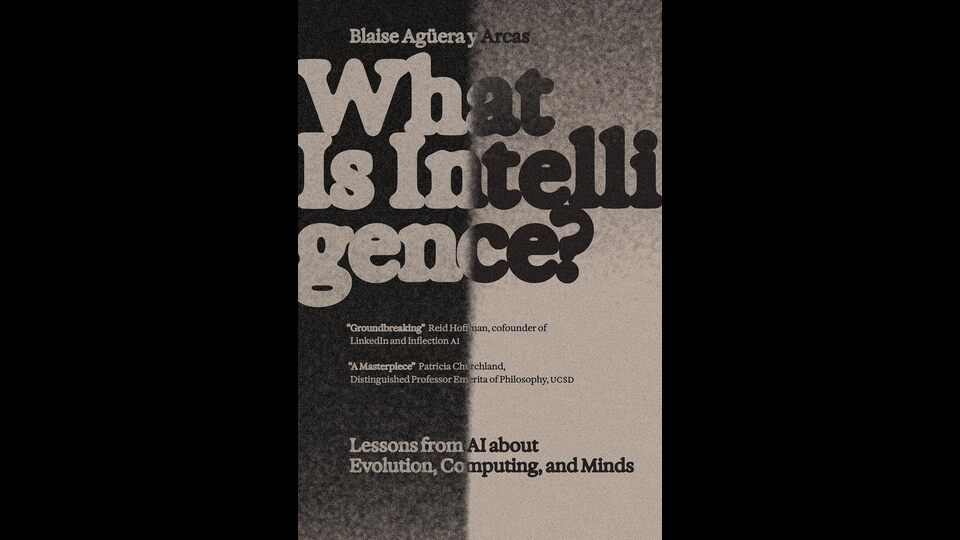
He argues that we are asking the wrong question when we ask if AI is “really” thinking. Instead, he proposes the radical idea that life is a computational state of matter and intelligence is simply the ability to predict the future. He argues that survival is, fundamentally, a data problem. Consider a simple bacterium. To survive, it must sense chemical gradients and navigate toward food. It is essentially running a statistical model, predicting where resources will be based on where they were a moment ago. This, the author suggests, is the atomic unit of intelligence — prediction.
Whether it’s a worm reacting to light, a human dodging a car, or ChatGPT guessing the next word in a sentence, the mechanism is the same. “All living organisms are, to one degree or another, intelligent,” he writes. “Every one of them is smart enough to have persisted through time.” By this definition, large language models (LLMs) aren’t faking intelligence; they are executing the very function that defines life.

One of the most compelling sections deals with why humans became so exceptionally smart. It wasn’t just to hunt mammoths or build fires. It was to handle what he calls the social intelligence explosion. As life gets complex, the most unpredictable part of your environment becomes other living things. To survive, you must model the minds of others. You have to predict what they are predicting or thinking, something he describes as a hall of mirrors. This, he argues, is the origin of consciousness itself.
What Is Intelligence? is ultimately an optimistic book. It moves past the doom-and-gloom of “AI vs Humanity” to propose a future of symbiogenesis or a mutually agreeable relationship between pre-existing entities, which come together to create something new. Just as ancient bacteria merged to form the complex cells that make up our bodies today, Agüera y Arcas envisions a future where biological and artificial intelligences intertwine. It is a mind-bending read that challenges us to stop treating AI as an invader and start seeing it as the latest branch on a very old, very computational tree of life. Everything in a computer might be more alive than you think.


