
 E-Paper



Looking to explore the wild side? Head to the one-horn nation
Tigers may remain elusive in Kaziranga, but rhinos are everywhere — and so is sumptuous food


As we climb down from a watchtower deep inside the forest, a tourist from another Gypsy asks, “Where are you guys coming from?”
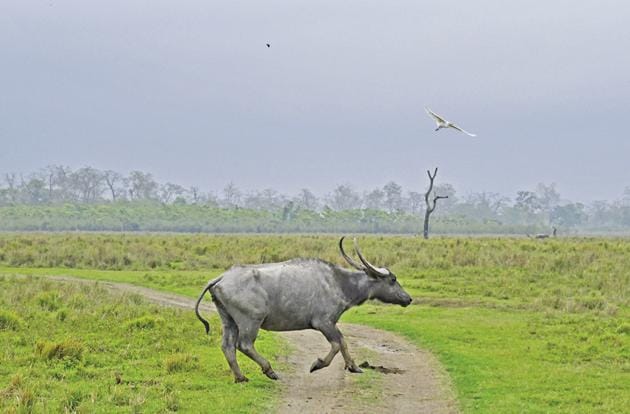
“Delhi,” I say.
“Arre, then why come here? There’s Jim Corbett and Ranthambhore near your home, na!”
I try to explain that every jungle is unique and just because Kathmandu is closer to Delhi doesn’t mean I should not buy tickets for Kuala Lumpur.
Actually, I am a sinner. Long ago, I was posted in Assam for a year but didn’t see Kaziranga. It’s like visiting Egypt and not finding time for the pyramids.
The closest I came to Kaziranga was on a cold night in Guwahati, when my friend Samim Sultana said, “Let’s form a group and go to Kaziranga.” I think I yawned and said good night.
Turning savage
This time, I ask every Assamese I know: how do you get the best out of Kaziranga?
Rituparna, my colleague at the Hindustan Times, connects me to a travel company in Assam.
Leftist Sushanta Talukdar says, “Why do you want to stay there? You can see rhinos even from the highway.”
Finally, Achinta Borah sends me the number of Mukut Das, the Assistant Conservator of Forest, with a note: “He’s your best go-to person.”
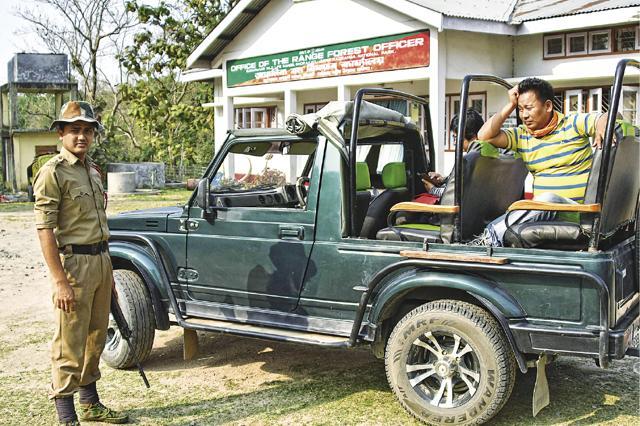
Das helps me book the elephant safari without involving agents. He also gets me Kutub Ahmed, a top-rated guide in Kaziranga.
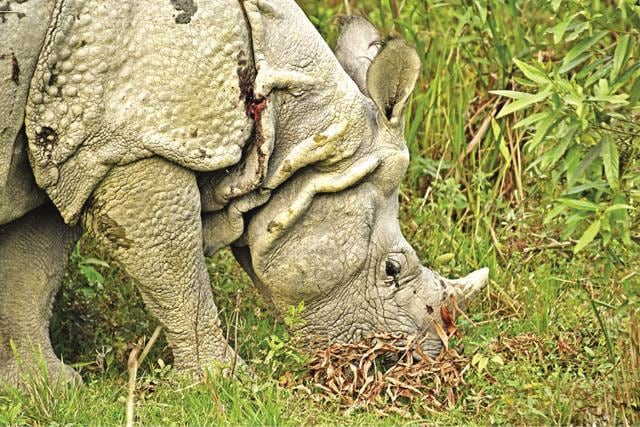
Five minutes after Kutub and his driver take my wife and me inside the Bagori range, we meet a rhino barely 20 meters away from our Gypsy. The fat fellow is happily grazing after a turf war. As the vehicle moves closer, the vegetarian stops eating and raises his head with a cold look.
Kutub panics. “Move out,” he directs the young driver. He has reasons to worry. Last week, three rhinos targeted his other car, leaving it almost beyond repair.
“Rhinos can run very fast. Even elephants don’t dare to disturb them,” Kutub says from his 18 years’ experience as a safari guide.
My wife’s friend helped us book Borgos, an awesome resort with awfully slow service. But I don’t mind. This is a place to relax, not rush.
As three people at the reception try to fix the Wi-Fi service, I order a beer and chicken fry from its restaurant. The waiter comes with a bottle. ‘Savage Beer, extra strong’, the label reads. “Are you sure this is good?” I ask.
“Yeh best hai,” he announces.
After I am done with two Savage bottles, I start getting calls from the forest office detailing the elephant safari next morning. I understand Assamese, but now it sounds somewhat like Latin. The only word I remember is ‘elephant’.
Back in our room, my wife asks, “Everything finalised?” I promptly nod my head, “Of course!”
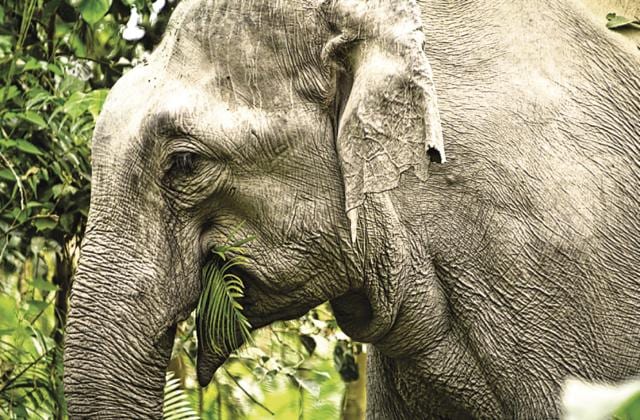
Early in the morning, the forest guy again calls. A young elephant is assigned for us. But our mahout is overcautious. He waits for all other elephants to arrive before approaching a rhino. The result: I miss some good photo ops. At the end of the safari, I realise it’s more difficult to get off an elephant. He’s a hot-blooded animal eager to go out. So, with two forest guards pulling me and one pushing me, I finally come down.
I try a new guide for a jungle safari in Kohora range. The guy has little interest in helping us spot animals. We drive around the muddy path interrupted with occasional comments like: “Sir, three days ago I saw a tiger here”, “four days ago I saw a tigress there.”
For the birds
Our cabbie from Guwahati takes us to a small, shabby outlet with a hoarding: Hornbill restaurant. But behind its dirty curtains is a brilliant world of Assamese food. When our thali comes, I am speechless. It is the best Assamese thali I’ve ever had, far better than Delhi’s overpriced Assam Bhawan.
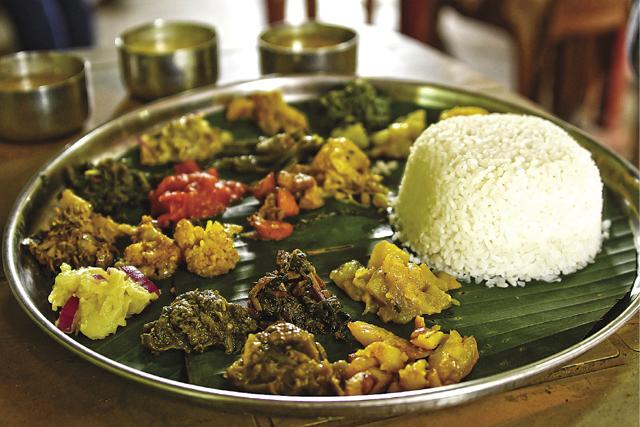
My wife declares, “If you give me such great vegetarian fare, I don’t need to eat non-veg.” Then, the country chicken curry arrives. She quickly changes her mind.
That afternoon, Kutub takes us to the westernmost range – Burapahar. An armed forest guard jumps into our vehicle and says, “You are the only tourist here today. I need to protect you from charging rhinos.”
In the fascinating terrain of Burapahar, we reach a point where the jungle suddenly comes to an end. There, the Brahmaputra, India’s mightiest river, flows slowly, eating away large tracts of land.
In the monsoon, almost every year, this river floods Kaziranga, leaving animals dead. But its devastating waters have also inspired poets, authors and singers of Assam and the North East. The confluence of the river and the jungle paints a serene portrait of nature. The air is so fresh. The sky is so clear. And all I hear is the sound of small waves bashing the bank.
Suddenly, Kutub turns the wheel and approaches a small patch of elephant grass. “Sshhh, don’t make noise. We’ll see a very rare bird. Bengal florican.” As soon as our car stops, a huge bird flaps its black and white wings and flies away. “Oh Lord, I see it after three years!” Kutub exclaims.
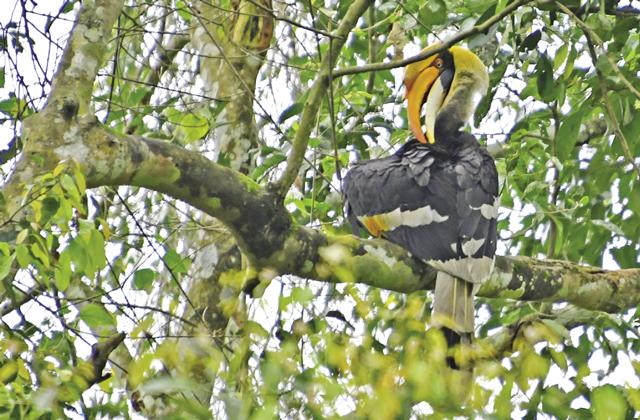
“The Bengal florican is so rare that there’s a special act to protect it. Recently, a foreigner spent 15 days in Kaziranga only to spot it and couldn’t find it,” says the overwhelmed guard. In that moment of ecstasy, I murmur: “When can we see a tiger?”
The armed guard, Kutub and my wife are aghast. “Sir, you just spotted a Bengal florican! A Bengal florican!!” says Kutub.
Back in Delhi, I run into my friend, NDTV’s Sandeep Phookan, on a blistering afternoon. “How was your Kaziranga trip?” he asks. “Not good. I spent not one, but three days, but couldn’t see a tiger.”
“S***”, the Assamese snubs. “I have been there at least 20 times. I am yet to see a tiger.”
Follow @SaubhadraC on Twitter
From HT Brunch, May 14, 2017
Follow us on twitter.com/HTBrunch
Connect with us on facebook.com/hindustantimesbrunch


