The Union budget for 2019-20 on Friday unveiled broad measures aimed at catapulting India into a $5 trillion economy within the next few years, announcing ramping up of physical and social infrastructure. The size of the Indian economy is $2.7 trillion currently. PM Narendra Modi on June 15 laid down the target, when he said the “goal to make India a $5 trillion economy by 2024 is challenging, but achievable.”
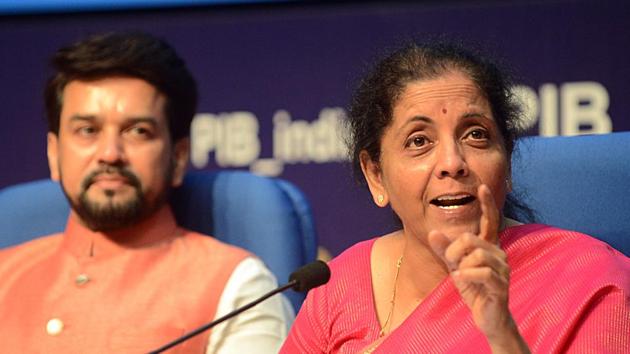
Finance minister Nirmala Sitharaman said India was poised to become a $3 trillion economy by end of 2019-20.
The $5 trillion benchmark refers to the size of the Indian economy or the value of its gross domestic product (GDP) in absolute terms by 2024. Put another way, the value of all goods and services produced in India, as measured by the value of the dollar in 2024, should be about $5 trillion by that year. The government spelt out broad measures to boost private investment, the single most critical driver of growth. “I wish to propose a number of initiatives as part of a framework for kick-starting the virtuous cycle of domestic and foreign investments,” Sitharaman said. Here are some of the proposed steps. The budget allocated Rs 100 lakh crore for the infrastructure sector, with an expert committee to ensure ease of flow of funds. The government plans to inject another Rs 70,000 crore into the country’s public sector banks to quicken the pace of lending to various sectors.
The budget talked about further opening up of Foreign Direct Investment (FDI) in aviation, media and insurance sectors, including allowing 100% foreign holding in insurance intermediaries. In single-brand retail sector, local sourcing norms will be eased for FDI. Does the size of the economy matter? It does in that the rate of economic growth is, after all, nothing but the increase in the overall size of the economy (GDP) expressed as a percentage.
{{/usCountry}}The budget talked about further opening up of Foreign Direct Investment (FDI) in aviation, media and insurance sectors, including allowing 100% foreign holding in insurance intermediaries. In single-brand retail sector, local sourcing norms will be eased for FDI. Does the size of the economy matter? It does in that the rate of economic growth is, after all, nothing but the increase in the overall size of the economy (GDP) expressed as a percentage.
{{/usCountry}}“There is a general view that the bigger the cake, the better. This is the neo-classical mantra,” said NR Bhanumurthy, an economist with the National Institute of Public Finance and Policy.
Neo-classical economics denotes a bunch of economic theories that primarily deal with how economies grow and the role investment plays in it.
To achieve a target of $5 trillion, India’s inflation-adjusted growth rate must be 8%, Bhanumurthy said. The budget was a more medium-term growth document rather than having a one-year focus, according to him. Merely achieving a target of $5 trillion may not be an end in itself. To be sure, economists widely view GDP as a necessary but not a sufficient condition of human well-being.
“It helps us to say we are the fastest-growing economy or the third largest economy. It is a feel-good number…that sort of a thing,” said economist Abhijit Sen. However, Sen argues if an increase in GDP translates into an increase in incomes, what ultimately matters is how it is distributed and whether people’s spending power will go up.