...
...
Next Story

Excise duty cut on petrol-diesel: Relief likely temporary as international crude prices expected to rise

The relief however is likely to be temporary, as crude prices are expected to rise in the future and probably cross the psychological barrier of $100 per barrel, last seen in 2014. A falling rupee will mean that prices increase even more in rupee terms.

Updated on: Oct 5, 2018, 08:36:35 IST
Hindustan Times, New Delhi | By
Prefer HTon Google
Advertisement

Finance minister Arun Jaitley on Thursday announced a cut of 2.5 per litre on the prices of petrol and diesel. According to data from Indian Oil, the existing levels of excise duty on petrol and diesel (as on 1 October 2018) are 19.48 per litre and 15.33 per litre. Jaitley also called upon state governments to undertake similar cuts in state Value Added Tax on petroleum. Twelve states have already announced a cut of 2.5 per litre on these taxes. Some states had announced cuts of varying magnitudes earlier. Thursday’s cuts will lead to a reduction of 5 per litre in petrol-diesel prices. Petrol and diesel prices have increased by 19.8% and 26% between 1 January and 3 October this year.
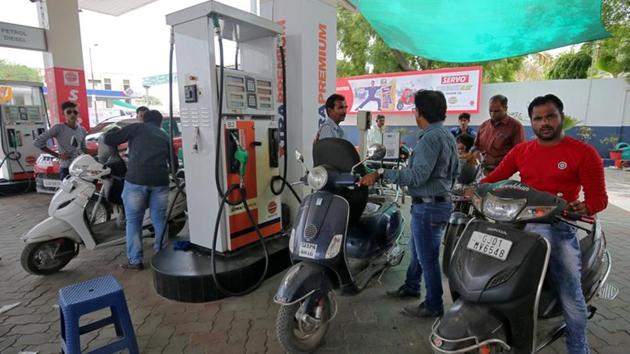
Finance minister Arun Jaitley announced a cut of  ₹2.50 in the price of petrol (REUTERS File)
Finance minister Arun Jaitley announced a cut of ₹2.50 in the price of petrol (REUTERS File)

The relief however is likely to be temporary, as crude prices are expected to rise in the future and probably cross the psychological barrier of $100 per barrel, last seen in 2014. A falling rupee will mean that prices increase even more in rupee terms.

On Thursday, crude was trading at more than $85 a barrel, and the rupee closed at 73.58 to the dollar. The chart given below shows the monthly average of petrol and diesel prices in Delhi and the price of India’s crude oil basket till September 2018.

Petrol and diesel prices have increased by 7.2 and 7 per litre in the month of September itself. If the crude and rupee continue their current trajectory, the relief from government’s tax cuts will nullify itself in a very short period. The question is whether this will be a one-off cut in petroleum taxes or will more such moves follow as elections come closer.

 
ABOUT THE AUTHOR
Roshan Kishore

Roshan Kishore is the Data and Political Economy Editor at Hindustan Times. He heads the newsroom's data journalism team, which produces Number Theory, a daily data-driven feature for the print edition and the HT app. Number Theory uses data analysis and story-telling based on it to add value to the newsroom’s daily coverage by putting stories in a larger context on a range of issues, including politics, macroeconomy, markets, global affairs and climate. Under his leadership HT’s data journalism work has established itself as a niche product in Indian journalism and pushed the boundaries of marrying academic rigour with news sense and speed. Along with writing and editing data stories, he has also been writing a weekly political economy column called Terms of Trade for HT Premium. A trained economist with an MPhil degree from Jawaharlal Nehru University, Kishore has also been a visiting fellow at the Centre for Advanced Studies of India (CASI) at the University of Pennsylvania. Along with his journalistic work, his writings have also appeared in journals such as the Economic and Political Weekly and working papers for CASI and UNESCAP.

Stay updated with the latest Business News, stock market updates, petrol and diesel prices, gold and silver rates, income tax updates and major developments from India and across the world.
SHARE THIS ARTICLE ON
Hindustantimes wants to start sending you push notifications. Click allow to subscribe