
 E-Paper



Retail inflation climbs to 4.91% in November
The increase in non-core inflation in November is primarily the result of an increase in food inflation, particularly the inflation in cereals and vegetables.

 Prefer HTon Google


Retail inflation, as measured by the Consumer Price Index (CPI), increased for the second consecutive month in November to 4.91% from 4.48% in October, despite the central and several state governments reducing fuel taxes early in the month. A Bloomberg poll of economists had estimated inflation at 5.1% for November.

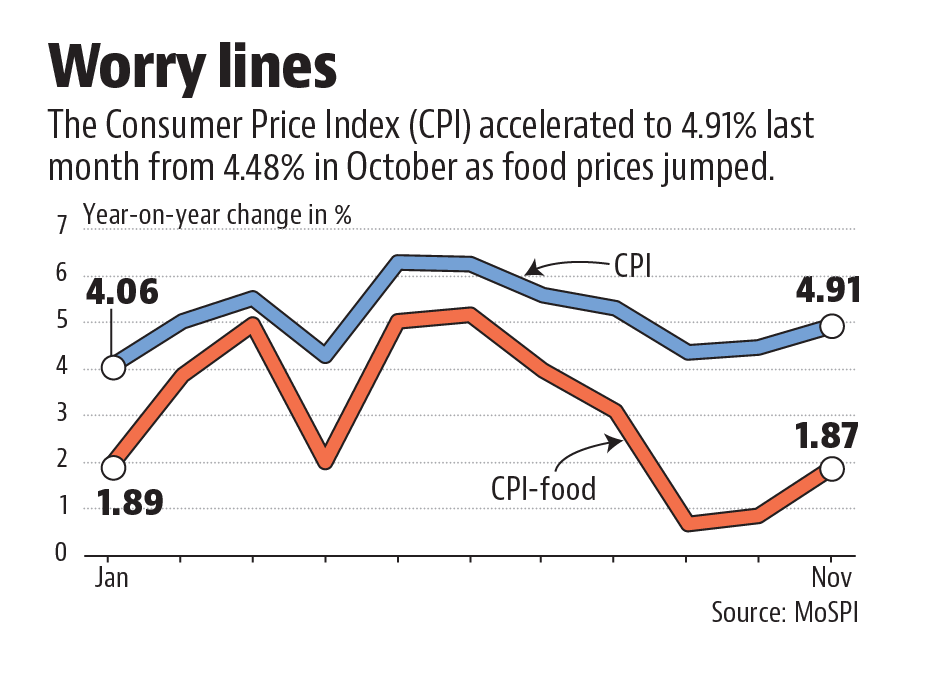
The low headline inflation number is because of a favourable base effect from high inflation in November 2020. Core inflation – that excluding the food and fuel and light groups – continued to be above the 6% mark. It has decreased by only 5 basis points: from 6.24% in October to 6.19% in November. Non-core inflation increased by 76 basis points to 3.39%. One basis point is one-hundredth of a percentage point.
The increase in non-core inflation in November is primarily the result of an increase in food inflation, particularly the inflation in cereals and vegetables. Fuel and light inflation did decrease by 100 basis points, a result of the tax cuts last month.
Inflation in the food group, which has 39% weightage in the CPI basket, increased from 0.85% in October to 1.87%. Cereals and products – they make a quarter of the food group – inflation rose from 0.41% to 1.51%, the highest since November last year. This was because of an increase in rice inflation from 0.07% in October to 0.95% in November and in wheat or atta from 0.27% to 2.42%.
Tomato prices – where inflation was 31.35% in November compared to -8.4% in October – were responsible for reducing the fall in vegetable inflation. Vegetable prices decreased 22.42% in September year-on-year, 19.43% in October, and decreased by 13.62% in November. This trend is likely the result of heavy rain in October and November. The moderation in core inflation is also largely because of the moderation in transport inflation, a result of the cut in fuel taxes. Transport has a weightage of 8.6% in CPI, and inflation for this sub-group decreased 88 basis points to 10.02%. Clothing and footwear inflation and housing inflation increased 41 and 12 basis points, respectively, compared to October. Input cost pressures because of high raw material prices and global supply chain disruptions are a likely cause of high core inflation, RBI governor Shaktikanta Das had said earlier this month. The Monetary Policy Committee (MPC) however voted to keep the benchmark repo and reverse repo rates unchanged, in expectation that inflation will go down once fuel tax cuts are passed down and rains stop affecting vegetable prices.
“In our assessment, as long as the CPI inflation remains within the target of 2-6%, the MPC and RBI will prefer to prioritise growth, and maintain policy support to impart durability and sustainability to the recovery. As of now, there isn’t enough evidence on the durability of the growth recovery to confirm that the stance will be changed to neutral in the February 2022 policy review,” Aditi Nayar, chief economist at ICRA Limited, said in a note.


