E-Paper



US report criticises India’s trade policies
It labels India’s average most-favoured-nation (MFN) applied tariff rate of 17% in 2023 as “the highest of any major world economy.

 Prefer HTon Google


A day before retaliatory tariff announcement was expected on April 2, the Trump administration on Tuesday released a report criticising India’s trade policies, highlighting both tariff and non-tariff barriers that American exporters face in the Indian market.
Officials in India characterised the report as part of an “annual routine exercise” and said it appeared to refer to some issues that had been ironed out and pointed to several other aspects that are part of discussions between the two countries for a bilateral trade agreement that they want to sign by fall this year.
“Most of its contents are from the report of the previous years, and it could not capture some of recent developments because of time lag. For example, India has withdrawn the Google tax (the 6% equalisation levy) recently, but the same is not mentioned in the report,” said one person aware of the development.
The 2025 National Trade Estimate (NTE) report, prepared by the US Trade Representative (USTR) and released on March 31, dedicates 16 pages to India out of its 397-page assessment of global trade barriers. India ranks as America’s 13th largest merchandise export market, after Canada, Mexico and China.
A second official said the assessment is based on feedback from American traders and investors. “It compiles their asks mainly related to NTBs [non-tariff barriers]. We also have similar asks. For example, they too impose stringent requirements for Indian pharmaceutical exports,” this person added.
A third person said that India too is planning similar reports. “The report has caught unusual attention because of the timing, that matched with the Trump’s administration’s impending retaliatory tariff action on April 2. India has already created an NTB portal, which is currently in beta stage. A section of its content will be made public soon.”.
To be sure, the American report elaborated on both, NTBs and duty rate mismatches.
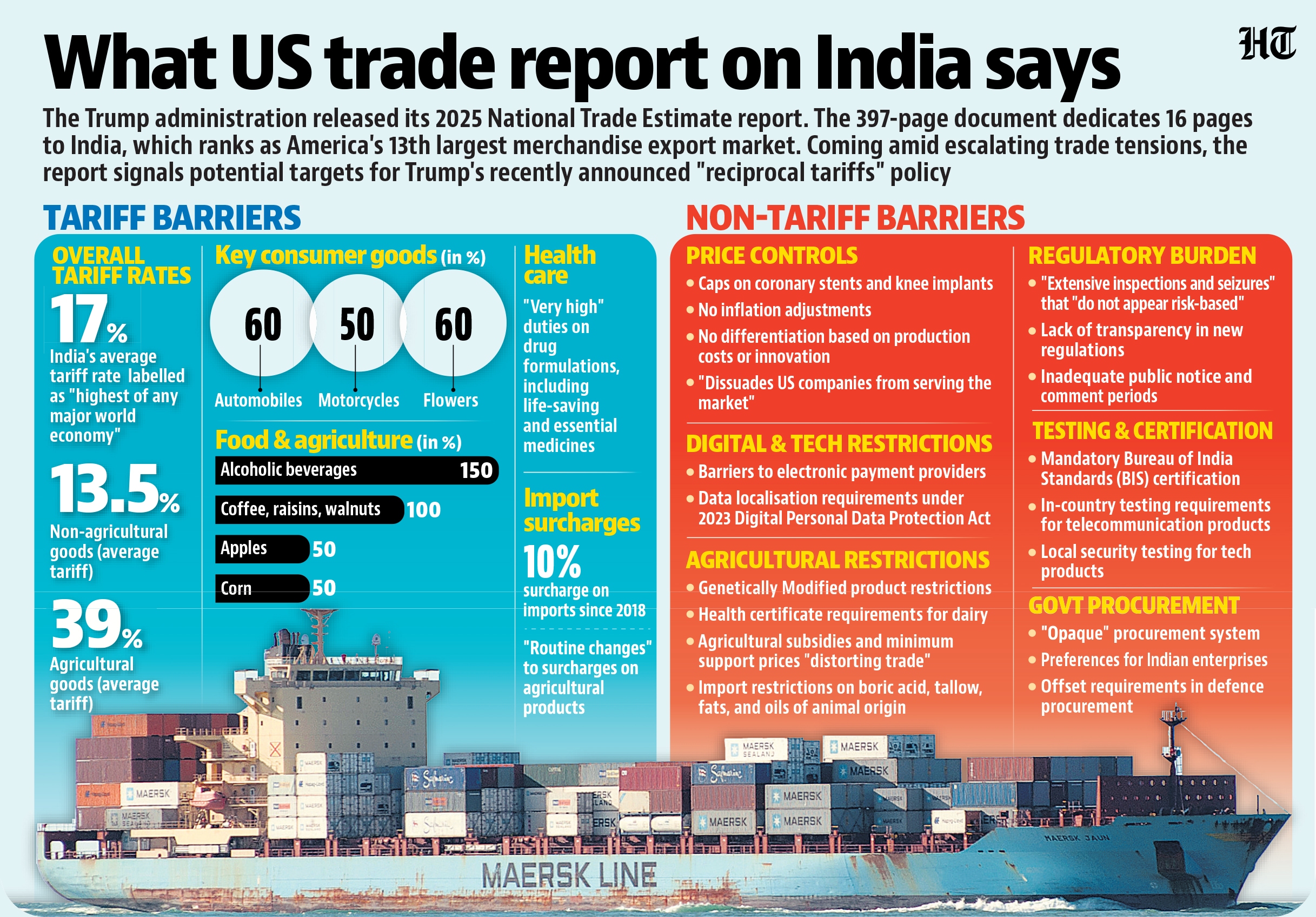
It labels India’s average most-favoured-nation (MFN) applied tariff rate of 17% in 2023 as “the highest of any major world economy.” It stated that on average, India levied 13.5% import duties on non-agricultural goods, but on agriculture, it was 39% average.
American officials specifically flagged steep tariffs on numerous products: alcoholic beverages (150%), coffee, raisins and walnuts (100%), natural rubber (70%), automobiles and flowers (60%), apples, corn and motorcycles (50%), and vegetable oils (up to 45%). The report also noted “very high basic customs duties” on drug formulations, including life-saving medicines, and on processed foods like poultry, citrus fruits, chocolate, and items used in fast-food restaurants.
Adding to these barriers, the report cited India’s 10% surcharge on imports since 2018 and “routine changes” to surcharges on agricultural products without adequate notification.
Beyond tariffs, the report highlighted multiple NTBs affecting American businesses. “India’s National Pharmaceutical Pricing Authority caps prices of coronary stents and knee implants,” the report stated, noting these controls “have not been increased in line with inflation and do not differentiate on the basis of the cost of production or technological innovation, which dissuades US companies from serving the market.”
The report criticised India’s agricultural subsidies and Minimum Support Price (MSP) program covering 25 products as “distorting trade.” It specifically mentioned credit subsidies, debt waivers, crop insurance, and input subsidies for fertiliser, fuel, electricity and seeds. “The MSP bolsters planting decisions, resulting in overproduction, limited demand for imports, and artificial export competitiveness,” the report stated, noting that rice and wheat account for the largest share of products under this program.
To be sure, the World Trade Organization’s (WTO) frameworks allow countries to implement non-tariff measures to protect public health, safety and other legitimate policy objectives, such as protecting vulnerable industry like farmers, and several countries, including the US, have leveraged these provisions. The American contention, in part, appears to include a criticism on transparency. “A lack of transparency continues to affect new and proposed laws and regulations, as well as a lack of uniform notice and comment procedures and inconsistent notification of these measures to the WTO,” the report stated.
The report highlighted several other issues, including violations of intellectual property rights, restrictions on foreign investments in financial services and retail sectors, “extensive inspections and seizures” of imports that “do not appear risk-based”, “opaque” government procurement system and requirements for health certificates for dairy items.