
 E-Paper



With CAA, Article 370 volleys, PM Modi takes aim at Opposition
The Prime Minister, at the same time, called for the ongoing Parliament session to be “dedicated” to the economy while saying that its fundamentals


Prime Minister Narendra Modi on Thursday launched a scathing attack on the Opposition, blaming the Congress and the Left parties for hiding behind the Constitution to encourage those who were violating it, reading out quotes from three former Jammu & Kashmir chief ministers to justify their preventive detentions, terming the anti-CAA protests as anarchic, and staunchly defending the changed citizenship law by highlighting the plight of minorities in Pakistan.
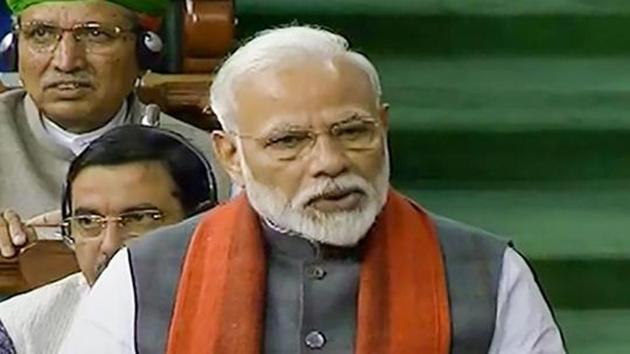
The Prime Minister, at the same time, called for the ongoing Parliament session to be “dedicated” to the economy while saying that its fundamentals – from fiscal deficit targets to manageable inflation to macroeconomic stability – were strong.
Modi also spoke in the Rajya Sabha later -- the first time he addressed both houses of Parliament in the same day -- focussing more deeply on the economy and bringing in the National Population Register (NPR) into the discussion by asking Opposition leaders not to “mislead” people by “lying” about what he called a “regulation administrative process”.
In a fiery Lok Sabha speech often interrupted by objections and interjections from the Opposition benches, Modi, in his reply to the Motion of Thanks by President Ram Nath Kovind, said: “The people who are trying to lecture us to save the Constitution, need to repeat their own words to themselves. These are the same people who imposed the Emergency, tried to take judicial rights away from the Supreme Court, tried to end the right to life, made the most changes in the Constitution, dismissed state governments dozens of times, tore Cabinet decisions in press conferences, and put up a remote control above the prime minister and the PMO.”
Linking that with ongoing agitations in several parts of the country against the Citizenship (Amendment) Act, or CAA, Modi said that it was these same people who were standing next to those who wanted to divide the country (“tukde-tukde”), and were encouraging people through lies and speeches to undermine democratic decisions. “Can the path of anarchy run the nation?” Modi asked.
The speech was broken into eight distinct parts: Modi first addressed questions raised by members about the hurry with which the government was bringing in major legislations in this term; he then spoke about integrating the North-east and held the recent Bodo peace accord as an example; spoke on measures to boost the farm sector; called for a constructive debate on the economy, which, he said, was ploughed and ready to seed; criticised “disruptive and violent” protests while citing the Constitution; castigated those who slammed the nullification of special provisions for J&K; offered a treatise on why CAA was necessary, including quotes from Jawaharlal Nehru and past Hindu legislators in the Pakistan parliament; and finally called on fellow parliamentarians to come together to work for development rather than division.
“Instead of this, come, let’s sit together and run the country. Let’s take India on the path to becoming a $5 trillion economy, let’s resolve to give clean drinking water to the 15 crore families who don’t have it, let’s work together to give every poor person a home, and every farmer, fisherman, cattle raiser a better income. Let’s make it possible for every panchayat to have broadband connectivity and to make ‘One India, Leading India’. Come, let us sit together to take India forward,” he said.
The Congress rejected Modi’s contentions, with its former president Rahul Gandhi calling the PM’s speech an attempt at distracting the people. “His style is of distracting the country. Talk about the main issue Prime Minister ji. Tell the youth what you are doing about jobs...His style is to distract the country. He had said two crore jobs will be given to youngsters, but five and a half years have passed. Last year, one crore youth lost jobs, he is unable to say a word,” he said outside Parliament.
The Congress also said the PM’s comments on India’s former Prime Minister Jawaharlal Nehru -- Modi said the country was partitioned so that “one particular person could become the PM” -- were unacceptable. “It is extremely unfortunate and deeply regrettable that the prime minister’s comments oscillated between stand-up comedy, half truths and rank communalism. It is regrettable that the Prime Minister of India should quote one of his illustrious predecessors Jawaharlal Nehru completely out of context,” said Congress spokesperson Manish Tewari, calling on Modi to apologise for it.
While the PM’s speech was peppered with strong jibes and sarcastic attacks on the Opposition, particularly the Congress and its former president Rahul Gandhi, the most combative points of his speech were when he was talking about the CAA protests and Kashmir.
On Kashmir, particularly, he quoted comments by the former CMs made in August – at the time when Parliament cleared the nullification of Articles 370 and 35A, and the reorganisation of the region into two Union Territories – to suggest that they were not in sync with the spirit of the Indian Constitution. Saying that former CM Mehbooba Mufti of the Peoples Democratic Party (PDP) called the move a “betrayal”, Omar Abdullah of the National Conference (NC) warned of an “earthquake” in the aftermath of the decision, and Farooq Abdullah said people would stop waving the Indian flag in the region, Modi asked if any “true Indian” would “advocate the cause of such people”.
Mehbooba and the Abdullahs have been in preventive custody for the past six months – a move that has been criticised by opposition parties, civil society members, and raised in international forums.
Representatives from the NC and the PDP rejected Modi’s claims. “What former CMs had said in context of the Article 370 was that it is a right and guarantee given to them under Indian Constitution,’’ said PDP spokesperson and youth leader Tahir Sayeed. NC spokesperson Imran Nabi Dar said the government must answer what development had taken place since the Article 370 move for the region’s development since that was one of the reasons given for it.
In what was his first speech in Parliament on the anti-CAA protests, the Prime Minister repeated the government’s assurance that the law would not impact any Indian citizen. “From this House today, I would like to make it clear that the CAA law will not affect any Indian citizens, whether they are Muslim, Hindu, Sikh or from any religion,” he said.
CAA, passed by Parliament on December 11, identifies people from religious minorities from some neighbouring Muslim-majority countries as those eligible for Indian citizenship if they have faced persecution.
Just as he brought up Nehru in the Lok Sabha, Modi quoted Lal Bahadur Shastri, Ram Manohar Lohia, and a Congress Working Committee resolution of 1947 to contend that CAA was an idea that had endorsement in the past from the same parties that now opposed it.
In the same vein, he brought up NPR in the Rajya Sabha speech, saying it was the previous regime’s idea but was now being used to stir up a frenzy by “provoking” people with “false information”.
“The NPR is a normal administrative process. You brought it in 2010, now you are misleading people? These are procedural issues, don’t spread rumours,” he said.
With the Delhi elections just two days to go, the national capital made only fleeting appearances in the speeches – briefly while talking about anti-CAA protests; during a reference to the Eastern Peripheral Expressway as an example of the government’s pace of work; when he mentioned a scheme for regularising 1,700 unauthorised colonies; and once towards the end when he said that people accused in the 1984 anti-Sikh riots in Delhi had been made chief ministers by the Congress. (The reference was to Madhya Pradesh CM Kamal Nath, who was named in connection with the riots but has not been formally accused and denies any link).
Modi said that the difference between his government and opposition governments was its ability to deliver, and its intention to take everyone along (“sabka saath”). “Where the Congress saw Muslims, we see Indians,” he said, naming Khan Abdul Gaffar Khan, Ashfaqullah Khan, Begum Hazrat Mahal, Abdul Hamid and former president APJ Abdul Kalam as a few examples of Muslims who are forever linked with India’s values and identity.
If we had done work like the Congress, it would have taken us 50 years to get the enemy property law, 35 years to get next generation fighter aircraft and, even after 28 years, we wouldn’t have had a benami property law.
Modi also addressed specific members of the Opposition – including Gandhi, Congress’s floor leader Adhir Ranjan Chowdhury and Shashi Tharoor – for specific remarks made by them inside and outside the House in the past few days.
To Gandhi, who said in a rally in Old Delhi on Wednesday that the youth of the country would “lathi-charge Modi” over unemployment, the Prime Minister said he was happy with the forewarning and would prepare to make his back ready for the lathis by doing more ‘surya namaskara’.
When Gandhi first got up to object to Modi’s comment, the PM, without naming him, said: “I have been speaking for 30-40 minutes, but the current has finally reached only now.”


