E-Paper



I am planning to buy the Maruti Suzuki Fronx, but sales stopped in New Zealand after poor crash tests. Should I proceed?
Sales of the Maruti Suzuki Fronx were halted in New Zealand after a serious ANCAP crash test failure. What this means for Indian buyers.

 Prefer HTon Google


If you were planning to buy the Maruti Suzuki Fronx, the recent developments in New Zealand do raise a valid question. Here’s how to look at it, based strictly on what is known so far.
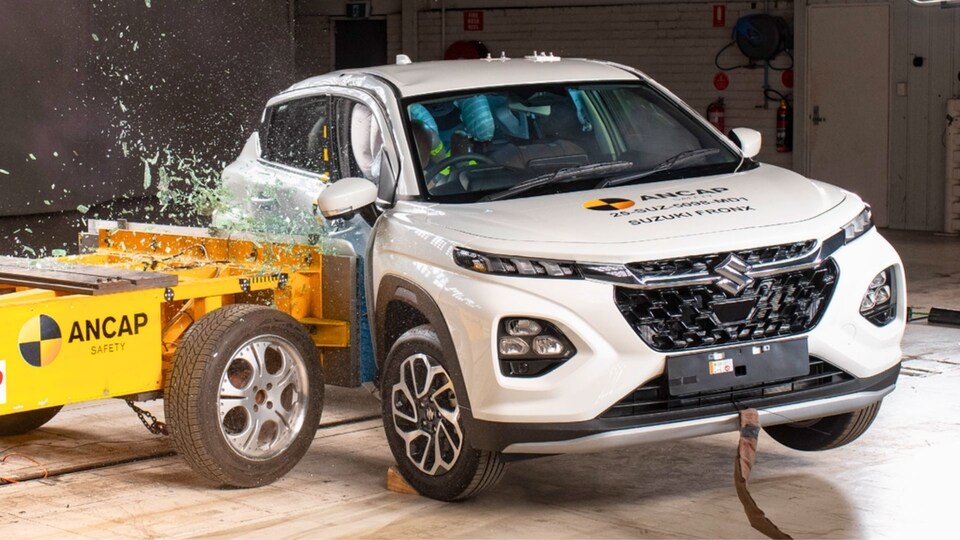
What exactly went wrong in the ANCAP crash test?
The Fronx sold in New Zealand and Australia, which is manufactured in India, has received a poor safety outcome from the Australasian New Car Assessment Program (ANCAP). Following these results, Suzuki has issued a recall in New Zealand and has temporarily stopped sales of the model in that market.
ANCAP’s main concern was a failure of the rear seatbelt retractor during a full-width frontal crash test. In that test, the rear seatbelt released uncontrollably, leaving the rear passenger dummy unrestrained and allowing it to hit the front seat. According to ANCAP, this kind of failure is rare and serious. Until the cause is identified and fixed, the agency has advised that adults and children should not travel in the rear seats of the Fronx. Australian and New Zealand safety regulators have also been informed.
Why did the Fronx score five stars elsewhere then?
This result is surprising because, earlier this year, the Fronx sold in Thailand scored a five-star rating from ASEAN NCAP. That model is also manufactured in India. The difference highlights an important point: NCAP ratings can differ across regions because the test protocols and scoring criteria are not the same.
What Indian buyers should know right now?
For Indian buyers, the crucial point is that the India-spec Fronx has not yet been tested by either Bharat NCAP or Global NCAP. This means there is currently no independent crash test rating that directly applies to the version sold here.
On paper, the India-spec Fronx comes well-equipped, with electronic stability control, hill hold assist, six airbags, ISOFIX mounts, three-point seatbelts for all seats and seatbelt reminders. These are important safety features; however, standard safety features do not substitute for verified crash performance.
(Also Read: Grap IV restrictions lifted in Delhi: Can I now drive my Petrol BS 4 vehicle?)
So, should you buy it or wait?
If rear-seat safety is a priority and you are uncomfortable with unanswered questions around the seatbelt mechanism, it would be reasonable to wait until Maruti Suzuki clarifies whether the issue affects India-spec cars and until an official Bharat NCAP or Global NCAP rating is available. If you plan to buy immediately, go in with the understanding that independent crash test data for the Indian model is still pending.
(This question was asked by Anuj Sharma from Mumbai)