
 E-Paper



Chandigarh increases testing, but high positivity rate remains a concern
The city’s testing rate was 150 a day in July, which jumped to 500 in early August and has now touched 700.

 Prefer HTon Google


Under fire for the last few months over low testing rates, Chandigarh has, for the first time, managed to test 700 samples in a 24-hour cycle. The feat, however, has been marred by the high positivity rate of 12%, which is four percent more than the national average.
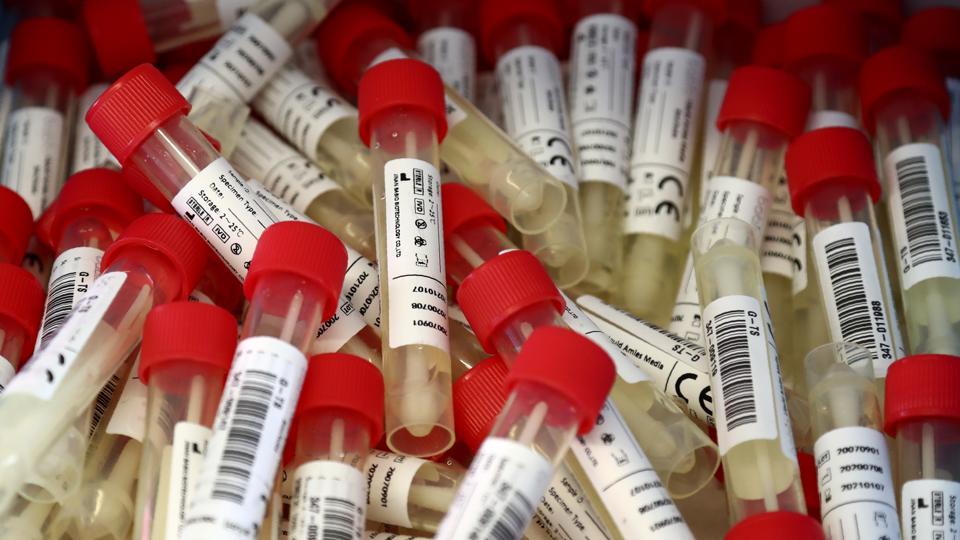
A community health expert at the Postgraduate Institute of Medical Education and Research (PGIMER), not wishing to be named, said, “The high positivity rate indicates that authorities are testing sick patients and those reporting for testing which is as per the established protocol. However, if more random samples within the high-risk and low-risk groups are taken, the positivity rate will eventually go down.”
When contacted, UT health secretary Arun Gupta said the city has now brought its testing rate to 700 a day and this number will be further be increased to keep up with the infection spread. “There is no target to be achieved here. We will go according to the virus spread. More people will come under the ambit of testing as the infection spreads,” he said.
The city’s testing rate was 150 a day in July, which jumped to 500 in early August and has now touched 700. Gupta added that number has increased after antigen tests were also included for the detection of infection in the asymptomatic cases.
UT’s test per million ratio currently stands at 23,381.7, which is less than the national average of 28,941.8.
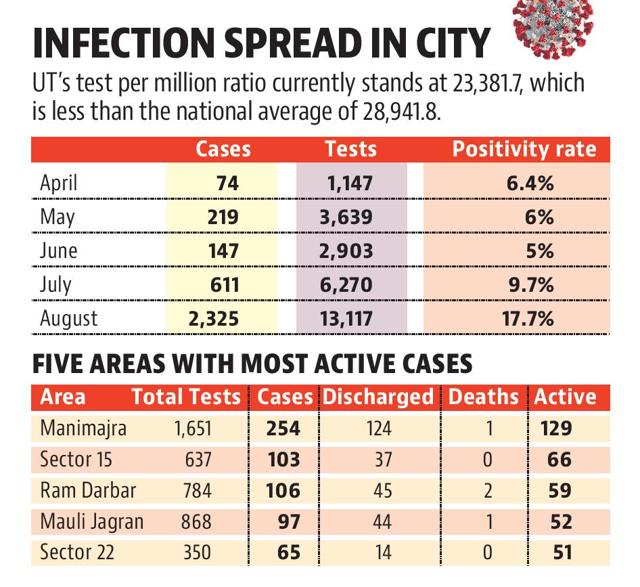
TRACKING UT’s POSITIVITY RATE
Chandigarh’s positivity rate (number of tests turning positive per 100 tests) has grown from 7% on August 1 to 12% in just 27 days. According to the World Health Organisation’s suggestions, a city’s positivity rate should remain below 5% for 14 days before it can be considered that the outbreak is under control.
Director, health services, Chandigarh, Dr G Dewan said, “Chandigarh is carrying out high-quality testing of symptomatic cases reporting in flu clinics established by the UT health department. The positive person’s contacts, identified through rigorous contact tracing, are being tested within a stipulated period. All this is in accordance with the test protocol developed by Indian Council of Medical Research. Around 5,500 tests have also been done through antigen testing apart from RT PCR tests.”


