
 E-Paper



Coronavirus in Chandigarh: Contact tracing teams giving it their all to contain spread
Four teams set up by the MC are leaving nothing to chance while tracking contacts of Covid-19 patients and quarantining their families


His mother has been critically ill, his son wants hugs and his wife is worried sick about the work he does, but sub-divisional officer Vijay Bahadur hasn’t been able to give them the attention they need as he’s been at the frontline of the battle with Covid-19 since the first positive case was reported in Chandigarh.
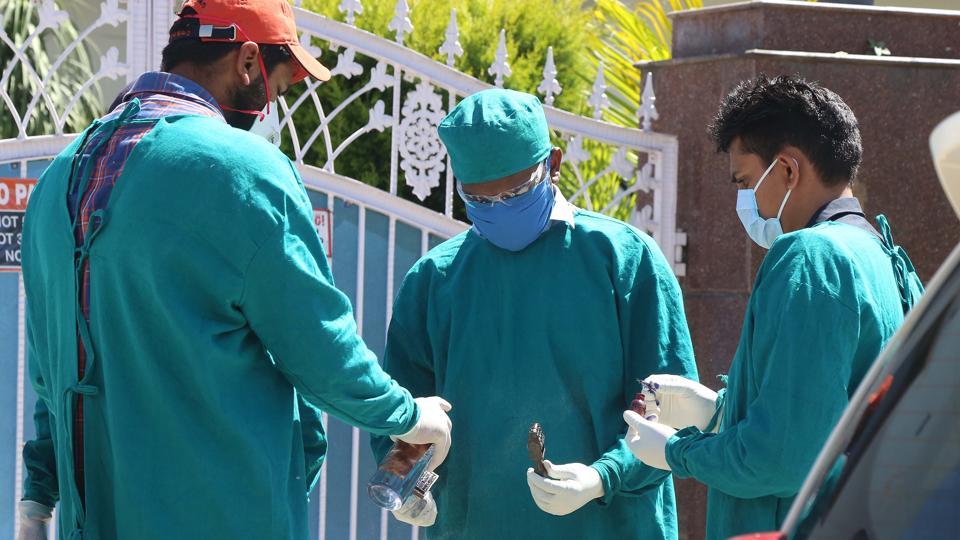
Heading one of the four teams constituted by the municipal corporation (MC) to track contacts of Covid-19 patients, he says it’s tough work.
The team is called the moment a suspected Covid-19 case reaches hospital and given the address of the patient with details of contacts.
About 30% contact details are given by the doctors examining the patient and the remaining 70% have to be traced by the team that goes meticulously through the movement details of the patients, says Bahadur.
At 10am on Thursday, after getting information that a suspected Covid-19 case from Sector 35 had reached the Government Multi-Specialty Hospital in Sector 16, the team had reached the man’s residence by 10.30am.
Wearing masks and gloves, team members advised the family members to stay indoors, handed over an advisory, assured them that their needs would be taken care of, pasted a home quarantine notice outside the house and cordoned off area.
When they got to know later that the man had tested positive for Covid-19, the team members’ hearts sank.
One big worry is of picking up the infection then as team members are the first ones to interact with the Covid-19 patient’s family, said Kapil Kisana, a 37-year-old firefighter.
His family is based in Nawanshahr, he says. “They keep making video calls. My wife wants to talk to me at least 10 times a day to check if I’m wearing masks and gloves,” he adds.
“We work with great enthusiasm and keep joking, saying ‘pata chale agli stamp saade laggi hove’ (who knows we might get the coronavirus quarantine stamp on our hand),” Kisana laughs, his eyes brimming over with laughter over the white N-95 mask.
About four teams with 32 members were set up by Anil Kumar Garg, additional commissioner MC-cum-nodal officer contact tracing team. These included at least 17 firemen, police personnel, peons and MC staff. Each member was provided two kits of OT gowns, gloves, masks, protective eyewear and sanitisers.Two vehicles were provided to each team.
“So far over 1,300 houses have been quarantined, including 305 contacts of coronavirus patients in Chandigarh,” Garg added.
Things got ugly sometimes. “Some patients give us wrong leads and some are rude and refuse to be quarantined, saying they are asymptomatic,” said Bahadur.
“Keeping the team motivated is tough, everyone’s afraid of contracting the disease. We are also humans and have families. But we can’t afford to let our spirits down so I start my day by giving a pep talk to the team,” he adds.Once home, Bahadur showers, washing his clothes in hot water before moving to his isolated room. However, he can’t sleep until he checks in on his bedridden mother (from a distance of course).
Not many people know that firefighters are a part of the tracing team, a majority of them young men aged between 23 and 25.
Among their tasks: Locating travellers in the travel history list and quarantining them, says firefighter Sukhwinder Singh, who is posted at the Sector 32 fire station. On a particularly tough day on March 20, he says the teams began the day at 9am and was working up to 1.30am the next day.
“There are instances where people respond very aggressively and use harsh words. However, we don’t take their words to our hearts,” says Deepak, 23, another fireman.


