
 E-Paper



Lockdown effect: Restrictions, police presence block drug supply in Chandigarh
Only 100 NDPS cases have so far been registered in different police stations of the city since January this year

 Prefer HTon Google


Restrictions on inter-state movement and increased police presence on the ground seems to have snapped the drug supply chain in the city as the number of cases registered under the Narcotic Drugs and Psychotropic Substances (NDPS) Act in the city has come down drastically this year.
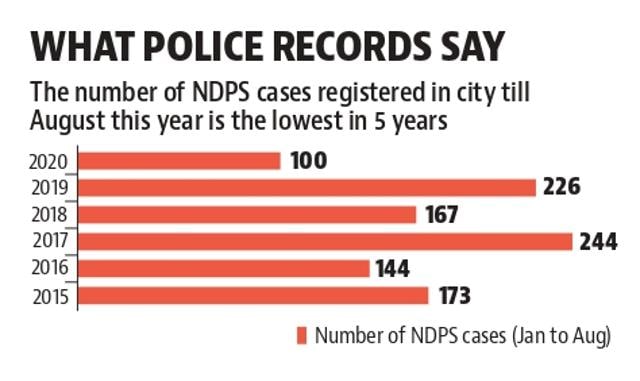
As per the Chandigarh police records, only 100 NDPS cases have so far been registered in different police stations of the city since January this year. This is also the lowest number of drug cases registered in the last five years.
The city had seen 226 drug cases in the first eight months of 2019, 167 cases in 2018, 244 cases in 2017, 144 cases in 2016, and 173 in 2015.
Acting senior superintendent of police (SSP) Vineet Kumar said, “We had managed to break the supply chain of the drugs and even arrested a few big suppliers in 2019. There has been a consistent effort by the police to not allow peddlers to build their supply chain again.”
He added, “The increased patrolling owing to the pandemic, restrictions on interstate movement and night curfew have also worked as deterrents to drug peddling.”
101 ARRESTED SINCE JANUARY
As per the UT police, as many as 34 persons were arrested in 31 drug cases in March, April and May, when complete lockdown was in place. Since January, 101 persons were arrested under the NDPS Act, of which 11 were women drug peddlers.
SUPPLY OF VIALS REGISTERED DIP
Medicinal drugs, such as injections of Buprenorphine, Pheniramine Maleate, are popular owing to easy availability and low cost. This year police recovered 529 such banned vials from addicts. In 2019, a total of 1,633 vials were recovered while in 2018, 4,193 vials were seized.
Heroin and opium recoveries have also seen a dip this year. As per police records, 1.5kg heroin was recovered this year as compared to 3.1kg in 2019 and 1.4 kg in 2018. The opium recovery stood at 500gm this year against 934gm in 2019 and 3.9kg in 2018.


