The much-touted tunnel road project between Hebbal and Silk Board, projected as a game-changer for Bengaluru’s traffic, could end up exacerbating the very congestion it aims to solve, The New Indian Express reported.
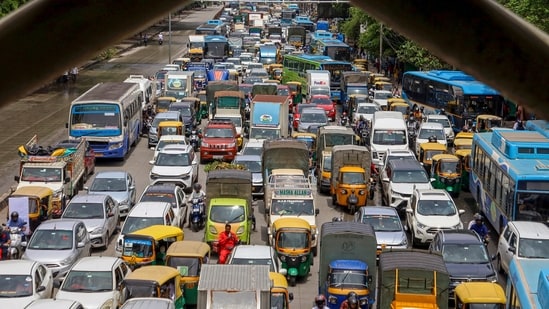
According to the report, the final Detailed Project Report (DPR) says the ₹22,000-crore initiative may introduce 16 new traffic gridlocks across the city.
Promoted as a signature solution by Deputy Chief Minister DK Shivakumar, the tunnel road will feature only eight entry and exit ramps. However, these points are expected to become new congestion hotspots, as merging vehicles, U-turns, and lane shifts are likely to slow down traffic at surface level.
(Also Read: ‘It’s not travel, it’s trauma’: Viral Bengaluru traffic post sparks relatable uproar)
The New Indian Express, which accessed Volume-V of the DPR prepared by Rodic Consultants Private Limited, reported that the ramps are proposed in some of the city’s already overburdened zones, including Hebbal Flyover, Indian Institute of Science (IISc), Maharani College Junction, Freedom Park vicinity, Wilson Garden junction near Ashoka Pillar, and parts of Hosur Road.
{{/usCountry}}The New Indian Express, which accessed Volume-V of the DPR prepared by Rodic Consultants Private Limited, reported that the ramps are proposed in some of the city’s already overburdened zones, including Hebbal Flyover, Indian Institute of Science (IISc), Maharani College Junction, Freedom Park vicinity, Wilson Garden junction near Ashoka Pillar, and parts of Hosur Road.
{{/usCountry}}Critically, the DPR does not clarify what proportion of the city’s overall traffic will be diverted into the tunnel, nor does it account for the average trip length commuters will endure, the report added.
Data from BBMP’s feasibility study, developed by Altinok, indicates that a user won’t just travel the 16.68 km core tunnel stretch but will also need to cover an average additional 2.23 km, 1.14 km to enter and 1.09 km to exit the tunnel.
This brings the total average tunnel commute to around 18.91 km one way. Depending on where users begin or end their trips, the actual journey, including surface-level travel, could easily surpass 19 km, raising concerns over the tunnel’s overall utility and efficiency.
(Also Read: ‘Hardly a garbage-free stretch’: Author slams Bengaluru’s civic neglect, calls it collapse of urban governance)