
 E-Paper



Hijab ban against rights of students, says report
The report pointed out that there was an arbitrary and sudden restriction when six Muslim students were prevented from sitting in classrooms at the Government Girls PU College in Udupi on December 31, 2021.

 Prefer HTon Google


Almost a year after Karnataka high court ruled that hijab is not essential in the religious practices of Islam and thereby upheld the state government order barring all religious clothing in educational institutes, a report by the People’s Union of Civil Liberties (PUCL) suggested on Monday the ban violated various constitutional and fundamental rights of the Muslim students.
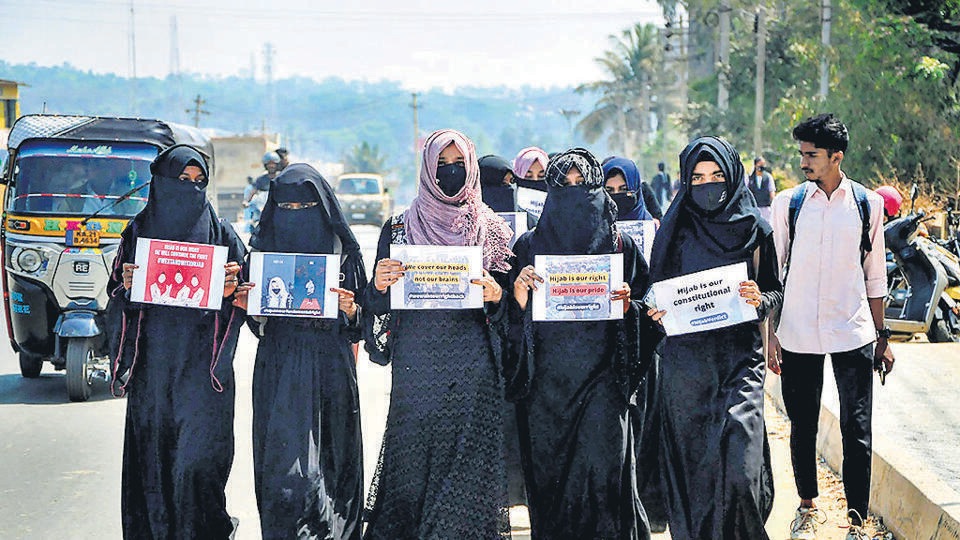
The report also revealed how these students have not only been denied their right to education but have also borne the brunt of a climate of hate, hostility, and misinformation.
The study analysed the impact of the judgement in three different parts of the state: south Karnataka, coastal Karnataka, and north Karnataka. It focused on five districts: Hassan, Dakshina Kannada, Udupi, Shivamogga and Raichur.
The report pointed out that there was an arbitrary and sudden restriction when six Muslim students were prevented from sitting in classrooms at the Government Girls PU College in Udupi on December 31, 2021.
“This act of discrimination was met with no legal or disciplinary action against college authorities by the Education Department or the Department of Public Instruction,” it said.
After the education department issued the government order, more colleges in Udupi instituted a ban on the hijab. On February 10, 2022, the high court passed an interim order restricting the wearing of hijab until the final judgement would be delivered.
“The arbitrary and sudden implementation of a ban of the hijab before the end of the academic year, especially during examinations of students, came as a shock to Muslim students across the state, and a violation of their right to protect against arbitrary state action,” the report pointed out.
Since January 2022, the rights of Muslim students to education without discrimination have been gravely violated across Karnataka, the PUCL report said, adding that young students in the five districts of the study opened up about their experiences and expressed their grief at the calculated indifference towards their plight is shown by their classmates, the college administration, and the government.
“Our main fear was that our attendance records would get affected. The Principal told us that those who wore the hijab should sit at home and
give up on their studies,” a student in Hassan district told PUCL.
Many students were denied the right to write their examinations, which in effect, cost the students’ families an entire year of college fees, thwarted the students’ learning opportunities, and adversely affected the students’ mental health, the report said.
In other cases, students endured emotional turmoil because of the imposed ban. In Udupi, a student shared, “There are very limited options for some of us. We cannot afford a transfer to another college. So, I was forced to remove my hijab. I felt naked without my hijab.”
In Dakshina Kannada, a student said that the classroom became an extremely divided space. “Our classmates will not even share their notes with us to help us. Even college clerks and staff refused to provide any support to enable us to at least continue our learning,” she said.
The report pointed out that the compulsion to remove the hijab was an assault on the Right to Dignity in many instances. For most Muslim students, the act of forcing them to remove the hijab was insensitive and violent, especially when perpetuated by teachers, principals and examination centre officials.
Along with the misbehaviour of the college administration, social media provided an offensive portrayal of Muslim students. Hijab-wearing Muslim girls had overnight become the focus of everyone’s attention, it said.
The report said the right to privacy of the students was violated in attempts to control the dress which Muslim women wear. “On the day after the High Court delivered its judgement, a camera person from TV9 climbed over the college boundary, which was a bamboo fence and pointed his camera at me, ‘Why are you here? Where is your ID card?” a student studying for her Bachelor of Science in Hassan said.
The report also mentioned that the restriction on wearing the hijab was a violation of their freedom of expression, as many students shared with the PUCL team that their choice of wearing the hijab was their way of expressing themselves. Students reported several instances when they were shamed in public spaces for expressing themselves with their hijab. Several students felt compelled to choose between their right to freedom of expression and their right to education.
The student’s right not to be discriminated against was violated by both the state and citizens, the report said.
“By denying them any process or mechanism to appeal to protect their fundamental rights, and by excluding them from educational institutions through the sweeping ban, the state and all its governance mechanisms discriminated against Muslim women students.”
“As is evident from the testimonies of the students, the violations of their fundamental rights had serious impacts on their academic lives, aspirations, economic losses, reduced self-confidence and their social relations with students and people of other communities,” PUCL said in its report.
“All students have expressed that they feel betrayed by the state government, who emboldened the series of assaults on their constitutional rights. It, therefore, becomes crucial to retain their voices, while investigating the role of state authorities and the media, who failed to recognise the rights of Muslim women students,” it added.
Meanwhile, BJP spokesperson Ganesh Karnik said he strongly condemned the PUCL report, adding that it was irresponsible in giving such statements.
“Whether in the name of so-called freedom, as far as the faith is concerned, do we refuse to accept the rule of law of this country? They may say that we have been given the right to practice what we believe, but is comes with a certain amount of reasonable restrictions. The Court, which is a competent authority, has interpreted the law. It has said that as far as the rule of the institution is concerned, that is paramount,” Karnik said.
“Why do we have uniforms in armed forces, police and certain professions? Many a time, the exemptions sought were turned down by the Supreme Court. So, the question is not about getting into somebody’s faith and practices. So, it is about the rule of law. As a responsible citizen, you are supposed to respect the provisions of the Constitution,” Karnik added.
Karnik also questioned the alleged role played by Campus Front of India (CFI) – the student wing of the banned Islamist outfit Popular Front of India (PFI) in instigating the controversy over hijab. The report by PUCL, however, does not mention the role of these two organisations in its report.
BJP National general secretary CT Ravi said, “These liberals are propagating a false narrative. PUCL is not a constitutional authority. The HC and SC both have given a verdict. They are not above it.”
“What is going on Iran? It’s a Muslim country and they are opposing hijab. According to the 1956 Act, schools have only uniform. Once hijab also becomes a part of the uniform then it’s okay. But these students are fighting against uniform,” he added.


