
 E-Paper



Abhi na jaao chhod ke: Rafi’s songs defy age
Rafi was born to a Punjabi family and his father was a respected figure in the village with henna dyed hair and beard

 Prefer HTon Google


It all started in Kotla Sultan Singh, a Punjab village and a hamlet like many other, but if you go to Wikipedia, you will learn that it is no ordinary settlement but the birthplace of Mohammed Rafi (24 Dec 1924-31 July 1980). Rafi as we know him was no ordinary person but a legend whose songs are stamped on every Indian heart. He was a rare singer and he was considered the greatest and the most influential singer of the subcontinent’.
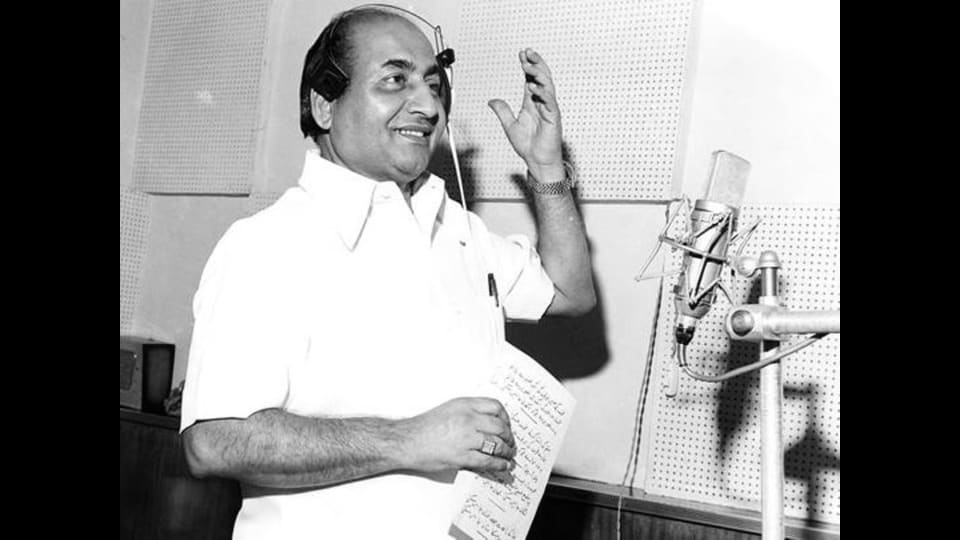
He was born to a Punjabi family and his father was a respected figure in the village with henna dyed hair and beard. He was addressed as Haji Ali Mohammad for he had gone thrice to the Islamic pilgrimage at Mecca in Saudi Arabia, all the way from his remote village. Rafi’s mother’s name was Alharakhi Bai. They called their son Pheeto and had hopes that he would study hard and do well in life. He who was admitted in the village school to study and get a job when he would grow up. But to the father’s disappointment he showed no interest in his studies but chased a mendicant who visited the village singing for alms. And not just that, but also chose to sing with him. The mendicant’s favourite song was ‘Khedan de din chaar’ (The time for play is short).
This interest in music by his son irked the father who was a religious person and did not quite approve of such hobbies. So it was decided that he be sent to his uncle’s hair saloon in Lahore and make a career there. So Pheeto left the village and started training in the saloon at age eleven. As the legend goes, young Rafi was humming away always. And one day as he manicured a gentleman’s nails in the Lahore saloon in Bhatti Gate, he started singing softly. The customer happened to be the famous music director in Lahore and his name was Ghulam Haider. It was said that Haider changed the mood of Indian film music with a merry mix of popular Ragas and the rhythms of Punjabi music. Haider complimented the young man for his hold on music and these were the first words of praise that Rafi had heard in the face of constant discouragement. So he held these words close to his heart and made his first public appearance by singing a KL Sehgal song. His first break as a playback singer came in a Punjabi film in Lahore, in a debut number ‘Goriye ni, Heeriye ni’ with singer Zeenat Begum and Shyam Sundar as music director. Following this the Lahore Radio Station invited him to sing and the journey began.
Yeh hai Bombay meri jaan!
Rafi moved from Lahore to Mumbai in 1944 when just 20 and shared a ten-by-ten feet room in the congested Bhendi Bazar area and the first song, a peppy number in Noorjahan starring film ‘Gaon ki Gori’ in 1945: ‘Aji dil ho kaabu mein tao dildar ki aisi taisi’! This was his first recorded song in a Hindi film and he went onto record over 7000, in not more, songs across Indian languages, besides singing in several foreign languages including English, Persian, Arabic, Dutch, Mauritian Creole and more. He made a great impact with leading music directors like Naushad Ali, 0. P. Nayar, S.D Burman and Roshan. His most memorable song with Naushad was a famous Bhajan of the film ‘Baiju Bawra’ which interestingly was written by Shakeel Badayuni. The song of the 1952 film gained immense popularity overnight as one of the best bhajans ever sung. As the story goes, three staunch Bandits from Benares travelled all the way to meet and thank the creators of the bhajan. When they learned that the song was created by three born to the Muslim faith, they bowed down to touch their feet in gratitude.
He remains the singers’ singer
Even now no musical soiree, wedding or birthday can be imagined without a song or a qawali without playing or singing of a cherished Rafi number. “Abhi Na Jao Chhod Kar,” The greatest tribute came to this song when leading classical musicians of the country sang it on the hundredth birthday of Rafi. Originally sung by Rafi and Asha Bhosle, penned by none other than our Sahir Ludhianvi to the lilting music by Jaidev it was performed by many famous Indian singers as a tribute for World Music Day 2024 which coincided with the birthday of Rafi. And lo, singers included Shankar Mahadevan, Shubha Mudgal, Papo, Usha Uttap, Amjad Ali Khan, Rekha Bhardwaj, Lesle Lewis and many others. In recent times, the same song which had won Indian hearts in the 1961 film Hum Dono popped up once more courtesy Karan Johar in the 2023 in the film “Rocky Aur Rani ki Prem Kahani’ starring Ranveer Singh and Aulia Bhatt. Interestingly, it was picturized on oldies of the cinema world, an ageing Dharmendra, on the edge of dementia and a widowed Shabana Azmi as the two remember a crush they had for one another in older times to the annoyance of Jaya Bhaduri, the rather strict wife of Dharmendra, who does not share his love for music and poetry. It was a hit once again among the old and the young. Such was the magic of the 1961 song.
Expressing the magic Rafi caste is often difficult to explain even by those who fall under its spell. However, own city’s senior singer-composer Kamal Tewari, puts it thus: “Rafi’s greatest gift was that he sang with intensity that can be found only in the purest of hearts. I have had the good fortune of attending his concert here at Tagore Theatre and, of course following him on the radio since childhood. I feel besides the formal music training I took, it was listening to him that honed my singing. While still in college, my greatest joy was singing the qawali penned by Sahir and sung to great heights by Rafi”. Five hours away Delhi based singer Nasser Harvani, well trained in classical music, says: “The songs of Rafi Sahib are embedded deeply in my heart. What was remarkable about Rafi, apart from his mellifluous, was his unique tonal control and technique. His high note pitching was effortless and he enhanced the lyrics by putting so much soul and expression. Every song is a story told. He created masterpieces for their sheer romantic expression, cadence and tonal quality”. We all have our own personal collection of Rafi favourites in our hearts and for this singer it is songs like ‘Thehariye hosh nin aa loon’, ‘Jaag Dile Diwana’ and ‘Aap se maine meri jaan mohabbat ki hai’. Well one hopes the readers will now be recalling or even humming their own Rafi favourites. And this scribbler, that’s me, has had a good time this Saturday interspersing my writing with listening to my cherished share of the songs of Pheeto the boy, as he was called in childhood: ‘Cherha mere dil ne tarana tere pyar ka! Jisne suna kho gaya, Poora nasha ho gaya... Such were the melodies that the ageless singer is remembered by.
nirudutt@gmail.com


