
 E-Paper



Alert sounded in Punjab’s cotton belt after pink bollworm attack in Haryana
After Bathinda and Mansa, pink bollworm spread has now been reported in cotton crop in Sunam and Lehragaga subdivisions of Sangrur in Punjab


The Punjab agriculture department on Wednesday directed all eight cotton-growing districts to immediately start a drive to check the spread of pink bollworm after an extensive infestation of the deadly disease was reported in adjoining districts of Haryana and parts of Rajasthan.
Agriculture director Sukhdev Sidhu said the next three weeks are crucial to containing the further spread of the infestation. After Bathinda and Mansa, pink bollworm infestation has now been reported in Sunam and Lehragaga subdivisions of Sangrur, he added.
“Official inputs say a few pockets of Sriganganagar have spotted the deadly moths in cotton fields and agriculture teams in the adjoining Fazilka district have been alerted. All cotton-sowing villages in southern Punjab will be surveyed twice in the next three weeks. Farmers need not worry and follow the guidelines issued by the department,” said Sidhu.
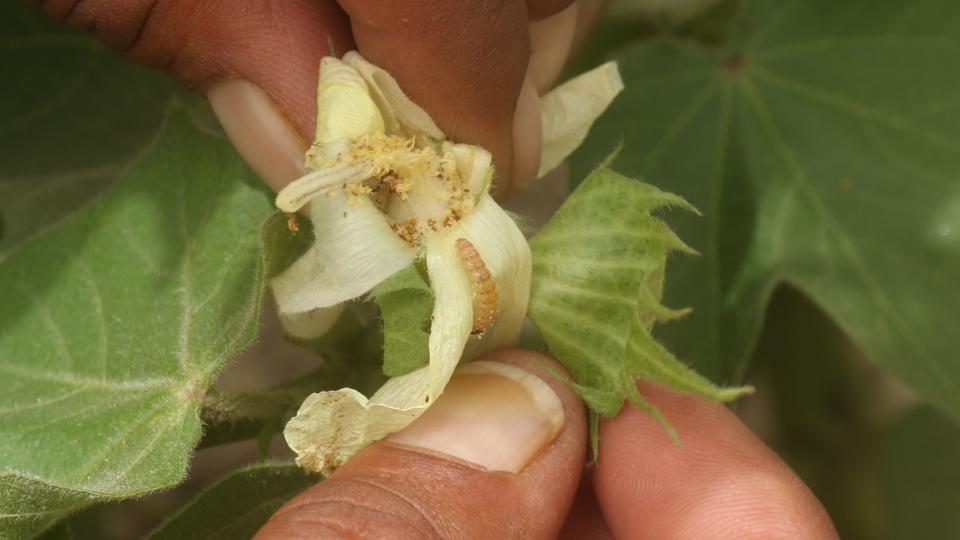
Experts say in the infested fields, the cotton bolls look absolutely normal from outside. But each infected boll has a pink bollworm inside. The worm eats cotton seeds and prevents the development of cotton staple fibre around it well before the cotton boll opens.
Infestation is found double in Bathinda and Mansa, the largest cotton-growing belt after last week’s estimation of 5% of nearly 1.61 lakh hectare area. It is for the first time that the disease has been found at this magnitude in Punjab and infestation is spotted even in villages where there are no cotton ginning units, considered among the two reasons behind it.
The first picking of cotton bolls is expected to begin from next week.
According to chief agriculture officer for Bathinda and Mansa Manjit Singh, nearly 10% of the crop in the twin districts was found hit with pink bollworm.
“The situation is in control as fields are under surveillance. Our teams are sensitising the farmers about the use of spay and keeping a constant watch on crop,” he said.
SK Verma, head of Sirsa-based Central Institute for Cotton Research (CICR), a central organisation, said Bollgard 2, or BG-2, Monsanto’s second-generation insecticidal technology for cotton, is now found susceptible to pink bollworm. He said 12 districts of Haryana, including Jind, Sirsa, Hisar and Palwal, have been infected with the bollworm.
“It is a deadly pest that appears in cotton at its later stage. It cannot be prevented but is easy to avoid and manage with active support of stakeholders. Farmers must ensure that cotton residue, which is commonly used as firewood, is not kept in fields. This moth can survive in any climatic condition and lives only on cotton plants or its residue,” said Verma.
Haryana joint director, agriculture, RP Sihag said the pest larvae is reaching the north Indian states with cottonseed consignments brought from south-west states, including Maharashtra and Karnataka, for processing by millers.
“The current situation is not alarming but a comprehensive plan is needed to implement to manage it before next sowing season,” he added.


