
 E-Paper



Among 1.17 lakh winged visitors, rare arctic guest visits Pong Wetlands for first time
Formerly known as oldsquaw, the winged visitor has been spotted in the Pong Wetland though it has been reported in Kashmir on rare occasions. Last month, a group of the rare duck specie was sighted at in Jammu and Kashmir at the Wular Lake after a gap of 84 years.


Among the estimated 1.17 lakh winged visitors roosting and nesting in the Pong Lake Wetland, there is a rare arctic guest—long-tailed duck.
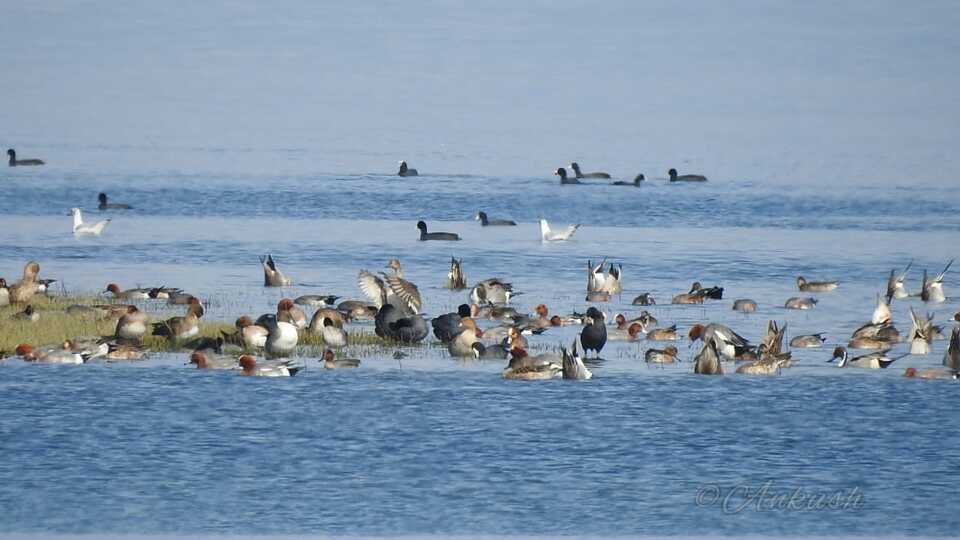
Formerly known as oldsquaw, the bird has been spotted in the Pong Wetland though it has been reported in Kashmir on rare occasions. Last month, a group of the rare duck specie was sighted at in Jammu and Kashmir at the Wular Lake after a gap of 84 years. The last sighting of this bird was in 1939 at Hokersar Lake in Kashmir.
Chief conservator of forests (wildlife), north, Upasna Patial said a single duck was spotted in the Sugnara area of Pong Lake.
The sea duck is known to breed in the tundra and taiga regions of the arctic and in winters along the northern coastlines of the Atlantic and Pacific Oceans.
The long-tailed duck (Clangula hyemalis) was formally described by the Swedish naturalist Carl Linnaeus in 1758 in the 10th edition of his Systema Naturae and is the only member of Clangula genus. The male is white and black with a distinctive dark cheek patch while the female has a brown back.
Birds of 108 species recorded
The forest official said that 1,17,022 lakh water fowls of around 108 avian species have descended at the Pong Dam wetlands, nestled in the scenic Kangra valley, for their winter sojourn this winter.
The wildlife wing’s annual waterfowl estimation, for both local and migratory birds, was carried out on January 31 and February 1. This is over 6,700 more than the previous year’s count of 1,10,309.
Divisional forest officer (wildlife), Hamirpur, Reginald Royston said the most significant increase is in the number of northern pintail, whose count has gone up to 15,784 from last year’s 4,665.
The count of bar-headed geese, the world’s highest-flying migrating bird, is up by more than 2,600.
The population of the elegant-shaped bird with two distinctive black bars across its neck has been estimated to be more than 49,000 compared to 47,500 last year.
Other dominant avian species visiting Pong marshes this year are eurasian coot (13,035), common pochard (8,096), common teal (6,478), great cormorant (6,768) and little cormorant (6,565) etc.
Some uncommon species sighted here are ‘lesser white-fronted goose’, red-crested pochard, pied avocet, northern lapwing and common kestrel.
The Pong Dam Lake, constructed on the Beas in 1960, was declared a bird sanctuary in 1983 and was given the status of a wetland of national importance in 1994. In 2002, it got the status of the Ramsar site. The reservoir, covering an area measuring 24,529 hectares with 15,662 hectares area under wetland, is among the top 10 sites that attract a larger number of migratory birds.
So far, since 1988, 425 bird species have been recorded at the Pong Wetland.


