
 E-Paper



BJP bigwigs in Chandigarh don’t see eye to eye on Metro
Former MP Satya Pal Jain, senior leader Sanjay Tandon favoured metro, while MP Kirron Kher vehemently opposed it during the advisory council meeting on Tuesday.


In a major embarrassment to the Bharatiya Janata Party (BJP), three of its senior leaders were seen expressing divergent views during discussion on the viability of a metro for the city, at the advisory council meeting on Tuesday.
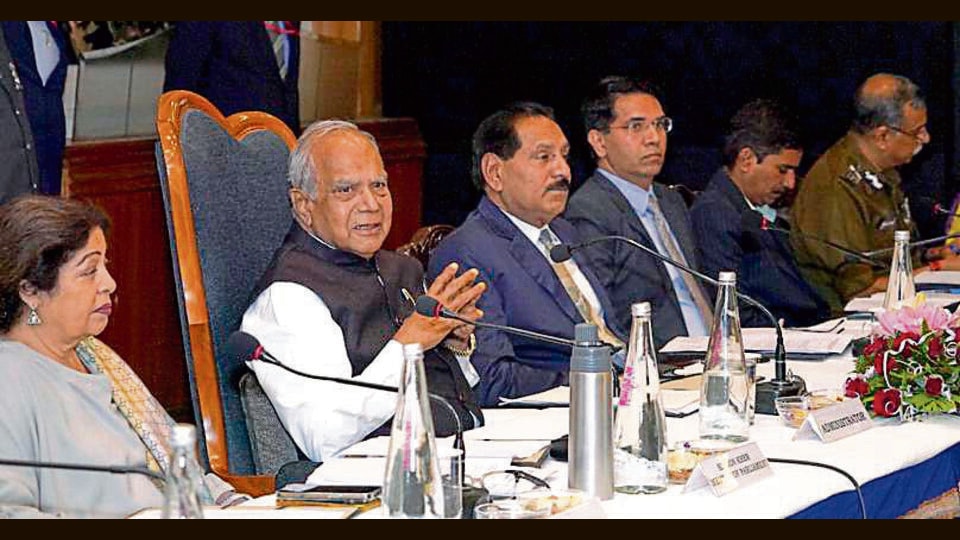
While Additional Solicitor General of India and former BJP MP Satya Pal Jain and senior Bharatiya Janata Party leader Sanjay Tandon spoke in favour of the metro, Member of Parliament Kirron Kher, who is known to be critical of the project, vehemently opposed it.
All three deferred in the presence of UT administrator Banwarilal Purohit, who was chairing the meeting, prompting him to pacify them by stating that all stakeholder’s concerns will be taken into account before taking the final call.
Citing the city’s growing traffic issues, Jain said, “The Metro project should be revived as it is the need of the hour. We should not see Chandigarh in isolation, but as a part of the tricity.”
Echoing similar views, Tandon said, “A metro will be beneficial for future generations. The administration must think ahead. We are already late.”
Member of Parliament Kirron Kher, however, cited the example of Mumbai, to voice her concerns against the metro. “In Mumbai, wherever, the work of metro is going on, huge traffic snarls are witnessed. We do not want that for our city.”
Aam Aadmi Party (AAP) councillor Yogesh Dhingra, who is also the leader of the opposition in municipal corporation House, had a different solution. “The administration should make it mandatory for all UT employees to travel by CTU buses as they have fixed duty hours,” he said.
It is pertinent to mention here that the Rail India Technical and Economic Services (RITES) had, in its latest report submitted to the UT on November 3, proposed a 64.3-km metro network, spread across Chandigarh, Mohali and Panchkula, and termed it as the best way to curb the city’s traffic problem. Back in 2021, the Union home ministry had, however, rejected the metro project, terming it unviable for the city’s size. For the project to be viable, the MRTS needs to be used by 40,000-70,000 passengers at peak traffic hours, which is expected to be achieved only by 2051, the ministry had stated. Also, the ₹14,000-crore cost was a concern.
Council meets after 9 months
With the advisory council’s tenure set to end in December, the UT administrator Banwarilal Purohit said it will be reconstituted and asked members who wish to continue in the next tenure to submit their requests to him. Constituted in 2019, its two-year tenure was to originally end on August 5, 2021. But the term was first extended for six months by then UT administrator VP Singh Badnore. Later, UT administrator Banwarilal Purohit decided to extend it by another six months till September 30, 2022. In September, the administrator again extended the council’s term till the year-end. This was the council’s first meeting since the September extension. It had last met in February this year.
Key issues taken up in meeting:
EWS seats: The administrator said the UT will chalk out a plan to accommodate Class-10 dropouts and make it binding for all private schools to provide 25% seats to EWS students. He also said the city is also set to get 10 new schools.
Environment: The standing committee on environment placed its recommendations on working paperless, optimal use of email and other digital technology, running pilot projects of sprinkling water on roads, implementation of CSR policies for plastic waste disposal etc.
Health: The standing committee on health recommended increasing the patient capacity of existing hospitals and by more and better dispensaries in city. The Administrator advised officials to expedite the work of dispensaries approved for central government retirees.
Law and order: The need for high-operational intelligence to crush the growing drug mafia and increase night patrolling.
Social welfare committee: Uplifting of senior citizens, widows, destitute women and vulnerable children, and single window system for industries to improve ease-of-doing business in city.
City’s periphery: The adviser said that no new illegal construction shall be allowed and old illegal constructions shall be removed.


