
 E-Paper



Breaking barriers: Speech & hearing disabilities fail to deter these fuel station attendants
Four of the attendants at the pump are speech and hearing impaired since birth and now they have found a way to earn their livelihood with dignity.


At first glance, a petrol pump located on Mansa road in the heart of Bathinda city is like any other facility.
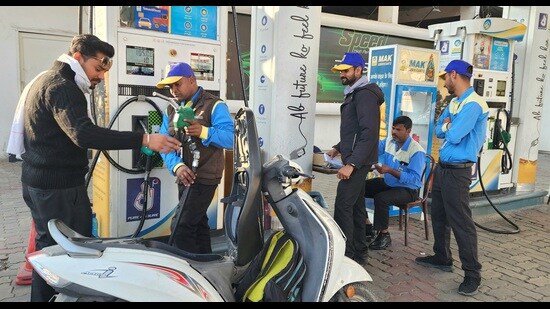
However, when attendants communicate with visitors like Sukhchain Singh through a notebook, instead of speaking, to know the quantity of petrol or diesel to be filled in their vehicles, drivers realise that something is different here.
Four of the attendants at the pump are speech and hearing impaired since birth and now they have found a way to earn their livelihood with dignity.
Industry sources say it is probably the only petrol pump in Punjab and Chandigarh with persons with speech and hearing disability are employed.
Owner of the Meenakshi Enterprises Aakash Bhargav credits the legacy of his parents in community service and top executives of Bharat Petroleum that he agreed to a social experiment by offering a job to the differently abled.
“In October, a Ludhiana-based social organisation, Sarthak, introduced us to eight deaf and mute individuals for work exposure. Later, four of them showed an interest in continuing to learn and made an impressive improvement on all fronts. After working with them, I feel that our society is ill-equipped to support the deaf and mute and train them to be employable in different trades,” said Bhargav.
He said during a meeting, an official of the public sector petroleum company once told him to plan to hire deaf and mute persons.
“Being active members of the Rotary Club, our family always make a bit to assist the needy. However, employing someone who could not speak or hear at a workplace to deal with hundreds of people daily, was a challenge. During six months of training that started in November, I realised the challenge our noble initiative faced as none of us at the petrol station had any understanding of the sign language, and there was no support system to bridge the gap. But it was heartening to see that other workers made an extra effort and improvised ways to make them train and understand them,” he said, adding that his initiative may encourage others also to hire and train differently abled.
After two months of training, they are also well-versed in cash handling and soon they will be imparted training in preparing pollution under control (PUC) certificates.
A 23-year-old special petrol pump worker, Mandeep Singh, travels from Gidderbaha in Muktsar to his workplace on a bus.
“I studied at Mahant Gurbanta Dass School for Deaf and Dumb, run by Bathinda Red Cross society, where I learnt using a mobile phone to communicate with others by typing text. I am married and feeling very good to work as it is my first job,” he shared his feelings by typing on his phone in English.
Another special worker, Navdeep Singh (19), travels from Mansa to Bathinda daily and belongs to a family of farmers.
“Before dispensing fuel, I request drivers to write on the notebook the quantity of the fuel to be filled in their vehicles. Now I can use digital transactions,” he communicated through his phone with a smile.
A tent service operator in Bathinda’s Kikar Bazar Prem Kumar, whose son Satish Kumar is among the four special workers, said that the society is not prepared to take care of the people with special needs.
“Earlier, my son worked for one-and-a-half years at a factory in Barnala where he was engaged in packing towels and other items. Night shifts on alternate weeks and long travelling did not work well with Satish. Now he is being paid ₹6,000 per month during the training period, which is not enough,” he said.


