
 E-Paper



Bright lights, traffic turning monkeys into night raiders in Shimla: Study
Preliminary findings of studies commissioned by Himachal Pradesh wildlife wing on behavioural changes in monkeys after sterilisation point to their turning more aggressive


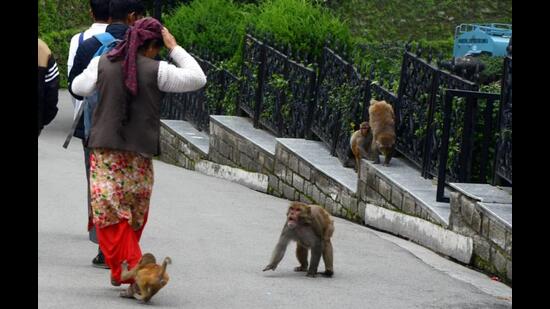
High-mast LED lights, streetlights on roads winding through forests and vehicle movement late at night due to increased tourist traffic have turned monkeys into night raiders in Shimla district.
Also read: Chill in our jails this winter, Himachal Police warn drugs peddlers
Findings of studies on post-sterilisation behaviour of monkeys in the Jakhu hills and Mall Road in Shimla suggest a social behavioural change. “The monkeys who once used to retreat to their hiding places at dusk, are now active at night. With bright lights being installed, they are becoming habitual to staying awake late and creating mischief. We are analysing the recent behavioural change as we find they have become more aggressive,” says Rajeev Kumar, the Shimla-based principal chief conservator of forests.
The movement of vehicles in the city lasts till late at night due to the rise in tourist footfall, which keeps the monkeys up and about. The monkey population has seen a rise in Chotta Shimla, Jakhu, Sanjauli, Lower Bazaar, Brockhurst, Khalini, Annandale, Kaithu, Summer Hill, Boileauganj, Porters Hill, Observatory Hill, Lower and Main Mall Road and Richmond.
The forest department pegs the monkey population in Shimla at 1,900.
TWO STUDIES UNDERWAY
Wildlife experts have observed that monkeys are becoming more aggressive after sterilisation when they are left in the wild because it affects the hierarchical set-up in the troops.
The wildlife wing has commissioned a study by experts of the Salim Ali Centre for Ornithology and Natural History, Coimbatore. A team of the centre’s research advisory council, comprising forest managers, wildlife scientists, environmentalists and policymakers, are studying behaviour in sterilised and non-sterilised monkeys across the state and is expected to submit a detailed report in March.
Another research team from the University of California, Los Angeles, is studying the behaviour of two troops of sterilised monkeys who they have tagged in the Jakhu hills and Mall Road in Shimla. Its report was delayed due to the Covid-19 pandemic and is expected in April.
CHANGE IN EATING HABITS
The eating habits of the monkeys has also changed due to feeding by tourists and easy access to garbage dumps. The studies show that monkeys of Shimla are addicted to junk food, which when unavailable can make them aggressive and they take to snatching eatables from tourists and passers-by.
The shift from natural diet has affected the fertility rate as female monkeys become capable of breeding earlier at the age of two-and-a-half to three years. “Usually, the monkeys in the urban areas bred twice a year but now it’s a year-round phenomenon,” says additional principal chief conservator of forests, Anil Thakur.
The Himachal Pradesh government has been grappling with the monkey problem in 10 of its 12 districts.
The Centre declared monkeys vermin in 2016 in 93 tehsils of Himachal Pradesh and has since extended the permission to cull them four times but so far, only five monkeys have been killed owing to religious sentiments.


