
 E-Paper



Chandigarh: 79 potential troublemakers on police radar ahead of PU polls
The list has been submitted to the sub-divisional magistrate (SDM, Central) as a preventive measure to maintain peace on Chandigarh’s Panjab University campus


In the run-up to the Panjab University Campus Students’ Council (PUCSC) elections on September 5, Chandigarh Police have identified 79 individuals, including the council’s president and prominent office-bearers of various student political parties, as potential troublemakers.
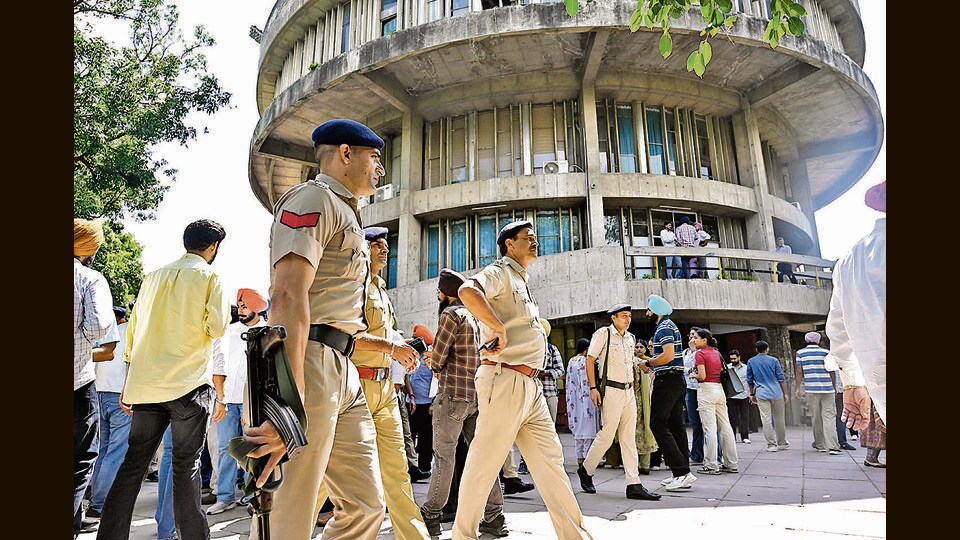
The list has been submitted to the sub-divisional magistrate (SDM, Central) as a preventive measure to maintain peace on the campus.
Among those named in the list is the incumbent PUCSC president, Jatinder Singh, from Congress’ student wing National Students’ Union of India (NSUI), who won the last election by 3,002 votes.
Other persons include Sandeep Kumar, president of Students for Society (SFS), who is already facing legal summons related to ongoing protests on the campus, and Paras Rattan, general secretary of the Chhatra Yuva Sangharsh Samiti (CYSS), the student wing of the Aam Aadmi Party (AAP).
Last year’s CYSS presidential candidate Divyansh Thakur and Bhupinder, president of the Panjab University Students’ Union (PUSU), associated with the party since 2019, have also been identified.
The Akhil Bharatiya Vidyarthi Parishad (ABVP), affiliated with the Rashtriya Swayamsevak Sangh (RSS), is not exempt from scrutiny, with former president Rajat Puri and current vice-president Ankit also on the list.
Police have also identified 25 students each from DAV College, Sector 10, and Government College, Sector 11, as potential sources of disruption.
As per standard procedure, each person named on the list will be summoned and required to fill out a bond of ₹10,000 with the SDM, guaranteeing they will maintain peace for one year. Should any of them be found involved in violent activities, they could face arrest.
The SDM will take preventive action under Section 126/170 of the Bharatiya Nyaya Sanhita, summoning these students and instructing them to avoid actions that could lead to clashes or violence on the PU campus or its affiliated colleges.
100 cops deployed
To ensure smooth conduct of the elections, Chandigarh Police have deployed 100 officers across the university, with 14 checkpoints identified for heightened security. These checkpoints will be located at key entrances and areas of the campus, including Gate Number 1, 2, and 3 on north campus in Sector 14, as well as Gate Number 4, 5 and 6 on south campus in Sector 25.
Additional police presence will be maintained at high-traffic locations, such as chemistry department’s canteen, physics department, zoology department, University Institute of Legal Studies (UILS), Student Centre, Arts Block and University Institute of Engineering and Technology (UIET) canteen.
Police will also patrol the campus continuously with two vehicles, and three PCRs will be stationed at Sector 14, Sector 25 and the outer university area. From 10 am to 10 pm, four key points will have dedicated police deployment: small chowk near Hostel Number 1, Student Centre, UILS and UIET canteen.
To further maintain order, police are conducting checks in hostels to ensure that no one is in possession of weapons or liquor and that no outsiders are residing illegally. They are also monitoring compliance with Lyngdoh guidelines and student election expenses, coordinating with Panjab University authorities to enforce these regulations.
In preparation for the elections, pre-election law and order arrangements will be in effect starting from August 28. The measures include deploying two PCR vehicles within Panjab University, Sector 14, and one on the outer cordon, as well as positioning intelligence officers at the university and its affiliated colleges to gather actionable intelligence.
Traffic management will also be a priority, with traffic officers stationed at the university’s main gates to control flow and enforce parking regulations. Traffic violations by students will be strictly monitored, particularly at entry gates and key intersections around the university.


