E-Paper



Chandigarh: At 836 mm, it has already rained more this year than all of last monsoon
As per IMD, the monsoon rain tally is counted from the start of June uptill the end of September; the normal figure for this period is 845 mm, and this year, with September still left, the total has already reached 836.6 mm

 Prefer HTon Google


The city recorded 308.5 mm rain this August, taking the total rainfall for the city so far this monsoon to 836.6 mm, as per the India Meteorological Department (IMD).
This is already higher than last year, when 776.2 mm rain was logged in the entire monsoon, from June up to September.
As per IMD, the monsoon rain tally is counted from the start of June uptill the end of September. The normal figure for this period is 845 mm, and this year, with September still left, the total has already reached 836.6 mm.
This comes even as the IMD in its forecast for the second half of the monsoon season had said that above normal rain is likely in September.
Speaking about this, IMD Chandigarh director Surender Paul said this happened as rainfall in monsoon, as a whole, was higher than last year, even as rain in July was 32% below normal.
While only 184.4 mm rain was recorded in July this year, 308.5 mm rain was witnessed in August, which is 8% above the normal figure of 284.8 mm. But it was lower than the 351.6 mm rain in August last year.
As most of August remained rainy, the average maximum temperature, at 33.1°C, was lowest since 2018, when also it was 33.1°C. The average minimum temperature, at 25.4°C, was also the lowest since 2011. Before this, it had gone down to 25.8°C in 2013.
41.3 mm rain lashed city on Sunday
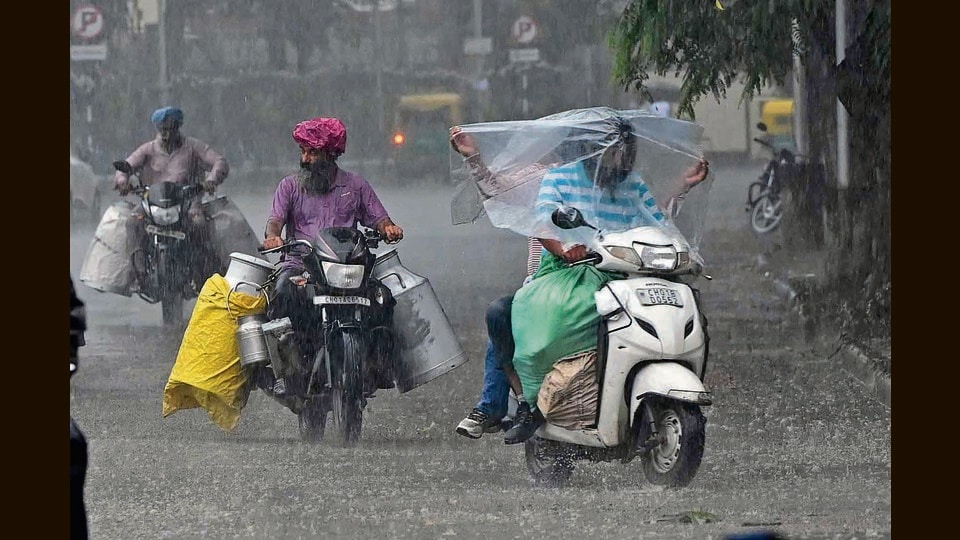
Meanwhile, 41.3 mm rain was also recorded in the city on Sunday amid a red alert for heavy rain by IMD. The rain started around 8.30 am and continued till 2.30 pm, and the sky remained cloudy and dark even thereafter.
Paul explained that the rain was caused due to a confluence between an active Western Disturbance (WD) and the prevailing monsoon system, which will continue on Monday as well, with chances of heavy rain up to 70 mm.
Orange alert for heavy rain today
An orange alert for heavy rain will continue on Monday. Orange is the second highest of the four colour warning system, asking people to be prepared. Red is the highest alert, which asks people to take action. A red alert will remain in place for Punjab on Monday.
Chances of rain will continue on Tuesday as well, but its intensity is likely to come down.
Because of the rain, the maximum temperature on Sunday fell significantly from 33.7°C on Saturday to 28.1°C, 5.5 degrees below normal and lowest in the month. It was also the lowest since 2021, when it fell to 26.2°C on August 21.
The minimum temperature, on the other hand, rose from 25°C on Saturday to 26.7°C on Sunday, 0.8 degree above normal. Over the next three days, the maximum temperature will remain around 29°C and the minimum temperature around 25°C.
Rainy weeks leads to clean air
The Air Quality Index (AQI) on Sunday as per the AQI bulletin by the Central Pollution Control Board was 42 at all three stations in Chandigarh. This is considered “good”, with minimal impact to people’s health. While cities in the south, especially along the coast mostly always have a good AQI, it remains on the lower side even in Chandigarh during the monsoon period, as the rain clears the pollutants, construction activities come to a halt and road dust remains settled. The AQI remained below 50 in the city through the week owing to the rains.
Overflowing rivulets inundate parts of Mohali
Heavy rain caused seasonal rivulets Jayanti Ki Rao and Patiala Ki Rao to swell once again, inundating low-lying areas and villages in Mohali.
The worst-affected areas included Nayagaon, Kurali, Kharar and Zirakpur, where water entered houses, shops and agricultural fields, leaving residents grappling with massive destruction.
Farmers from Jayanti Majri, Kasauli, Gurha, Karondiawal, Bhigandi and nearby villages said their fields were completely submerged. “This year the destruction caused by flash floods is unprecedented,” said Chaudhary Sham Lal Majarian, Zila Parishad member and resident of Gurha.
He added, “We have been urging the administration to construct bridges on causeways and lay pipelines under rivulet passages, which overflow every monsoon, but no action has been taken so far.”
In Zirakpur, roads, crossings and markets were left waterlogged, disrupting daily life.
The heavy waterlogging also triggered major traffic jams on the Zirakpur-Ambala and Zirakpur-Patiala highways. Singhpura crossing and Patiala crossing witnessed the worst congestion, with commuters stuck for over an hour before traffic crawled forward at a snail’s pace.
Villagers build temporary passage over Jayanti ki Rao after bridge collapse
Residents of five villages near Jayanti Majri have constructed a temporary passage across the Jayanti ki Rao rivulet at their own expense after the bridge was washed away by strong currents nearly a month ago.
Former sarpanch of Guda village, Chaudhary Sham Lal said since the ramp bridge collapsed due to heavy water flow, villagers had been left without any proper connectivity.
“Several ministers and officials visited the site but left without taking any action. For the past month, the residents of five villages have been facing immense difficulties as this is the only route connecting them to the city and other areas for their daily needs,” he said.
The villagers are particularly concerned as October 1, 2025, marks the upcoming Goga Madi fair, when thousands of devotees are expected to arrive in Guda. With no official arrangements in place for connectivity, the residents pooled resources and built a makeshift road over the river to ensure access during the fair.
MLA reviews Ghaggar embankment
Dera Bassi MLA Kuljeet Singh Randhawa on Sunday visited the Tiwana embankment of the Ghaggar river, along with senior officials, to review the situation. He assured residents that the local administration is fully alert and prepared to tackle any emergency.
The MLA appealed to people to stay away from the riverbanks and extend cooperation with the administration for ensuring safety. He further urged residents who can provide tractors, trolleys or essential items to come forward in support. He directed administrative and police officers to remain stationed at the embankment at all times.
Later, Randhawa visited Lalru to meet the family of farmer Janak Raj, who lost his life due to the rapid flow in the Jharmal river. He expressed heartfelt condolences to the bereaved family and assured them of due financial assistance from the government. He said efforts will be made to provide employment on compassionate grounds to an eligible member of the family.
Emergency helplines
DC Office: 0172-2219506, 76580-51209
Dera Bassi: 01762-283224, 01762-280095
Zirakpur: 01762-528902
Kharar: 0160-2280222