
 E-Paper



Chandigarh heritage panel okays revised high court expansion plan
As per the revised plan, the total built-up area under the expansion plan will be 10,46,335 square feet, and 40 courtrooms, 48 judges’ chambers and office space will come up on 7,03,357 square feet.

 Prefer HTon Google


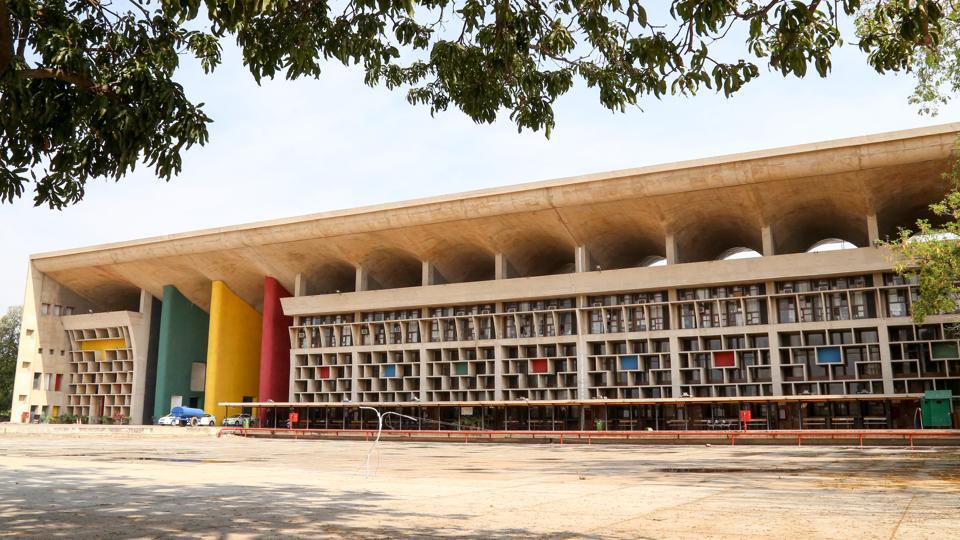
The Chandigarh Heritage Conservation Committee (CHCC) on Tuesday approved the revised holistic development proposal for the expansion of the Punjab and Haryana high court, clearing a mandatory hurdle before the plan is sent afresh to UNESCO for approval. As per the revised plan, the total built-up area under the expansion plan will be 10,46,335 square feet, and 40 courtrooms, 48 judges’ chambers and office space will come up on 7,03,357 square feet. The proposal also envisages three blocks, each with a maximum height of three floors, along with three underground parking facilities. It also includes dedicated office space for court staff, Advocate General’s offices, banks, stationery outlets, restaurants and other allied amenities.
Forest & other mandatory clearances to be obtained before execution
The clearance was given during a meeting of the heritage panel, chaired by UT chief secretary H Rajesh Prasad. The revised proposal has been prepared by a newly appointed consultant.
During the meeting, two members raised objections, expressing concern that the proposed site falls within an eco-sensitive zone and that the project could lead to an increase in traffic. Responding to the objections, the chief secretary clarified that the proposal is currently only a concept note and that any submission made to the international body would strictly comply with all applicable rules and regulations. He added that all statutory requirements, including forest clearance and other mandatory approvals, would be obtained before any execution.
Prasad said that as the panel has approved the revised plan, it would now be forwarded to the Fondation Le Corbusier in Paris as well as the Ministry of Culture, Government of India, for further approval.
Earlier on Sunday, a Noida-based consultant had made a presentation on two concept plans, following which the proposal involving development over 20.5 lakh square feet was cleared.
The presentation was made during the hearing of a 2023 public interest litigation (PIL) filed by Punjab and Haryana high court employees association secretary Vinod Dhatterwal, seeking the implementation of a holistic development plan to address the acute space crunch at the high court.
A bench headed by chief justice Sheel Nagu and justice Sanjiv Berry had directed the UT administration and the Centre to submit the proposal to the international body concerned by January 21, the last date for its consideration in the 2026 cycle.
A committee comprising two judges was constituted in 2025 to suggest a development plan. The committee had recommended the construction of four new blocks with 30-35 additional courtrooms over an area of 11.42 lakh square feet behind the heritage building designed by Le Corbusier, along with additional parking facilities spread over 11.17 lakh square feet within the Capitol Complex.
The original expansion proposal, mooted in 2013, was shelved after objections were raised by UNESCO’s World Heritage Committee and its advisory body, ICOMOS, which had warned that the plan could compromise the Outstanding Universal Value (OUV) of the Capitol Complex. The complex, which includes the Punjab and Haryana High Court, was declared a World Heritage Site in 2016.
Construction at a World Heritage Site is prohibited without prior approval from the UNESCO World Heritage Committee. While UNESCO does not provide financial assistance to the UT, it offers technical support for the conservation and preservation of the complex and periodically reviews its condition. Failure to maintain the site could even lead to its removal from the World Heritage list. In the past, UNESCO has also stalled two major projects at the Capitol Complex—an underground multi-level parking facility and an air-conditioning chiller plant.
A landmark of Chandigarh’s modernist architecture set against the Shivalik Hills, the Capitol Complex in Sector 1 spans over 100 acres and houses iconic structures such as the Open Hand Monument, Tower of Shadows, Geometric Hill, the Legislative Assembly and the Secretariat.
The high court expansion plan aims to address the pressing shortage of space, as the court caters to over 10,000 lawyers, around 3,300 employees, thousands of litigants and nearly 10,000 vehicles daily, leading to severe traffic congestion. The existing infrastructure is also inadequate to accommodate any future increase in the number of judges from the current strength of around 60 to the sanctioned 85.


