E-Paper



Chandigarh tricity crumbles on wettest June day in 52 yrs
As per the IMD, which started keeping records for the city in 1954, Chandigarh’s wettest day ever was on June 18, 1974, when 146.4 mm rain was recorded

 Prefer HTon Google


With 119.5 mm rain recorded till 8.30 am on Sunday, Chandigarh saw its wettest June day since 1973 even as waterlogging, road cave-ins and tree collapses brought the tricity to its knees.
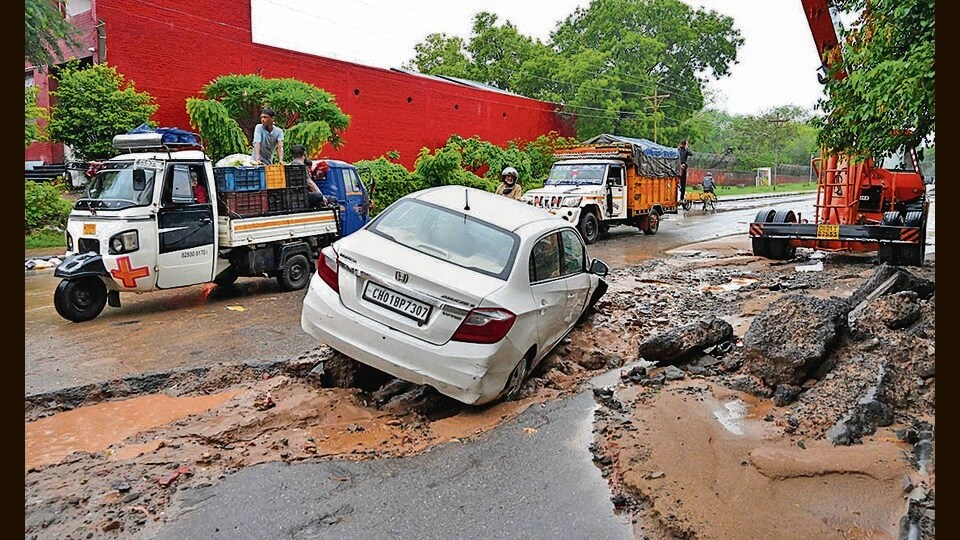
India Meteorological Department (IMD) officials said chances of heavy rain will continue over the next two days and issued an orange alert for Monday.
As per the IMD, which started keeping records for the city in 1954, Chandigarh’s wettest day ever was on June 18, 1974, when 146.4 mm rain was recorded.
While June marks the onset of monsoon, it rarely sees such a downpour, which is more common in July, August and September. IMD Chandigarh director Surender Paul said there were two major reasons behind it. “When the monsoon system is still progressing over parts of the country, the system isn’t as strong as it is in the central or southern parts of the country. But this time, the system moved northwards, which affected the whole region lying in the foothills of Himalayas, including Chandigarh.”
He added that a Western Disturbance (WD) was also active in the region though it wasn’t very active. But combined with the monsoon system, it led to heavy rain. The IMD has sounded an orange alert for the city on Monday, which asks people to stay alert and be prepared.
The downpour brought the maximum temperature down by three notches – from 33.9°C on Saturday to 30.2°C on Sunday, 6.1 degrees below normal. The minimum dropped from 23.8°C on Saturday to 23.6°C on Sunday, three degrees below normal. Over the next three days, the maximum temperature will remain between 32°C and 33°C while the minimum temperature will remain between 25°C and 26°C.
Choked road gullies sink UT
Like every year, Chandigarh again failed to cope with the downpour as choked gullies led to waterlogging across Madhya Marg, all internal sector roads, Chandigarh-Panchkula Road near Housing Board lights, and in Colonies No. 4 and 5. The worst-affected areas, where knee-deep water was witnessed, included the road from Attawa village to Sector 35, Sectors 43, 44, 45, Sector 22, Palsora village, Burail, and Sector 29’s Iron Market. In Sector 16, water entered homes, while shops in Khejeri village and Sector 38 were also inundated.
MC chief engineer Sanjay Arora said, “I have already sought reports from the executive engineers on the waterlogging in their respective areas. Once we receive the reports, preventive measures will be planned accordingly.”
According to records, the department hired only 100 workers to clean 30,000 road gullies across the city. However, residents allege that most storm drains, especially those in the southern sectors, remain uncleared. This, despite an annual allocation of ₹9 crore for the maintenance of the sewerage and drainage system.
Satish Khosla, general secretary of the welfare association, MIG Houses, Sector 40-C, said, “It was a flood-like situation in our sector, and this is not the first time. Every year, the authorities clean the gullies only on the main roads, neglecting V-6 (internal) roads. This causes flooding inside the sectors.” Meanwhile, two trees were uprooted in Sectors 22 and 32 due to the storm. On the Sector 22/23 dividing road, a tree fell on a wall, causing it to collapse. No injuries were reported.
Fire tenders called in to pump out water in Mohali
Mohali was no better with residents at many places having to call fire tenders to pump out water from the streets. The worst-hit localities were in Phase 3B2, 4, 5, 7, 11, and Sectors 70 and 71. In Phases 3B2, 4, 5, 7, and 11, water even entered homes. Roads in various parts of the Industrial Area turned into streams, with over one-ft water reported in Phases 7 and 8. Traffic jams were reported across the district due to water accumulation.
The situation was equally grim in Zirakpur, Kharar, and Nayagaon, where several roads were submerged. In Nayagaon, water entered houses, causing major inconvenience to the residents.
City mayor Amarjeet Singh Sidhu admitted that poor drainage infrastructure was a major concern. “Around four months ago, we conducted a survey to identify faults in the stormwater drainage system. We need ₹200 crore to address these issues, but despite repeated communications, the local bodies department has not responded,” he said.
He added that the survey indicated that stormwater could be diverted to choes (seasonal rivulets) in Balongi, Lakhnaur, near YPS, and Kambali.
Deputy Mayor Kuljeet Singh Bedi pointed out the impact of airport road construction. “Due to the airport road project, the natural flow of stormwater has been obstructed. We are working on channeling the water through Patiala Ki Rao to ease the situation,” he said.
Former SAD councillor Surinder Singh criticized the civic body’s preparedness. “Every time it rains heavily, residents live in fear. Rainwater entering houses in most sectors shows how unprepared the authorities are,” he said.
Even planned areas like Aerocity weren’t spared. Vacant plots were waterlogged, prompting criticism from locals.
Vinod Sharma, President of the Aerocity Welfare Society, said, “On one hand, GMADA is penalizing plot owners for non-construction, but on the other, there’s no sign of regular maintenance. Water is accumulating on nearly all vacant plots.”
With monsoon rains intensifying, residents are demanding urgent intervention and long-term solutions from the administration.